
الامتحان الوطني انجليزية 2 باك 2016 الدورة العادية (الآداب) مع التصحيح
الموضوع الرسمي كما هو. أجب مباشرة على الورقة: المس True أو False، اكتب على النقط، اختر جوابك. يظهر التصحيح ونقطتك في النهاية.


be concerned with تعني يهتم بـ.
take action تعني يتخذ إجراءات أو يتحرك.
global issues تعني القضايا العالمية.
قبل الاسم degradation نحتاج صفة: environmental degradation أي تدهور البيئة.
بعد to نحتاج فعلا في صيغته الأصلية: to illustrate.
بعد الفعل promote نحتاج اسما: promote tolerance أي التسامح.
this school شيء وهو فاعل was built، لذلك نستعمل which.
students أشخاص وهم فاعل used to walk، لذلك نستعمل who.
yesterday زمن منته في الماضي: الماضي البسيط → wasn’t able.
نفس الزمن في الماضي (أمس): الماضي البسيط → had.
الشرط الثالث: if + الماضي التام (had called) ثم would have + التصريف الثالث.
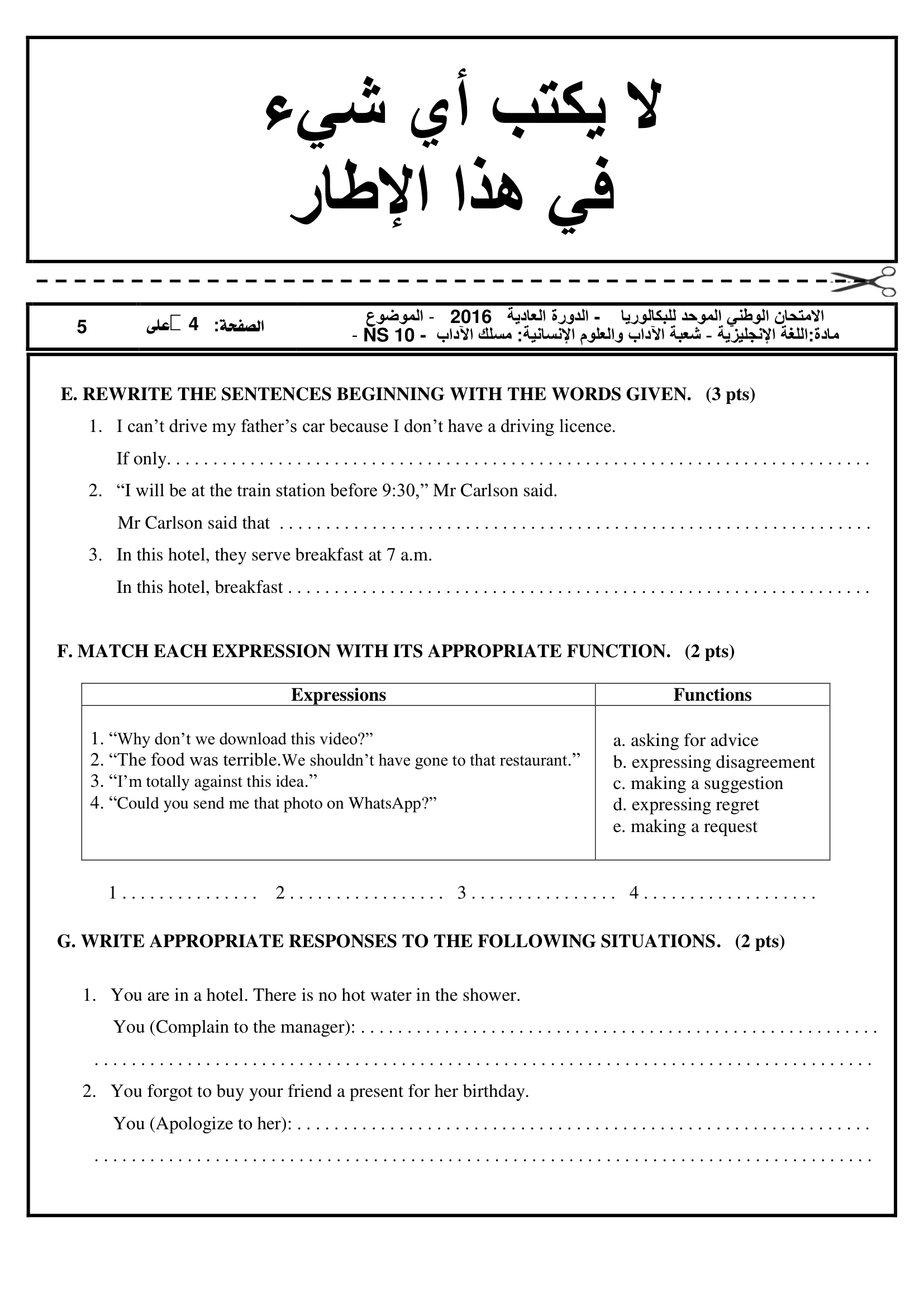
if only + الماضي = تمنٍّ في الحاضر: If only I had a driving licence.
الكلام غير المباشر: will تصبح would و I تصبح he.
المبني للمجهول في المضارع البسيط: is + التصريف الثالث (served).
Why don’t we …? = اقتراح.
shouldn’t have + التصريف الثالث = ندم.
I’m against … = عدم الموافقة.
Could you …? = طلب.
للتعبير عن الشكوى بأدب: Excuse me, there’s a problem with … / Could you please …?
للتعبير عن الاعتذار: I’m (really) sorry … / I apologize for …
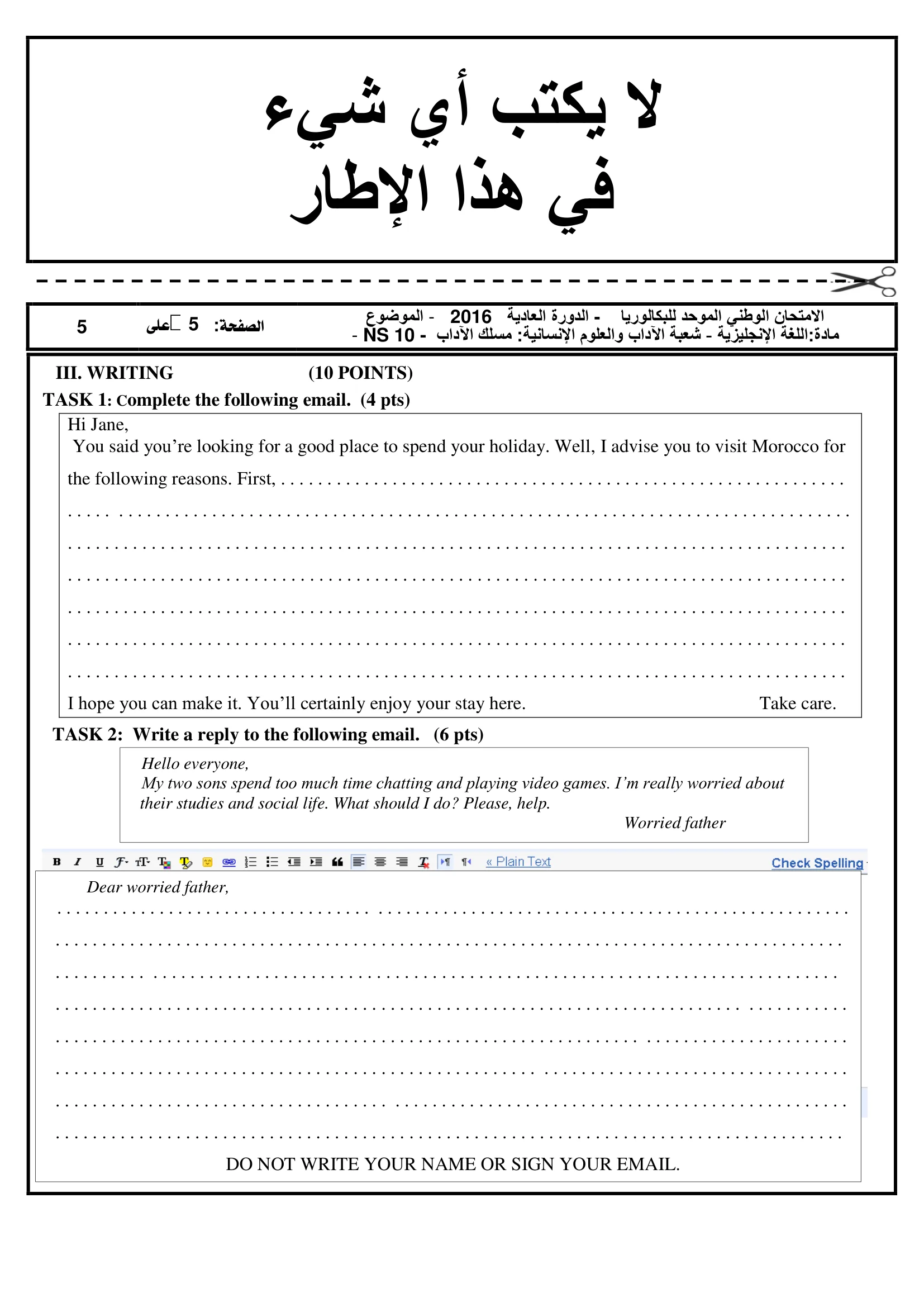
First, you should talk to your sons calmly and explain why spending too much time online is bad for their studies and their health. Don’t shout at them, because they will not listen.
Second, it would be a good idea to set clear rules together. For example, they can use their phones and play video games for one hour a day, only after finishing their homework. At night, all phones should stay in the living room.
Third, encourage them to do other activities. You could register them in a sports club or a music class, and spend more time with them at the weekend, going for walks or visiting family. This will improve their social life.
Finally, be a good example: if you use your phone less, they will follow you.
I hope this advice helps. Good luck!
الموضوع: الامتحان الوطني الموحد للبكالوريا، الدورة العادية 2016، وزارة التربية الوطنية (المركز الوطني للتقويم والامتحانات). نسخة تفاعلية من ILENG.
نقطتي
نقطة تقديرية: الأجوبة مصححة بالتصحيح الرسمي، والكتابة مصححة تلقائيًا بالشبكة الرسمية.
أخطاؤك، واحدًا تلو الآخر
المس خطأً لترى التصحيح.
لا أخطاء. عمل ممتاز!
الموضوع بصيغة نصيةالنص والأسئلة وموضوعا الكتابة، للقراءة أو النسخ.
موضوع الامتحان الوطني الموحد للبكالوريا في اللغة الإنجليزية (الثانية باكالوريا)، الدورة العادية 2016، مسلك الآداب (NS 10). موضوع النص: الحياة الصعبة للنساء في تيزي أوسم (Women’s hard life in Tizi Oussem). تظهر الأجوبة والنقطة عند إنهاء الامتحان أعلاه.
English national exam 2016, normal session – NS 10
Reading text: Women’s hard life in Tizi Oussem
[1] As men try to find work in big cities in Morocco, women in the countryside are traditionally destined to do the hard work. Every day after lunch, the women of Tizi Oussem (a village in the heart of the High Atlas Mountains) work in the fields, herd the sheep, do the washing by the river and gather wood for the fire. Even before that, they work for half a day doing housework and taking care of the children. At the end of the day, they gather the wood or crops into bundles which they carry on their shoulders back to the village. Then they start preparing dinner and doing their chores for the evening.
[2] “It’s a tough life, but it is what it is,” says Yamna, a woman from the village. Like all the old women who never attended school, she can’t read or write, and she doesn’t really know how old she is. “This is the life of the mountains. It’s not that good, but we don’t really have a choice. Why don’t men carry the heavy burden? I'm not sure, but most of them just don’t.”
[3] Malika, a 16-year-old girl, dropped out of school before she could graduate because of health problems. But that is only part of the reason why she quitted school. She also has to work and take care of her siblings. Every day she gets up at 6 a.m. to prepare breakfast, and then goes down to the valley to work in the fields or do the laundry. In her free time, she weaves beautiful and colourful carpets. “I regret now that I’ve left school,” she says. “I wish I had continued to become a preschool teacher to help children in the village.”
[4] Lahcen, 52, is one of the key figures who has multiple responsibilities in the village. He has to call an emergency when someone is in danger, when a woman has to give birth or when the roads are blocked in winter. He also settles disputes and makes sure other villagers help when a family is in need. He admits that life can be difficult in the valley, especially for women. “They carry heavy loads here. It is our tradition. Some people think it’s bad for a man's reputation to do a woman’s work. That’s why many men leave their wives and children behind to find jobs in big cities. They usually don’t make enough money,” says Lahcen. “They work for about 70 dirhams a day, but the cost of living in the city is higher. The families here don’t really profit from them, and neither does the village. It would be better if they stayed here to make it a better place,” he adds.
Adapted from: www.middleasteye.net
I. Comprehension (15 points)
A. Are these statements true or false? Justify. (3 pts)
- Women in Tizi Oussem have a lot to do when they come back from the fields.
- Yamna is happy with her life in the mountains.
- The village does not benefit from the men who go to work in the cities.
B. Answer these questions. (3 pts)
- What do women in Tizi Oussem do before lunch?
- What was Malika’s dream?
- Is Lahcen a good citizen? (Give one example to justify your answer)
C. Complete these sentences with information from the text. (3 pts)
- As Yamna has never been to school, she. …
- Malika left school in order to …
- In the village of Tizi Oussem, men don’t do women’s work because …
D. Find in the text words or phrases that mean the same as (2 pts)
- collect (paragraph 1) : …
- important people (paragraph 4) : …
E. What do the underlined words in the text refer to? (2 pts)
- them (paragraph 2) : …
- here (paragraph 4) : …
F. Choose the best title for the text. (2 pts)
- The best title is …
a. Girls’ education in Tizi Oussem – b. The beauty of nature in Tizi Oussem – c. Women’s hard life in Tizi Oussem
II. Language (15 points)
A. Fill in the gaps with the appropriate words from the list. (2 pts)
opportunities – create – concerned – take – environmental – educated – issues
- Global citizens are ………… with the world’s stability and prosperity.
- They ………… action to deal with …
- … global ………… such as poverty, war, child abuse and …
- … and ………… degradation.
B. Give the correct form of the words in brackets. (2 pts)
- The teacher gave three examples to (illustration) ………… the concept of sustainable
- The objective of this cultural event is to promote (tolerate) ………… within the community.
C. Fill in the gaps with the appropriate words from the list. (1 pt)
who – where – which – when – whose
- This school, ………… was built last year, is now receiving hundreds of students …
- … hundreds of students ………… used to walk a long way to attend classes.
D. Put the verbs in brackets in the correct form. (3 pts)
- I (not be able) ………… to attend Adil’s birthday party yesterday …
- … because I (have) ………… a lot of work to do.
- If he had called me earlier, I (arrange) ………… to join him.
E. Rewrite the sentences beginning with the words given. (3 pts)
- I can’t drive my father’s car because I don’t have a driving licence.
If only … - “I will be at the train station before 9:30,” Mr Carlson said.
Mr Carlson said that … - In this hotel, they serve breakfast at 7 a. m.
In this hotel, breakfast …
F. Match each expression with its appropriate function. (2 pts)
a. asking for advice – b. expressing disagreement – c. making a suggestion – d. expressing regret – e. making a request
- “Why don’t we download this video?”
- “The food was terrible. We shouldn’t have gone to that restaurant.”
- “I’m totally against this idea.”
- “Could you send me that photo on WhatsApp?”
G. Write appropriate responses to the following situations. (2 pts)
- You are in a hotel. There is no hot water in the shower.
You (Complain to the manager): … - You forgot to buy your friend a present for her birthday.
You (Apologize to her): …
III. Writing (10 points)
Task 1 (4 pts)
Complete the following email: “Hi Jane, You said you’re looking for a good place to spend your holiday. Well, I advise you to visit Morocco for the following reasons. First, … I hope you can make it. You’ll certainly enjoy your stay here. Take care.”
Hi Jane, You said you’re looking for a good place to spend your holiday. Well, I advise you to visit Morocco for the following reasons. First, …
Task 2 (6 pts)
Write a reply to the following email: “Hello everyone, My two sons spend too much time chatting and playing video games. I’m really worried about their studies and social life. What should I do? Please, help. Worried father” (Start: “Dear worried father,”)
الموضوع: الامتحان الوطني الموحد للبكالوريا، الدورة العادية 2016، وزارة التربية الوطنية (المركز الوطني للتقويم والامتحانات). نسخة تفاعلية من ILENG.