2 Bac English national exam 2017, regular session (Sciences and technology): paper and answers
The official paper, as it is. Answer directly on the sheet: tap True or False, write on the dotted lines, choose your answer. The correction and your mark appear at the end.

Academic studies = school or university studies. Before the noun *studies*, you need an adjective.
Population growth = the increase in the number of people.
After intend to, you need a verb in the base form: intend to emigrate.
After works in, you need a noun: in partnership with = working together with.
We are talking about a moment (his brother’s wedding): when.
Mr Clark is a person and he does the action (*will give*): we use who.
Polite request in reported speech: asked me to + verb (or *if I could* …). me becomes her (Pamela).
Passive voice in the present perfect: have been + past participle (installed).
Hypothesis about the past (third conditional): if + past perfect (had paid) and would have + past participle.
In order to + base form expresses purpose: in order to watch. The 2nd subject (He) disappears.
Although + subject + verb expresses contrast: she is young, yet she has written two books.
May I …? is used to ask for permission (e).
I don’t share your view = I don’t have the same opinion: it is disagreement (b).
What should I do …? = asking for advice (a).
Let’s … is used to make a suggestion (c).
Thanks for your email. It was nice to hear from you. You asked me about the films I like, so here is my answer.
I like comedies most. After a long week at school, I want to laugh and forget about my exams. Comedies help me relax, and they are fun to watch with my family and friends. I also enjoy action films because they are exciting and full of surprises. However, I don’t like horror films at all because they make me feel scared at night.
My favourite film is a Moroccan comedy that I watched with my cousins last summer. We laughed from the beginning to the end!
What about you? Which science fiction film do you recommend? Maybe we can watch it together online one day.
Write back soon,
Paper: Baccalaureate national exam, Regular session 2017, Ministry of National Education (CNEE). Interactive version by ILENG.
My mark
Estimated mark: answers corrected with the official answer key, writing corrected automatically with the official grid.
Your mistakes, one by one
Tap a mistake to see the correction.
No mistakes. Excellent work!
The paper as textText, questions and writing tasks of the exam, to read or copy.
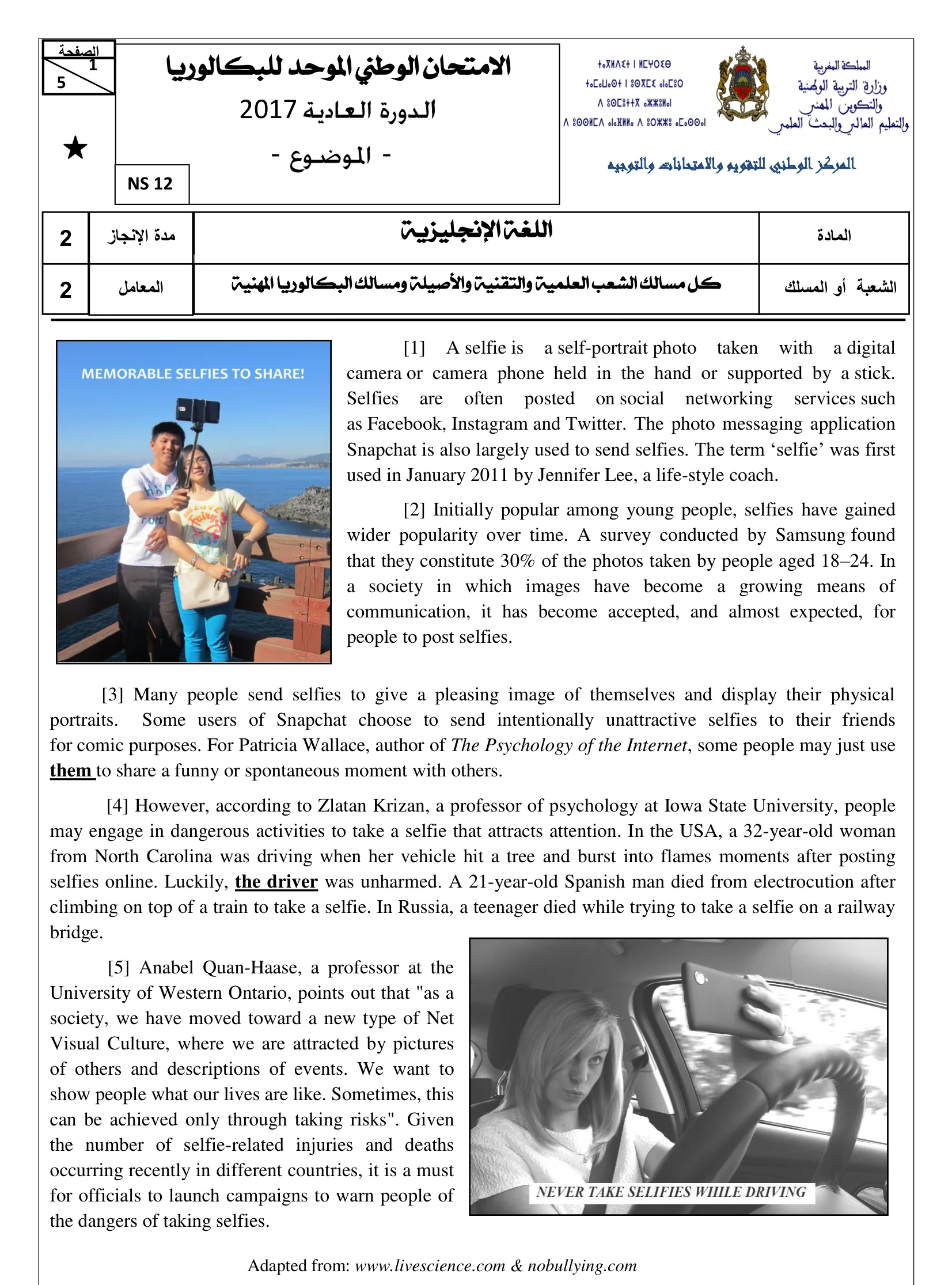
Paper of the baccalaureate English national exam (2 Bac), Regular session 2017, Science, technology and original streams (NS 12). Topic of the text: Selfies and their dangers (Selfies and their dangers). The answers and the mark appear when you finish the exam above.
English national exam 2017, normal session – NS 12
Reading text: Selfies and their dangers
[1] A selfie is a self-portrait photo taken with a digital camera or camera phone held in the hand or supported by a stick. Selfies are often posted on social networking services such as Facebook, Instagram and Twitter. The photo messaging application Snapchat is also largely used to send selfies. The term ‘selfie’ was first used in January 2011 by Jennifer Lee, a life-style coach.
[2] Initially popular among young people, selfies have gained wider popularity over time. A survey conducted by Samsung found that they constitute 30% of the photos taken by people aged 18–24. In a society in which images have become a growing means of communication, it has become accepted, and almost expected, for people to post selfies.
[3] Many people send selfies to give a pleasing image of themselves and display their physical portraits. Some users of Snapchat choose to send intentionally unattractive selfies to their friends for comic purposes. For Patricia Wallace, author of The Psychology of the Internet, some people may just use them to share a funny or spontaneous moment with others.
[4] However, according to Zlatan Krizan, a professor of psychology at Iowa State University, people may engage in dangerous activities to take a selfie that attracts attention. In the USA, a 32-year-old woman from North Carolina was driving when her vehicle hit a tree and burst into flames moments after posting selfies online. Luckily, the driver was unharmed. A 21-year-old Spanish man died from electrocution after climbing on top of a train to take a selfie. In Russia, a teenager died while trying to take a selfie on a railway bridge.
[5] Anabel Quan-Haase, a professor at the University of Western Ontario, points out that "as a society, we have moved toward a new type of Net Visual Culture, where we are attracted by pictures of others and descriptions of events. We want to show people what our lives are like. Sometimes, this can be achieved only through taking risks". Given the number of selfie-related injuries and deaths occurring recently in different countries, it is a must for officials to launch campaigns to warn people of the dangers of taking selfies.
Adapted from: www.livescience.com & nobullying.com
I. Comprehension (15 points)
A. Complete the following chart. (3 pts)
| Main idea | Paragraph number |
|---|---|
| a. Reasons for taking selfies | ………… |
| b. Definition of a selfie | ………… |
| c. Examples of selfie accidents | ………… |
| d. Quan-Haase’s views on selfies | 5 |
B. Answer these questions. (4 pts)
- What did the survey conducted by Sumsung show?
- Name two purposes for posting selfies:
a. … - How did the Spanish man lose his life?
C. Complete the following sentences. (3 pts)
- It was in 2011 that Jennifer Lee …
- Warning people of the dangers of taking selfies can limit. …
- In a society of a Net Visual Culture, people …
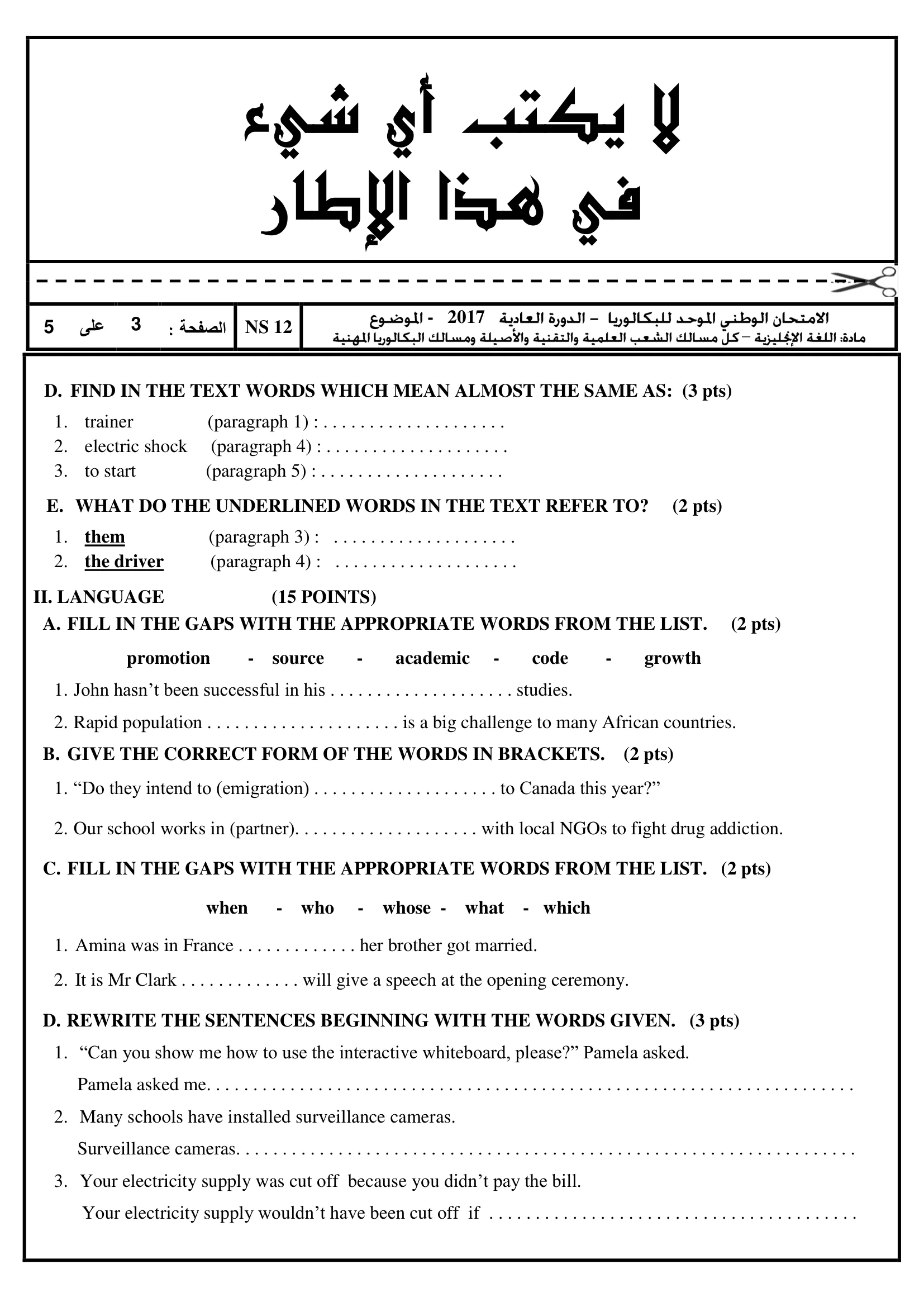
D. Find in the text words which mean almost the same as (3 pts)
- trainer (paragraph 1)
- electric shock (paragraph 4)
- to start (paragraph 5)
E. What do the underlined words in the text refer to? (2 pts)
- them (paragraph 3)
- the driver (paragraph 4)
II. Language (15 points)
A. Fill in the gaps with the appropriate words from the list. (2 pts)
promotion - source - academic - code - growth
- John hasn’t been successful in his ………… studies.
- Rapid population ………… is a big challenge to many African countries.
B. Give the correct form of the words in brackets. (2 pts)
- “Do they intend to (emigration) ………… to Canada this year?”
- Our school works in (partner). ………… with local NGOs to fight drug addiction.
C. Fill in the gaps with the appropriate words from the list. (2 pts)
when - who - whose - what - which
- Amina was in France ………… her brother got married.
- It is Mr Clark ………… will give a speech at the opening ceremony.
D. Rewrite the sentences beginning with the words given. (3 pts)
- “Can you show me how to use the interactive whiteboard, please?” Pamela asked.
Pamela asked me … - Many schools have installed surveillance cameras.
Surveillance cameras … - Your electricity supply was cut off because you didn’t pay the bill.
Your electricity supply wouldn’t have been cut off if …
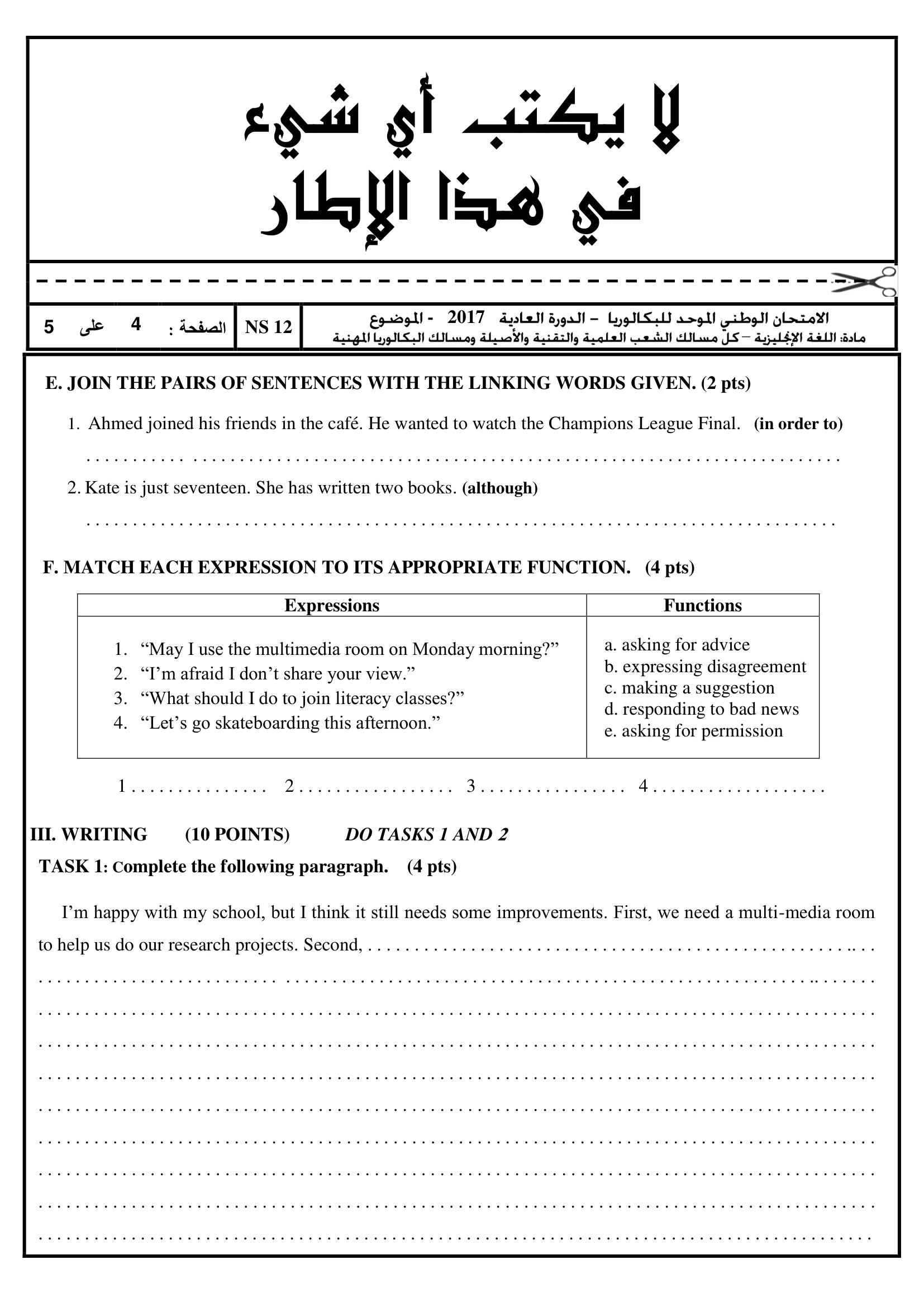
E. Join the pairs of sentences with the linking words given. (2 pts)
- Ahmed joined his friends in the café. He wanted to watch the Champions League Final. (in order to)
- Kate is just seventeen. She has written two books. (although)
F. Match each expression to its appropriate function. (4 pts)
a. asking for advice – b. expressing disagreement – c. making a suggestion – d. responding to bad news – e. asking for permission
- “May I use the multimedia room on Monday morning?”
- “I’m afraid I don’t share your view.”
- “What should I do to join literacy classes?”
- “Let’s go skateboarding this afternoon.”
III. Writing (10 points)
Task 1 (4 pts)
Complete the following paragraph.
I’m happy with my school, but I think it still needs some improvements. First, we need a multi-media room to help us do our research projects. Second, …
Task 2 (6 pts)
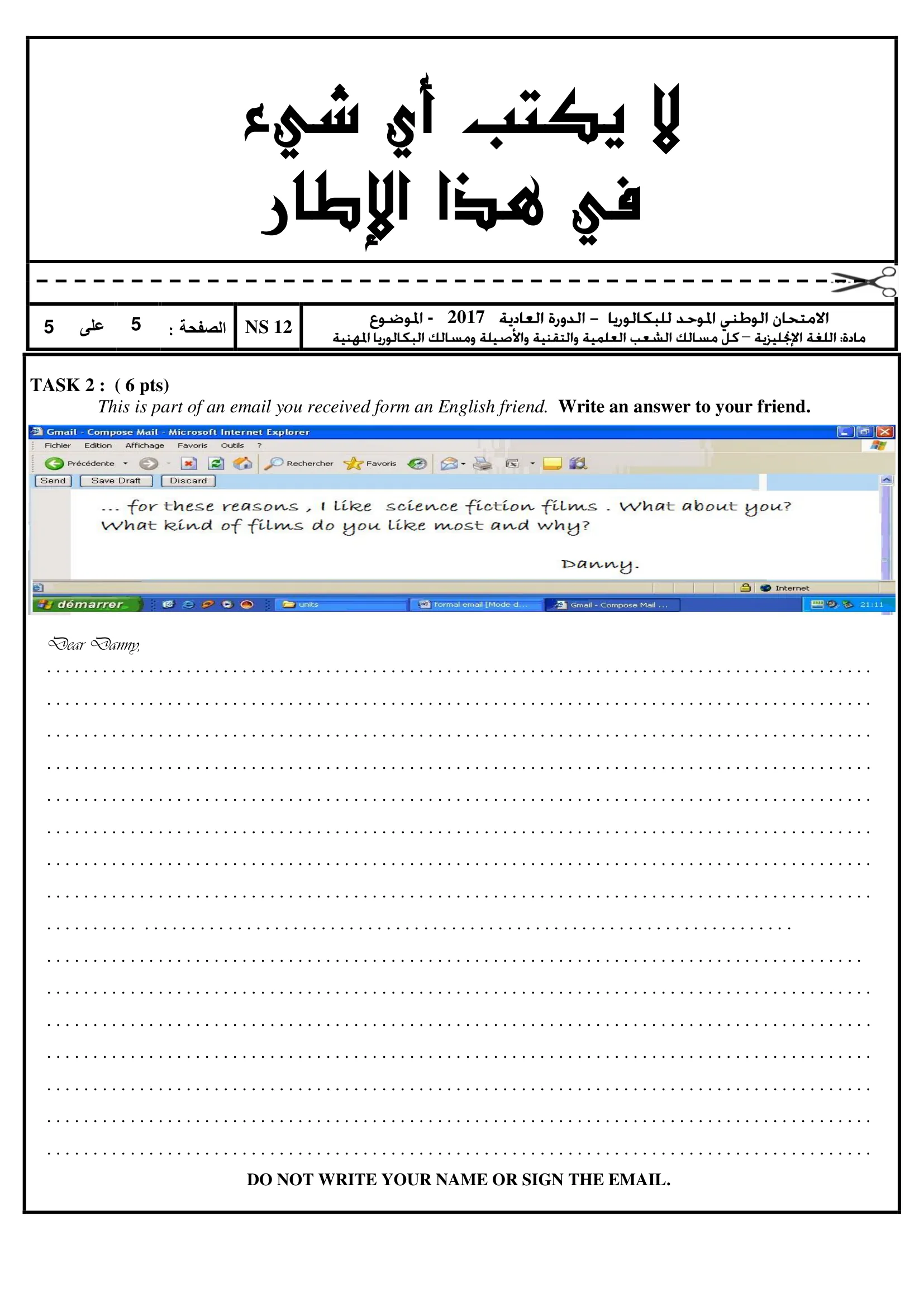
This is part of an email you received from an English friend: “… for these reasons, I like science fiction films. What about you? What kind of films do you like most and why? Danny.” Write an answer to your friend. Do not write your name or sign the email.
Paper: Baccalaureate national exam, Regular session 2017, Ministry of National Education (CNEE). Interactive version by ILENG.