
Examen national anglais 2 Bac 2017, session de rattrapage (sciences et techniques) : sujet et corrigé
Le sujet officiel, tel quel. Répondez directement sur la copie : touchez True ou False, écrivez sur les pointillés, choisissez votre réponse. La correction et votre note s’affichent à la fin.


Rely on = compter sur quelqu’un. Ma meilleure amie : je peux toujours compter sur elle.
Run away = s’enfuir. Les garçons ont eu peur et se sont enfuis.
Whereas (alors que) relie deux idées opposées : Samira travaille, son frère est paresseux.
Because of est suivi d’un nom (his illness), pas d’une phrase avec un verbe.
Après the, il faut un nom : the advertisement (l’annonce).
Après be (et avec *and patient*), il faut un adjectif : tolerant.
Four years ago = un moment précis du passé : prétérit (graduated).
Yet à la forme négative = pas encore : present perfect (hasn’t found).
Voix passive au prétérit : was + participe passé (edited).
3e conditionnel : if + had + participe passé → would have + participe passé (would have gone).
Conseil au discours indirect : told me to + verbe, ou *that I should* + verbe. You devient I.
For me, … = pour moi : on donne son opinion (d).
Could you …, please? est une demande polie (b).
I’m sorry for … sert à s’excuser (a).
I didn’t get your point = je n’ai pas compris ton idée : incompréhension (c).

Today, many young people spend hours in front of screens and eat fast food every day. As a result, they often feel tired and stressed. Here is some simple advice to stay healthy.
First, young people should eat a balanced diet with fruit, vegetables and enough water every day. They should also do sport at least three times a week, for example running, swimming or playing football with friends. Moreover, it is important to sleep eight hours a night, especially before exams.
On the other hand, young people shouldn’t smoke or try drugs because these habits destroy their health. They shouldn’t eat too much sugar and fast food either. Finally, they shouldn’t stay on their phones until late at night.
In conclusion, good health depends on our daily choices. If we follow this advice, we will feel stronger, happier and more successful at school.
Sujet : Examen national du baccalauréat, Session de rattrapage 2017, Ministère de l’Éducation nationale (CNEE). Version interactive ILENG.
Ma note
Note estimée : réponses corrigées avec le corrigé officiel, writing corrigé automatiquement avec la grille officielle.
Vos erreurs, une par une
Touchez une erreur pour voir la correction.
Aucune erreur. Excellent travail !
Le sujet en version texteTexte, questions et sujets de writing de l’examen, à lire ou à copier.
Sujet de l’examen national d’anglais du baccalauréat (2e année Bac), Session de rattrapage 2017, Filières scientifiques, techniques et originelles (RS 12). Thème du texte : Un hôpital dans un train en Inde (A hospital on a train in India). Les réponses et la note s’affichent quand vous terminez l’examen ci-dessus.
English national exam 2017, make-up session – RS 12
Reading text: A hospital on a train in India
[1] Lifeline Express is the world’s first hospital on a train. It started with a simple idea: take the hospital to people who do not have access to health care services in rural areas. An Indian foundation proposed the idea to the Ministry of Railways. Shortly after, the Railways and the foundation signed an agreement in which the Railways would offer a three-coach train, provide water and electricity while the foundation would provide medical services.
[2] There are fewer than 10 doctors to every 10,000 inhabitants in India. Many people must travel hundreds of miles to reach the nearest hospital. So, the train hospital is their only hope for medical treatment. For 26 years, Lifeline Express has been travelling through India to bring health services to millions of Indians who are in need of health care. It has helped many patients with sight, hearing or movement problems.
[3] The train hospital regularly camps in different parts of the country. Each camp lasts 35 days and involves treating patients, training local doctors and raising health awareness among rural population. Dr. Sarin, Lifeline Express chairman, said: “Now, the train hospital is operating with only three coaches. Soon, two new coaches will be added. A lot of help comes from companies, individuals and doctors across the country. But, we still need to improve our medical services. We need a blood bank and sophisticated equipment to do major surgeries. Hundreds of villagers are in urgent need of help.”
[4] The train hospital is not only treating patients, but changing their social lives as well. Dr. Nagda is a surgeon who has volunteered to work on the train for the last 16 years. He remembers receiving a wedding invitation from Sajida, a girl he once treated. “When she came to me as a child, she had a foot deformity. I told her father that after treatment she would be able to go to school, but he was more worried about her marriage. After the surgery, she could walk normally. She even finished her studies and got married.” The train hospital has saved over a million lives across the country and has inspired similar experiences in many other countries.
Adapted from: www.thehindu.com & www.middleasteye.net
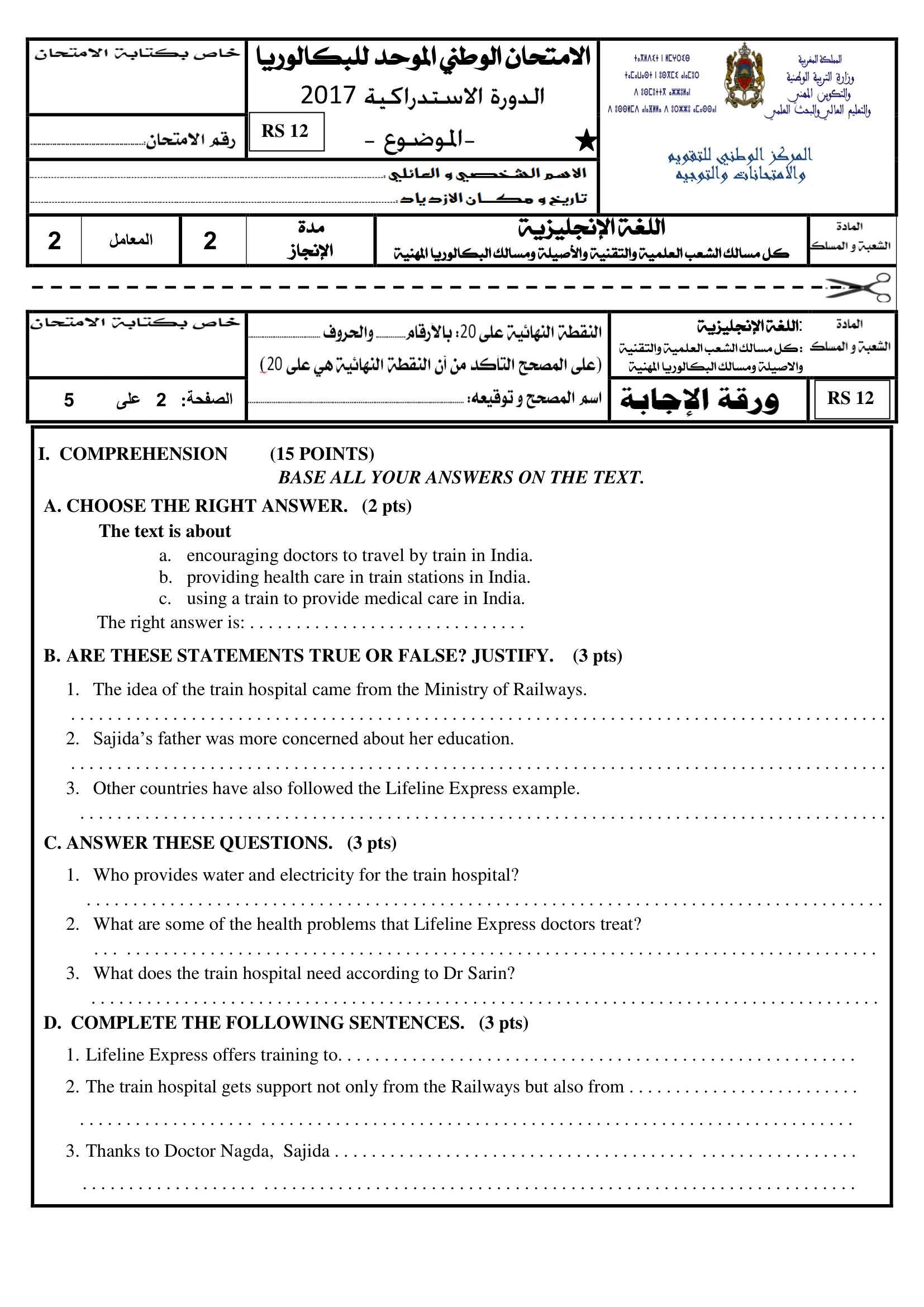
I. Comprehension (15 points)
A. Choose the right answer. (2 pts)
The text is about / a. encouraging doctors to travel by train in India. / b. providing health care in train stations in India. / c. using a train to provide medical care in India. / The right answer is:
- The text is about …
a. encouraging doctors to travel by train in India. – b. providing health care in train stations in India. – c. using a train to provide medical care in India.
B. Are these statements true or false? Justify. (3 pts)
- The idea of the train hospital came from the Ministry of Railways.
- Sajida’s father was more concerned about her education.
- Other countries have also followed the Lifeline Express example.
C. Answer these questions. (3 pts)
- Who provides water and electricity for the train hospital?
- What are some of the health problems that Lifeline Express doctors treat?
- What does the train hospital need according to Dr Sarin?
D. Complete the following sentences. (3 pts)
- Lifeline Express offers training to …
- The train hospital gets support not only from the Railways but also from …
- Thanks to Doctor Nagda, Sajida …
E. What do the underlined words in the text refer to? (2 pts)
- the country (paragraph 3)
- he (paragraph 4)
F. Find in the text words which mean the same as (2 pts)
- immediate (paragraph 3)
- operation (paragraph 4)
II. Language (15 points)
A. Fill in the gaps with the appropriate phrasal verbs from the lists. (2 pts)
- Lina is my best friend; I can always ………… her.
a. look into – b. take after – c. rely on - The boys got scared and ………… when the dog started barking.
a. ran into – b. ran away – c. made up
B. Join the pairs of sentences with the linking words given. (2 pts)
- Samira is a hard working student. Her brother Tariq is lazy. (whereas)
- Neil couldn’t attend the wedding party. He was ill. (because of)
C. Give the correct form of the words in brackets. (2 pts)
- Did you read the (advertise) ………… for that summer job at Plaza Hotel?
- Teachers have to be (tolerance) ………… and patient with their students.
D. Put the verbs in brackets in the correct form. (2 pts)
Salima (graduate) from university four years ago, but she / (not/find) a job yet.
- Salima (graduate) ………… from university four years ago, but she (not/find) … a job yet.
- … but she (not/find) ………… a job yet.
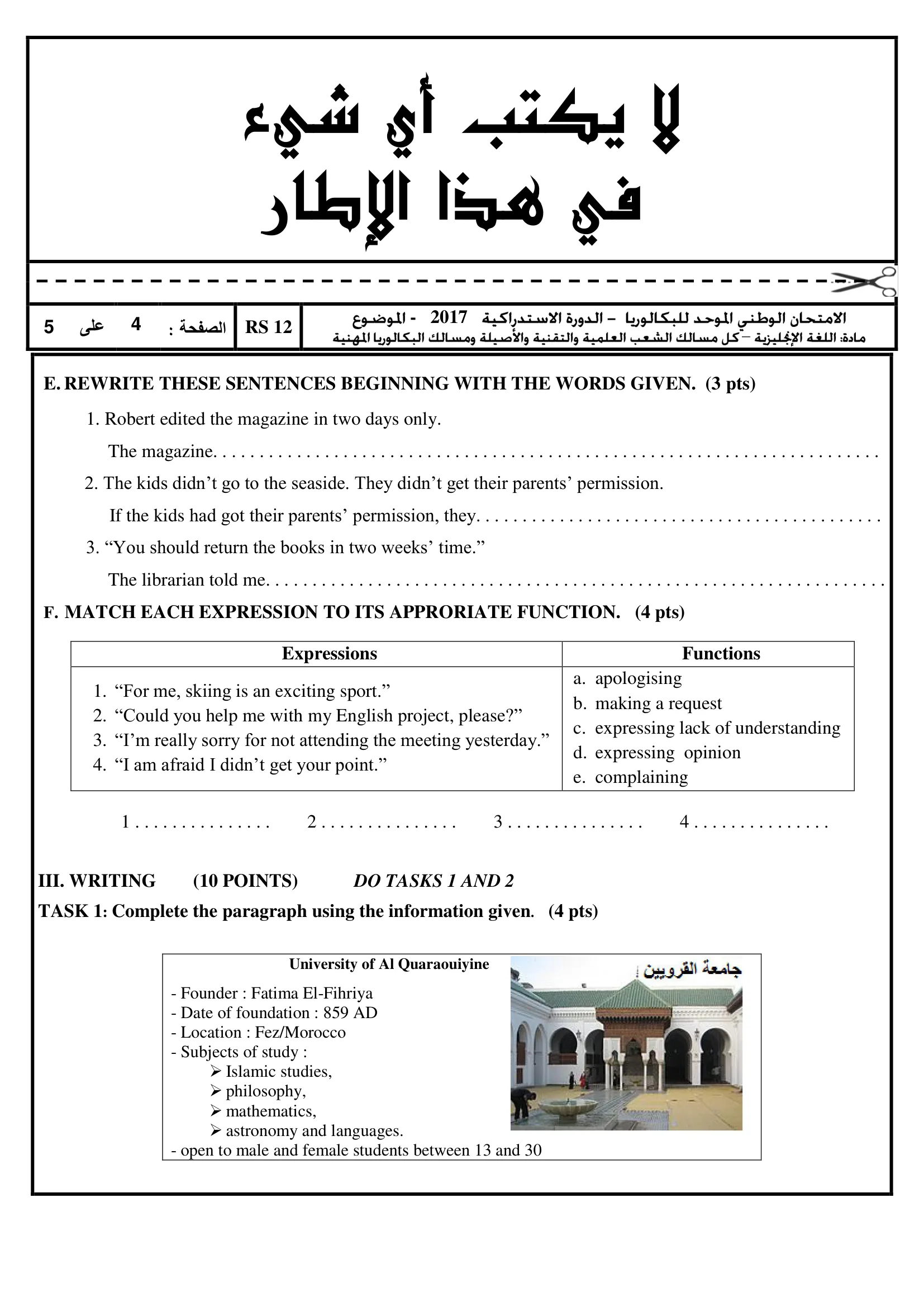
E. Rewrite these sentences beginning with the words given. (3 pts)
- Robert edited the magazine in two days only.
The magazine … - The kids didn’t go to the seaside. They didn’t get their parents’ permission.
If the kids had got their parents’ permission, they … - “You should return the books in two weeks’ time.”
The librarian told me …
F. Match each expression to its approriate function. (4 pts)
a. apologising – b. making a request – c. expressing lack of understanding – d. expressing opinion – e. complaining
- “For me, skiing is an exciting sport.”
- “Could you help me with my English project, please?”
- “I’m really sorry for not attending the meeting yesterday.”
- “I am afraid I didn’t get your point.”
III. Writing (10 points)
Task 1 (4 pts)
Complete the paragraph using the information given: University of Al Quaraouiyine – Founder: Fatima El-Fihriya – Date of foundation: 859 AD – Location: Fez/Morocco – Subjects of study: Islamic studies, philosophy, mathematics, astronomy and languages – Open to male and female students between 13 and 30.
Al Quaraouiyine is the oldest university in the world …
Task 2 (6 pts)
Write an article to be published in ‘Health and Welfare’ magazine explaining what young people should do and shouldn’t do to stay healthy.
Sujet : Examen national du baccalauréat, Session de rattrapage 2017, Ministère de l’Éducation nationale (CNEE). Version interactive ILENG.