
Examen national anglais 2 Bac 2016, session de rattrapage (sciences et techniques) : sujet et corrigé
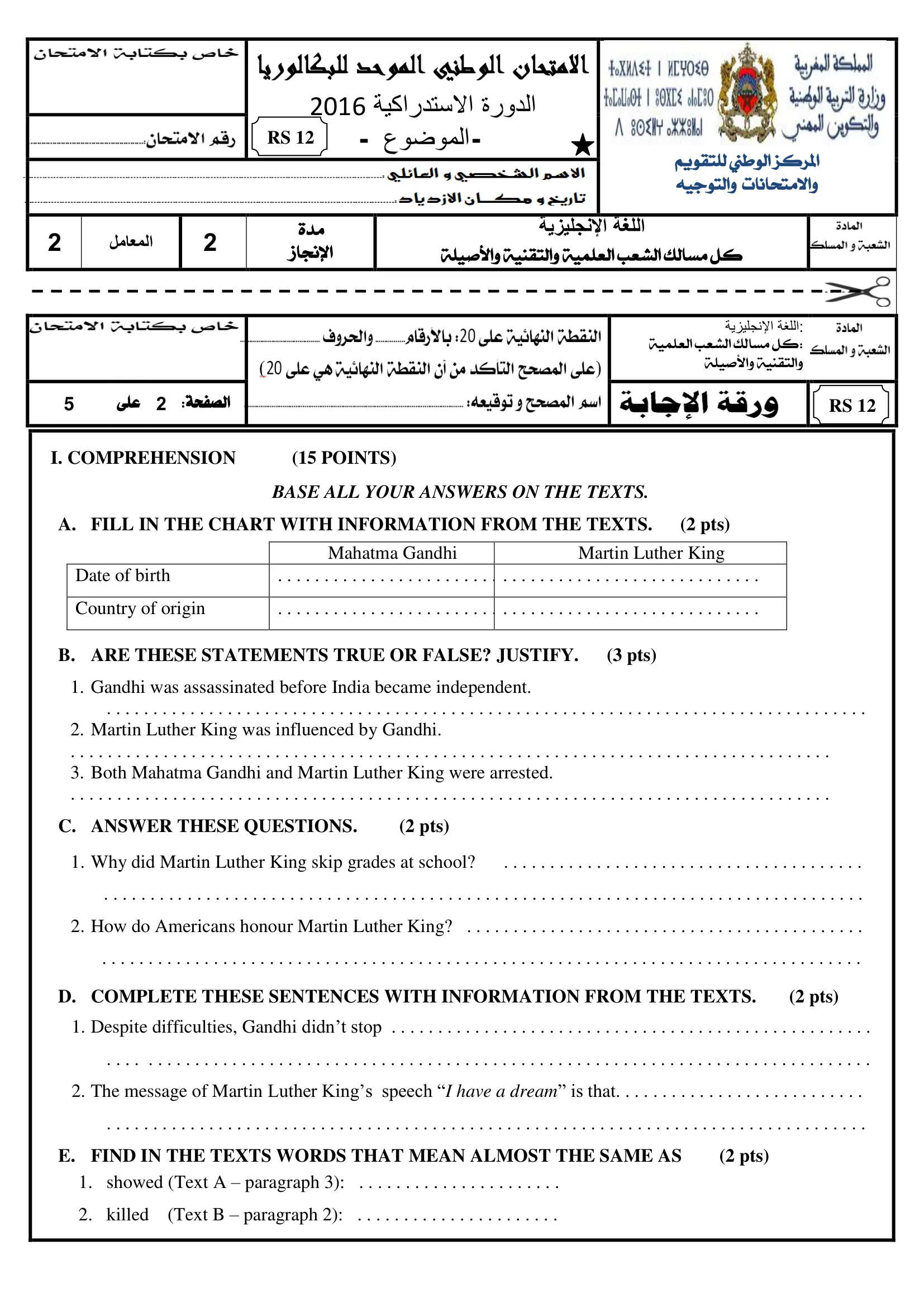
Le sujet officiel, tel quel. Répondez directement sur la copie : touchez True ou False, écrivez sur les pointillés, choisissez votre réponse. La correction et votre note s’affichent à la fin.

Après Brahim’s, il faut un nom : ambition.
Après couldn’t, il faut un verbe à l’infinitif : couldn’t agree.
Come across (came across) = rencontrer par hasard.
The international community = la communauté internationale (tous les pays).
Voix passive au prétérit : were + participe passé (cancelled).
Question au discours indirect : where + sujet + verbe, sans *did*. Le prétérit devient past perfect (had spent).
3e conditionnel : if + past perfect (had checked), would have + participe passé. Les négations s’inversent.
As a result (par conséquent) introduit la conséquence : elle mange mal (cause) → elle grossit (conséquence).
In order to + verbe à l’infinitif exprime le but : in order to produce.
On peut y aller à pied : ce n’est pas nécessaire de prendre le bus → needn’t.
Villages sont des choses (sujet de *suffer*) : on utilise which.
What should I do? = on demande un conseil (c).
In my view = à mon avis : on donne son opinion (e).
Congratulations! répond à une bonne nouvelle (a).
What do you mean by …? = on n’a pas compris (b).
C’est une mauvaise nouvelle : on montre de la sympathie (I’m sorry to hear that) et on encourage.
Ton ami a un problème : on conseille (You should … / Why don’t you …?).
If you are looking for the most beautiful city of the year, I strongly recommend Chefchaouen, a small town in the Rif Mountains in the north of Morocco.
First of all, Chefchaouen is famous for its blue streets and houses. Walking in its old medina feels like walking in a painting, and every corner is perfect for photos. The town is also surrounded by green mountains, forests and waterfalls such as Akchour, where visitors can go hiking and swim in fresh water.
Moreover, the people of Chefchaouen are friendly and welcoming. Tourists can taste delicious local food, like goat cheese and tajine, and buy traditional handmade products, such as carpets and woollen clothes. In addition, the city is calm and clean, far from the noise and pollution of big cities.
In conclusion, Chefchaouen combines natural beauty, rich culture and peace. That is why I think it deserves to be the best city of the year.
Sujet : Examen national du baccalauréat, Session de rattrapage 2016, Ministère de l’Éducation nationale (CNEE). Version interactive ILENG.
Ma note
Note estimée : réponses corrigées avec le corrigé officiel, writing corrigé automatiquement avec la grille officielle.
Vos erreurs, une par une
Touchez une erreur pour voir la correction.
Aucune erreur. Excellent travail !
Le sujet en version texteTexte, questions et sujets de writing de l’examen, à lire ou à copier.
Sujet de l’examen national d’anglais du baccalauréat (2e année Bac), Session de rattrapage 2016, Filières scientifiques, techniques et originelles (RS 12). Thème du texte : Gandhi et Martin Luther King (Gandhi and Martin Luther King). Les réponses et la note s’affichent quand vous terminez l’examen ci-dessus.
English national exam 2016, make-up session – RS 12
Reading text: Gandhi and Martin Luther King
Text A [1] Mahatma Gandhi was a great freedom fighter and non-violent activist. He was born in 1869 in Gujarat, India. He completed his schooling in India and went to England for further study of law. He then went to the British colony of South Africa to practise law. There he decided to become a political activist.
Text A [2] Later, he returned to India and started a powerful non-violent movement to fight for India’s independence. Many times, he was sent to prison, but he never discouraged himself and continued fighting for national freedom. He started many mass movements like Non- cooperation Movement in 1920 and the Quit India Movement in 1942.
Text A [3] After so many struggles, India gained independence in 1947. A year later, Gandhi was assassinated. Gandhi proved that everything is possible with non-violence and the unity of people. Even after his death, he is still alive in the heart of every Indian as ‘Father of the Nation’.
Text B [1] Martin Luther King was a great symbolic leader who worked for equality and civil rights in the United States. He was born in 1929 in Atlanta, Georgia. He was a bright student and skipped grades in both elementary school and high school. He graduated from high school at fifteen. At university, he learned about Mahatma Gandhi who helped change unfair laws in India by teaching people to protest without violence. He thought he could do the same in the USA.
Text B [2] In 1954, Martin organised a protest against racism on buses in Montgomery, Alabama. He began to organise other non-violent protests, and soon was a leader in the civil rights movement. He was arrested and attacked many times. In 1963, he led a march in Washington D.C. with over 200,000 people. In this march, he gave his famous speech, “I have a dream”, in which he said that people should not be judged by the colour of their skin. Martin was awarded the Nobel Peace Prize in 1964. Four years later, he was assassinated in Memphis, Tennessee. Martin Luther King's birthday is a national holiday, and each January his life and work are honoured by Americans.
Adapted from: www.indiacelebrating.com (Text A) & www.encyclopediaofalabama.org (Text B)
I. Comprehension (15 points)
A. Fill in the chart with information from the texts. (2 pts)
| Information | Answer |
|---|---|
| Mahatma Gandhi – date of birth | ………… |
| Martin Luther King – date of birth | ………… |
| Mahatma Gandhi – country of origin | ………… |
| Martin Luther King – country of origin | ………… |
B. Are these statements true or false? Justify. (3 pts)
- Gandhi was assassinated before India became independent.
- Martin Luther King was influenced by Gandhi.
- Both Mahatma Gandhi and Martin Luther King were arrested.
C. Answer these questions. (2 pts)
- Why did Martin Luther King skip grades at school?
- How do Americans honour Martin Luther King?
D. Complete these sentences with information from the texts. (2 pts)
- Despite difficulties, Gandhi didn’t stop …
- The message of Martin Luther King’s speech “I have a dream” is that …
E. Find in the texts words that mean almost the same as (2 pts)
- showed (Text A – paragraph 3)
- killed (Text B – paragraph 2)
F. What do the underlined words or phrases in the texts refer to? (2 pts)
- ‘Father of the Nation’ (Text A – paragraph 3)
- He (Text B – paragraph 1)
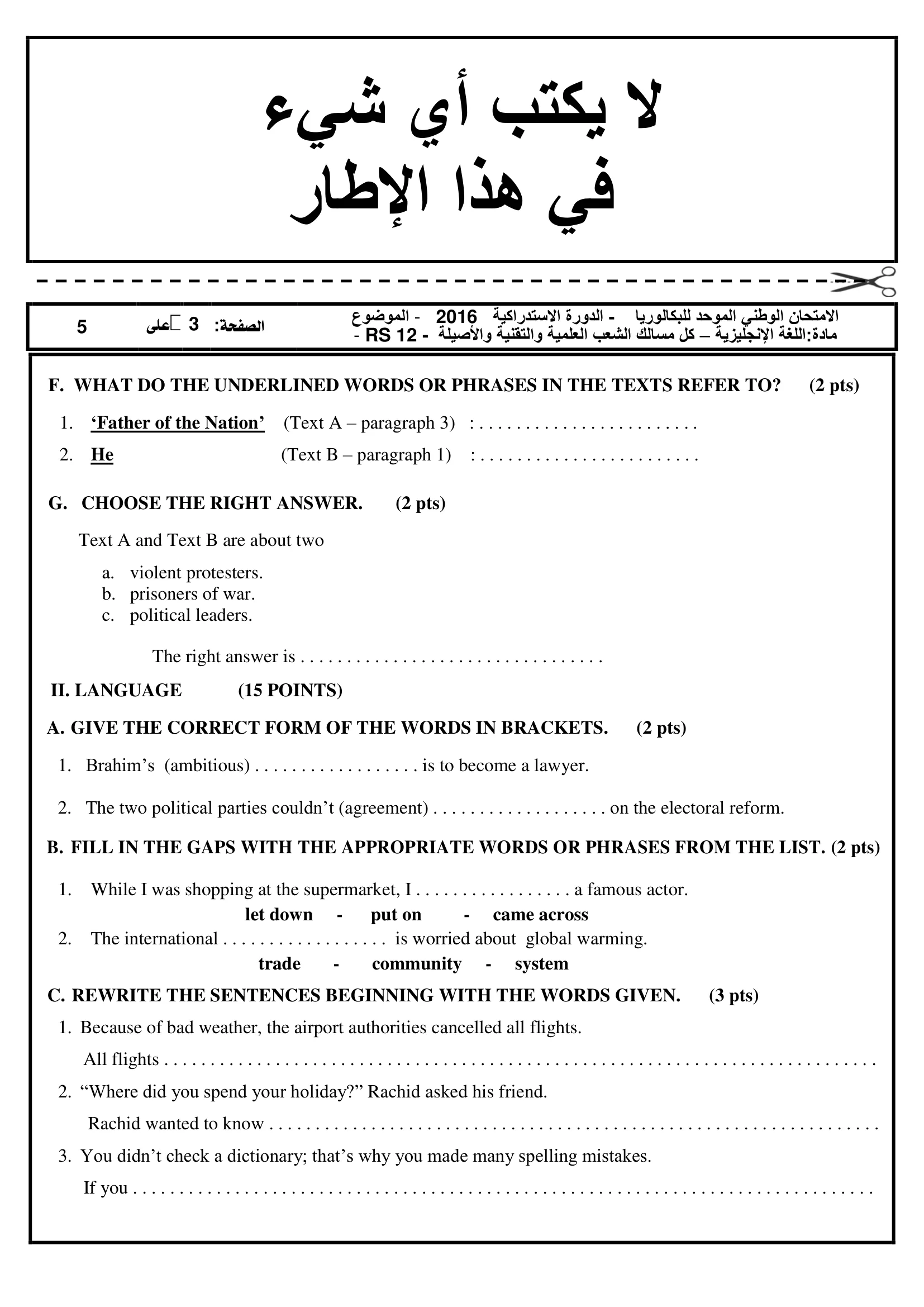
G. Choose the right answer. (2 pts)
Text A and Text B are about two / a. violent protesters. / b. prisoners of war. / c. political leaders. / The right answer is
- Text A and Text B are about two …
a. violent protesters. – b. prisoners of war. – c. political leaders.
II. Language (15 points)
A. Give the correct form of the words in brackets. (2 pts)
- Brahim’s (ambitious) ………… is to become a lawyer.
- The two political parties couldn’t (agreement) ………… on the electoral reform.
B. Fill in the gaps with the appropriate words or phrases from the list. (2 pts)
- While I was shopping at the supermarket, I ………… a famous actor.
a. let down – b. put on – c. came across - The international ………… is worried about global warming.
a. trade – b. community – c. system
C. Rewrite the sentences beginning with the words given. (3 pts)
- Because of bad weather, the airport authorities cancelled all flights.
All flights … - “Where did you spend your holiday?” Rachid asked his friend.
Rachid wanted to know … - You didn’t check a dictionary; that’s why you made many spelling mistakes.
If you …
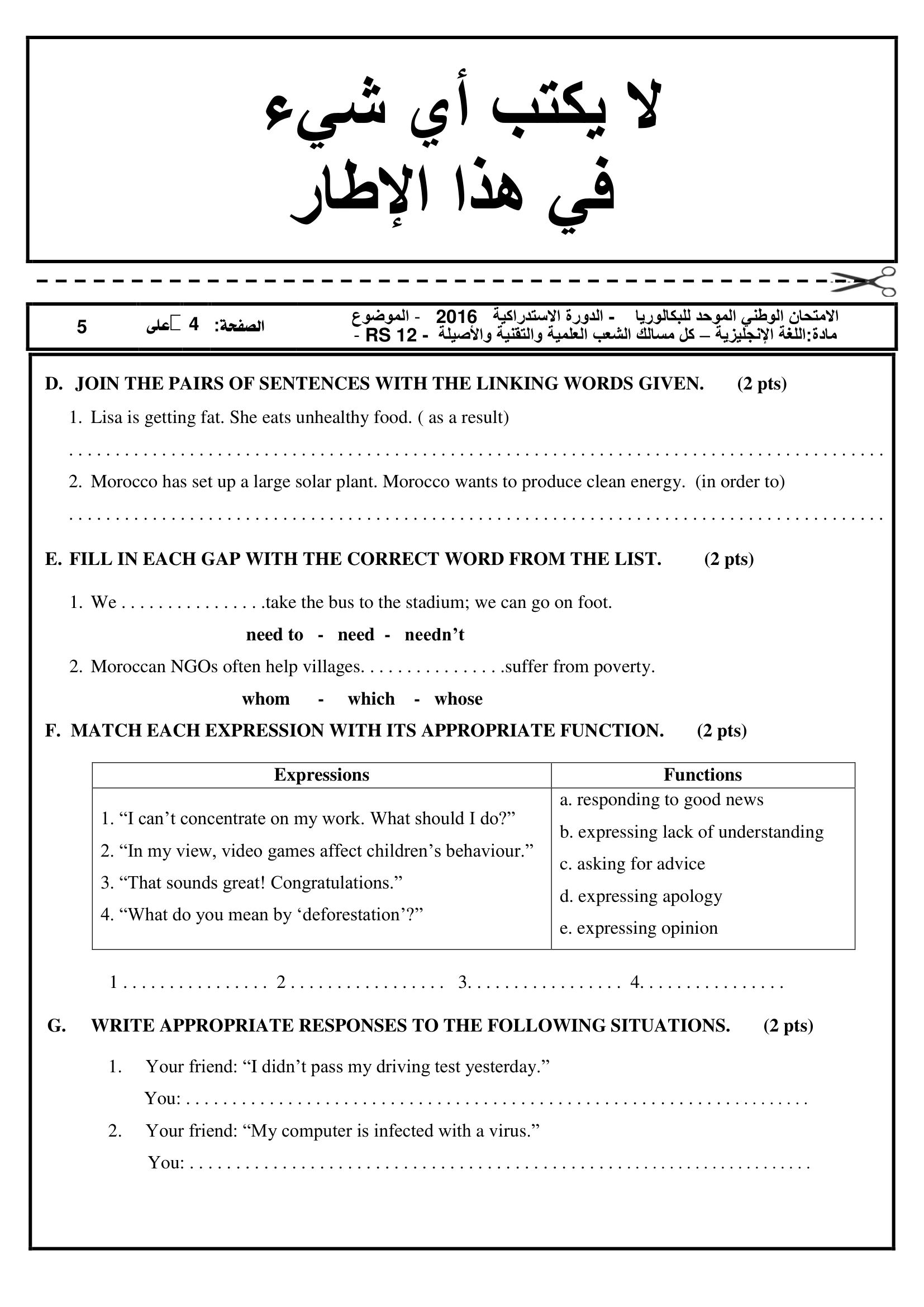
D. Join the pairs of sentences with the linking words given. (2 pts)
- Lisa is getting fat. She eats unhealthy food. ( as a result)
- Morocco has set up a large solar plant. Morocco wants to produce clean energy. (in order to)
E. Fill in each gap with the correct word from the list. (2 pts)
- We ………… take the bus to the stadium; we can go on foot.
a. need to – b. need – c. needn’t - Moroccan NGOs often help villages ………… suffer from poverty.
a. whom – b. which – c. whose
F. Match each expression with its appropriate function. (2 pts)
a. responding to good news – b. expressing lack of understanding – c. asking for advice – d. expressing apology – e. expressing opinion
- “I can’t concentrate on my work. What should I do?”
- “In my view, video games affect children’s behaviour.”
- “That sounds great! Congratulations.”
- “What do you mean by ‘deforestation’?”
G. Write appropriate responses to the following situations. (2 pts)
- Your friend: “I didn’t pass my driving test yesterday. ”
You: … - Your friend: “My computer is infected with a virus. ”
You: …
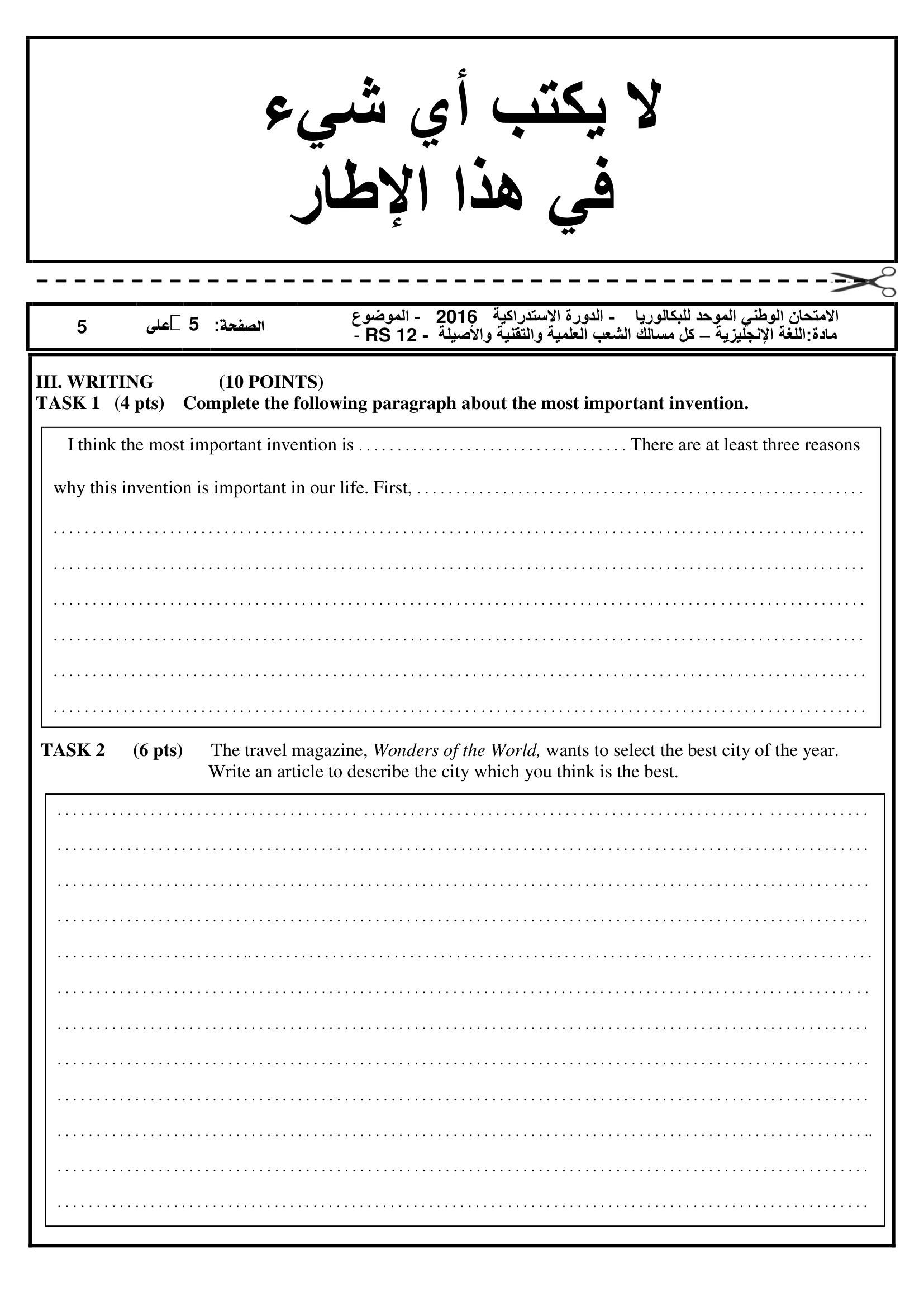
III. Writing (10 points)
Task 1 (4 pts)
Complete the following paragraph about the most important invention: “I think the most important invention is … There are at least three reasons why this invention is important in our life. First, …”
I think the most important invention is …
Task 2 (6 pts)
The travel magazine Wonders of the World wants to select the best city of the year. Write an article to describe the city which you think is the best.
Sujet : Examen national du baccalauréat, Session de rattrapage 2016, Ministère de l’Éducation nationale (CNEE). Version interactive ILENG.