
Examen national anglais 2 Bac 2018, session de rattrapage (sciences et techniques) : sujet et corrigé
Le sujet officiel, tel quel. Répondez directement sur la copie : touchez True ou False, écrivez sur les pointillés, choisissez votre réponse. La correction et votre note s’affichent à la fin.


Look forward to est suivi du gérondif (verbe + -ing) : looking forward to celebrating.
The athlete est une personne et il fait l’action (*won*) : on utilise who.
Après his, il faut un nom : his childhood (son enfance).
Après a, il faut un nom : make a decision (prendre une décision).
Despite est suivi d’un nom ou d’un verbe en -ing (being worried, her worry), ou de *the fact that* + phrase.
Demande polie au discours indirect : asked me to + verbe (ou *if I could* …). me devient him (Rod).
3e conditionnel : if + had + participe passé → could/would have + participe passé (could have attended).
Civic education = l’éducation civique : elle apprend à être un citoyen actif.
Take off = décoller (pour un avion).
Yesterday = passé terminé : prétérit (called).
Want est suivi de to + verbe : want to inform.
La candidature ne s’envoie pas toute seule : passif avec un modal = must be + participe passé (sent).
Tomorrow morning = futur : will email (ou *am going to email*).

I’m sorry to hear that … répond à une mauvaise nouvelle (b).
Great! répond à une bonne nouvelle (a).
On dit que le service est lent : on se plaint (d).
You’d better … = tu ferais mieux de : on donne un conseil (c).

I have chosen this club for several reasons. First, I care a lot about nature, and I am worried about the plastic and rubbish I see near our school and in the streets of my town. In the club, we can organise clean-up days, plant trees in the schoolyard and make posters to raise awareness. Second, I want to learn more about recycling and saving water, because these problems are very serious in Morocco today. Moreover, working in a team with other students will help me improve my communication skills and make new friends.
Finally, I think this club can make our school a cleaner and greener place for everyone.
Thank you again for this great opportunity. I am looking forward to the first meeting.
Best regards,
Sujet : Examen national du baccalauréat, Session de rattrapage 2018, Ministère de l’Éducation nationale (CNEE). Version interactive ILENG.
Ma note
Note estimée : réponses corrigées avec le corrigé officiel, writing corrigé automatiquement avec la grille officielle.
Vos erreurs, une par une
Touchez une erreur pour voir la correction.
Aucune erreur. Excellent travail !
Le sujet en version texteTexte, questions et sujets de writing de l’examen, à lire ou à copier.
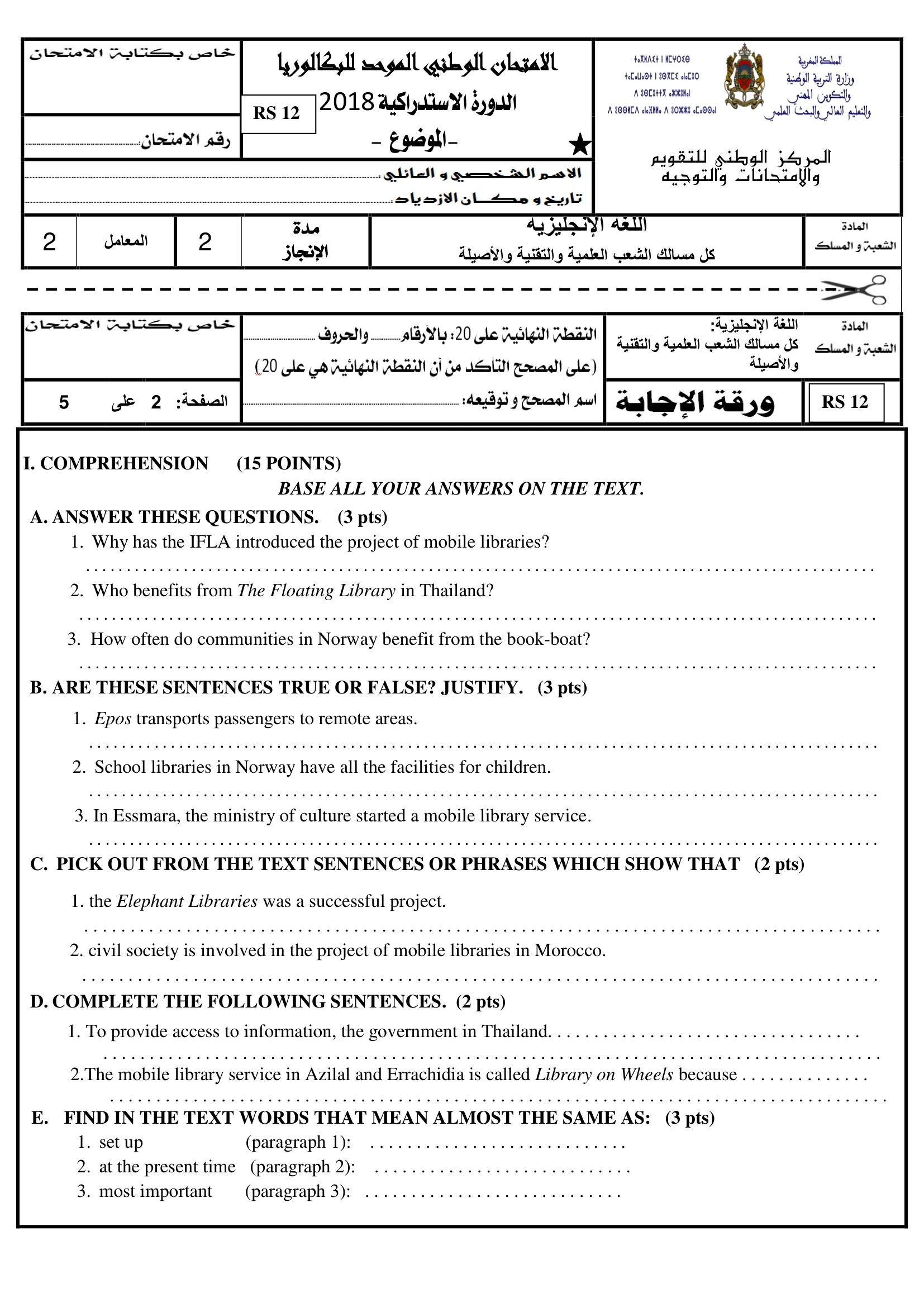
Sujet de l’examen national d’anglais du baccalauréat (2e année Bac), Session de rattrapage 2018, Filières scientifiques, techniques et originelles (RS 12). Thème du texte : Les bibliothèques mobiles dans le monde (Mobile libraries around the world). Les réponses et la note s’affichent quand vous terminez l’examen ci-dessus.
English national exam 2018, make-up session – RS 12
Reading text: Mobile libraries around the world
[1] In 2002, the International Federation of Library Associations and Institutions (IFLA) established a new section called Mobile Libraries with the aim of providing access to information for all residents, particularly in remote and rural areas in different parts of the world.
[2] In Thailand, a new mobile library called The Floating Library was launched. There are currently two book- boats in use, which offer a collection of over 2,000 books and educational facilities to riverside communities. Another way of implementing access to information in specific areas is the Elephant Libraries, where elephants are used to carry educational materials to 46 remote villages in Thailand. Materials carried by elephants include books, satellite dishes, generators, computers, video and CD players and writing boards. This project was awarded the UNESCO literacy prize for 2002.
[3] In Norway, a boat called Epos was built specifically to serve as a mobile library to reach rural areas. The book-boat carries approximately 6000 books, and visits 250 small communities twice a year. The book-boat sails from September to April, and each trip consists of 64 days in three regions. Every day it stops at one to four places for about one to two hours. Even in a rich country like Norway the school libraries are not well equipped to meet the children’s needs in today’s modern school. So for many of the students the book-boat is actually their main library.
[4] In Morocco, the ministry of culture and many non-governmental organisations have also adopted the idea of mobile libraries. Trucks or vans are used to carry different types of books to remote areas in Azilal, Errachidia and other regions. Library on Wheels is the name given to this outstanding service. The mobile library stops either at schools or public squares and provides its services for a period of time before moving to another area. In Essmara, for example, teachers of English started a project to facilitate the sharing of books among schools in the region in 2016. Each school has the list of books, and both students and teachers can request books they would like to read. Three volunteer teachers are in charge of keeping the books and then delivering them to a school whenever they are requested.
Adapted from: www.ifla.org
I. Comprehension (15 points)
A. Answer these questions. (3 pts)
- Why has the IFLA introduced the project of mobile libraries?
- Who benefits from The Floating Library in Thailand?
- How often do communities in Norway benefit from the book-boat?
B. Are these sentences true or false? Justify. (3 pts)
- Epos transports passengers to remote areas.
- School libraries in Norway have all the facilities for children.
- In Essmara, the ministry of culture started a mobile library service.
C. Pick out from the text sentences or phrases which show that (2 pts)
- the Elephant Libraries was a successful project.
- civil society is involved in the project of mobile libraries in Morocco.
D. Complete the following sentences. (2 pts)
- To provide access to information, the government in Thailand …
- The mobile library service in Azilal and Errachidia is called Library on Wheels because …
E. Find in the text words that mean almost the same as (3 pts)
- set up (paragraph 1)
- at the present time (paragraph 2)
- most important (paragraph 3)
F. What do the underlined words in the text refer to? (2 pts)
- it (paragraph 3)
- the region (paragraph 4)
II. Language (15 points)
A. Fill in the gaps with the appropriate words from the lists. (2 pts)
- Sophie is looking forward to ………… her birthday this week.
a. celebrate – b. celebrated – c. celebrating - El Hansali is the athlete ………… won the marathon.
a. who – b. whose – c. whom
B. Give the correct form of the words in brackets. (2 pts)
- Antonio spent most of his (child) ………… in the countryside.
- The manager will have to make a (decide) ………… about the employees’ salaries.
C. Rewrite the sentences beginning with the words given. (3 pts)
- Although Salma was worried, she managed to pass the driving test.
Despite … - “Can you send me the documents, please?” Rod asked.
Rod asked me … - Fiona had flu; so she couldn’t attend the meeting.
If Fiona hadn’t had flu, …
D. Fill in the gaps with appropriate words or expressions from the lists. (2 pts)
- Through ………… education, children learn how to be active members in their community.
a. human – b. distant – c. civic - The plane couldn’t ………… because of the bad weather.
a. take up – b. take after – c. take off
E. Put the verbs in brackets in the correct form. (2 pts)
Lucas : Hello, Alex. It’s Lucas. You (call) me twice yesterday. Well, my phone was off. / Alex: I just want (inform) you that your application (must /send) / before noon tomorrow. / Lucas: Ok, thanks for reminding me. I (email) it tomorrow morning.
- Lucas: Hello, Alex. It’s Lucas. You (call) ………… me twice yesterday.
- Alex: I just want (inform) ………… you …
- … that your application (must/send) ………… before noon tomorrow.
- Lucas: Ok, thanks for reminding me. I (email) ………… it tomorrow morning.
F. Match each expression to its appropriate function. (4 pts)
a. responding to good news – b. responding to bad news – c. giving advice – d. complaining – e. asking for clarification
- “I’m sorry to hear that you’ve lost your job.”
- “You’ve become manager! Great!”
- “I’m sorry to say it. The service here is a bit slow.”
- “You’d better look for another solution.”
III. Writing (10 points)
Task 1 (4 pts)
Complete the following paragraph: “Many people choose to learn English for different reasons. First, …”
Many people choose to learn English for different reasons. First, …
Task 2 (6 pts)
Your English teacher wrote: “Dear students, the school has created different clubs (a sports club, an environment club, an English club, a music club and a drama club); you are invited to join one of them. Please send me an email informing me about your choice and giving reasons.” Write the email. Begin with “Dear teacher,”. Do not write your name or sign the email.
Sujet : Examen national du baccalauréat, Session de rattrapage 2018, Ministère de l’Éducation nationale (CNEE). Version interactive ILENG.