
2 Bac English national exam 2016, make-up session (Letters): paper and answers
The official paper, as it is. Answer directly on the sheet: tap True or False, write on the dotted lines, choose your answer. The correction and your mark appear at the end.
Come back (came back) to Morocco = return to Morocco.
Set up a business = start a company.
Possession (the woman’s husband): whose + noun.
The man is a person, subject of “was driving”: who.
Before the noun views, you need an adjective: traditional views.
After the possessive their, you need a noun: their participation.
A question about the future: When will you join us? (or are you joining).
Next Monday = future: will be.
By the time + present: an action already finished at that moment in the future → future perfect (will have left).
Suggest that + subject + should + base form (or the base form alone).
The Games are organised (they don’t do the action): passive in the future will be held.
Third conditional: if + past perfect (had got), would have + past participle (would have gone).
Shouldn’t have + past participle = a regret.
You ought to … = advice (like you should).
What does … mean? = asking for an explanation.
I’m glad to hear that … = reacting to good news.
To complain: You’re late again! / I’m not happy that … / This is the last time I …
To apologise and give a reason: I’m (so) sorry, + the reason (My bus broke down / There was a lot of traffic).
The main objectives were to encourage students to read more and to show them that reading can be fun and useful. Students from all levels, teachers, parents and a local writer took part in the event.
The day started with a book exhibition in the library, where students could discover new novels, short stories and comics in Arabic, French and English. Then, some members of the club gave short presentations about their favourite books. After that, the guest writer talked about his life and answered our questions. At the end of the day, there was a ceremony to give prizes to the best readers of the year.
In my opinion, it was a very successful and useful event. Many students borrowed books, and I hope the school will organise similar events every year.
Paper: Baccalaureate national exam, Make-up session 2016, Ministry of National Education (CNEE). Interactive version by ILENG.
My mark
Estimated mark: answers corrected with the official answer key, writing corrected automatically with the official grid.
Your mistakes, one by one
Tap a mistake to see the correction.
No mistakes. Excellent work!
The paper as textText, questions and writing tasks of the exam, to read or copy.
Paper of the baccalaureate English national exam (2 Bac), Make-up session 2016, Letters stream (RS 10). Topic of the text: Child labour in Cambodia (Child labour in Cambodia). The answers and the mark appear when you finish the exam above.
English national exam 2016, make-up session – RS 10
Reading text: Child labour in Cambodia
[1] Earlier this year, a United Nations (UN) report found that 10 percent of Cambodian children between the ages of 7 and 14 are working. It is one of the highest rates in Southeast Asia. The report said that one in four Cambodians aged 7 to 14 are forced to drop out of school to help their families. UN officials say the child labour rate in Cambodia has dropped over the past 10 years, but the country has a lot more to do to keep a greater number of children in school.
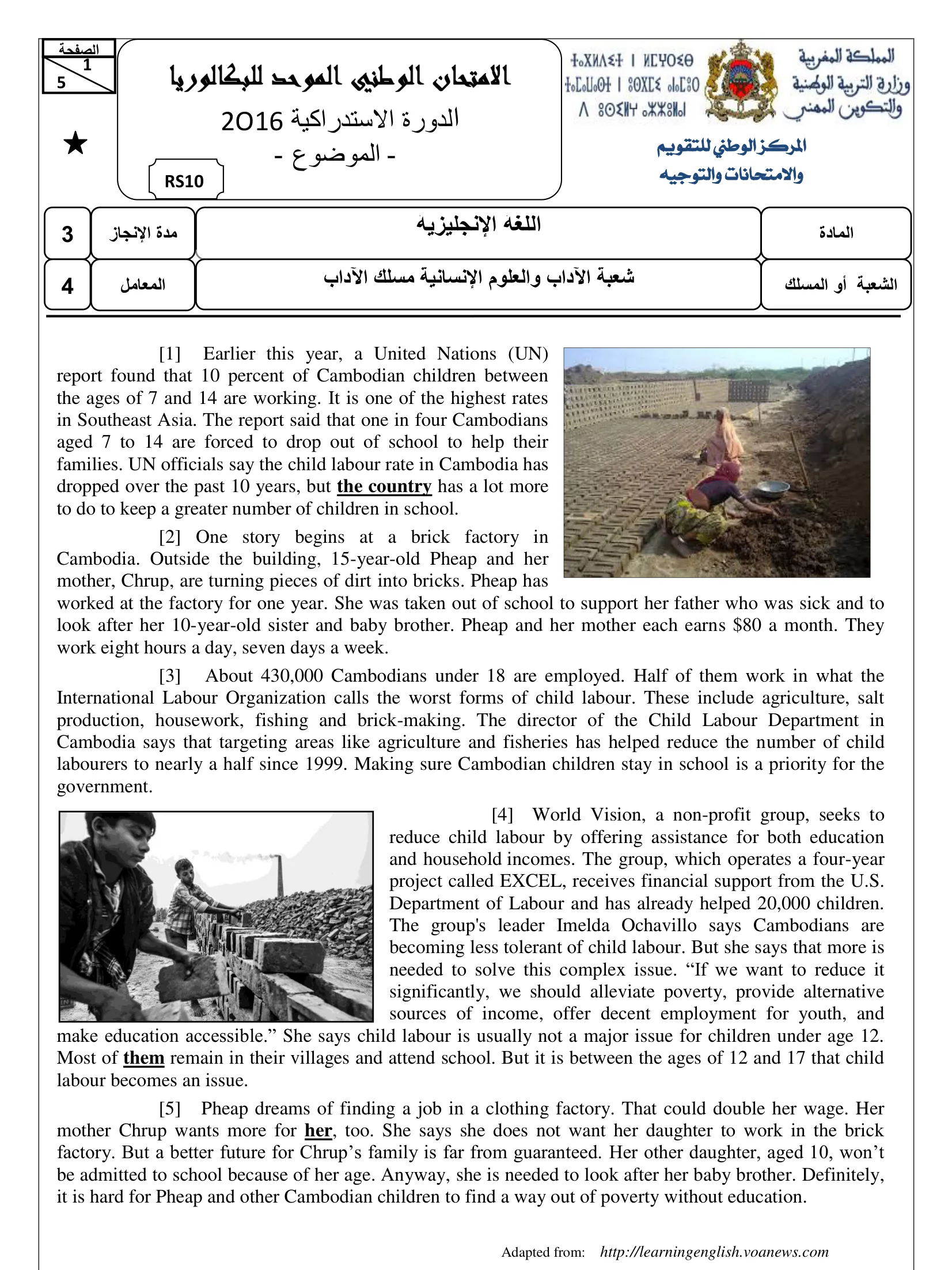
[2] One story begins at a brick factory in Cambodia. Outside the building, 15-year-old Pheap and her mother, Chrup, are turning pieces of dirt into bricks. Pheap has worked at the factory for one year. She was taken out of school to support her father who was sick and to look after her 10-year-old sister and baby brother. Pheap and her mother each earns $80 a month. They work eight hours a day, seven days a week.
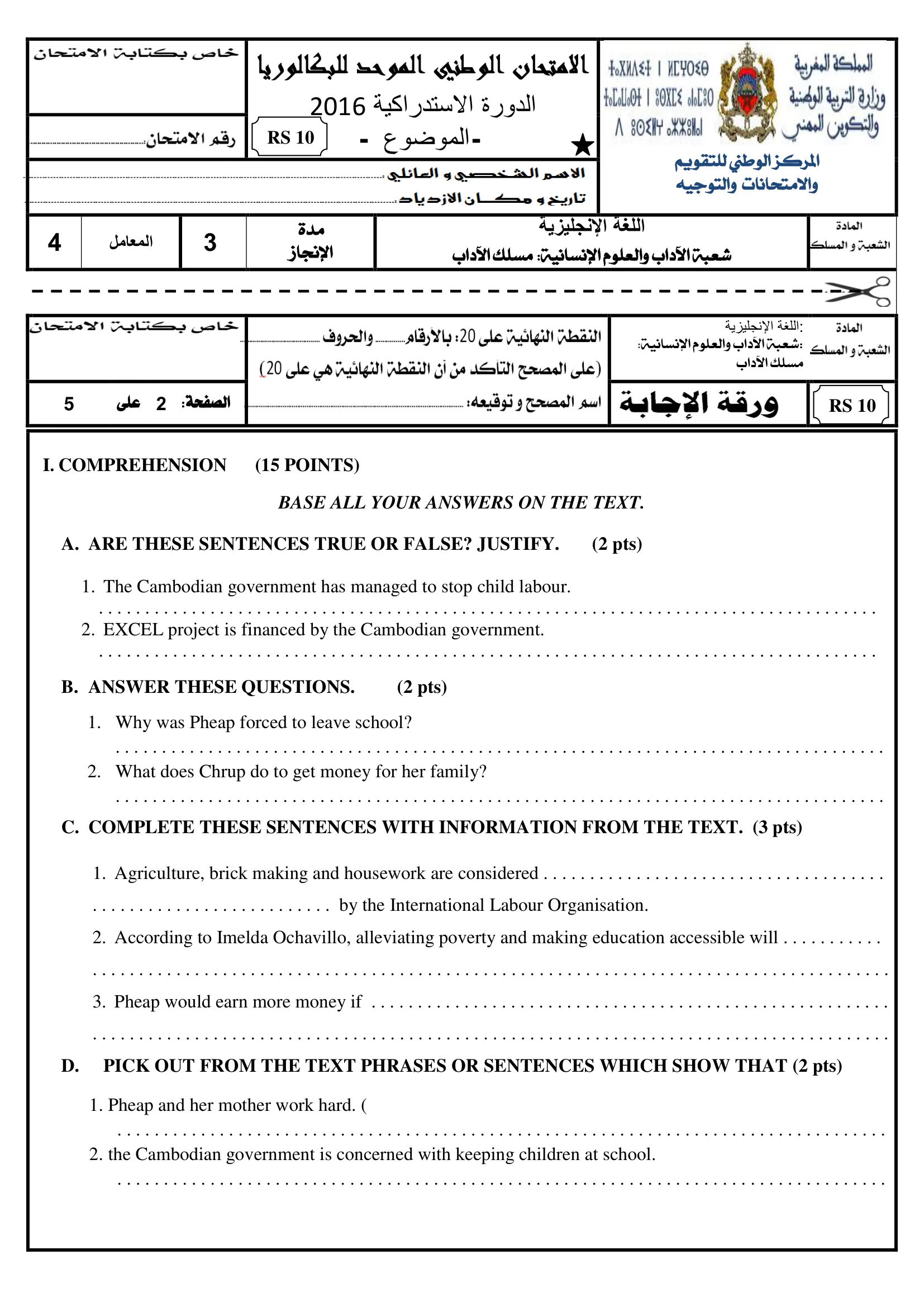
[3] About 430,000 Cambodians under 18 are employed. Half of them work in what the International Labour Organization calls the worst forms of child labour. These include agriculture, salt production, housework, fishing and brick-making. The director of the Child Labour Department in Cambodia says that targeting areas like agriculture and fisheries has helped reduce the number of child labourers to nearly a half since 1999. Making sure Cambodian children stay in school is a priority for the government.
[4] World Vision, a non-profit group, seeks to reduce child labour by offering assistance for both education and household incomes. The group, which operates a four-year project called EXCEL, receives financial support from the U.S. Department of Labour and has already helped 20,000 children. The group's leader Imelda Ochavillo says Cambodians are becoming less tolerant of child labour. But she says that more is needed to solve this complex issue. “If we want to reduce it significantly, we should alleviate poverty, provide alternative sources of income, offer decent employment for youth, and make education accessible.” She says child labour is usually not a major issue for children under age 12. Most of them remain in their villages and attend school. But it is between the ages of 12 and 17 that child labour becomes an issue.
[5] Pheap dreams of finding a job in a clothing factory. That could double her wage. Her mother Chrup wants more for her, too. She says she does not want her daughter to work in the brick factory. But a better future for Chrup’s family is far from guaranteed. Her other daughter, aged 10, won’t be admitted to school because of her age. Anyway, she is needed to look after her baby brother. Definitely, it is hard for Pheap and other Cambodian children to find a way out of poverty without education.
Adapted from: http://learningenglish.voanews.com
I. Comprehension (15 points)
A. Are these sentences true or false? Justify. (2 pts)
- The Cambodian government has managed to stop child labour.
- EXCEL project is financed by the Cambodian government.
B. Answer these questions. (2 pts)
- Why was Pheap forced to leave school?
- What does Chrup do to get money for her family?
C. Complete these sentences with information from the text. (3 pts)
- Agriculture, brick making and housework are considered …
- According to Imelda Ochavillo, alleviating poverty and making education accessible will …
- Pheap would earn more money if …
D. Pick out from the text phrases or sentences which show that (2 pts)
- Pheap and her mother work hard.
- The Cambodian government is concerned with keeping children at school.
E. Find in the text words that mean almost the same as (3 pts)
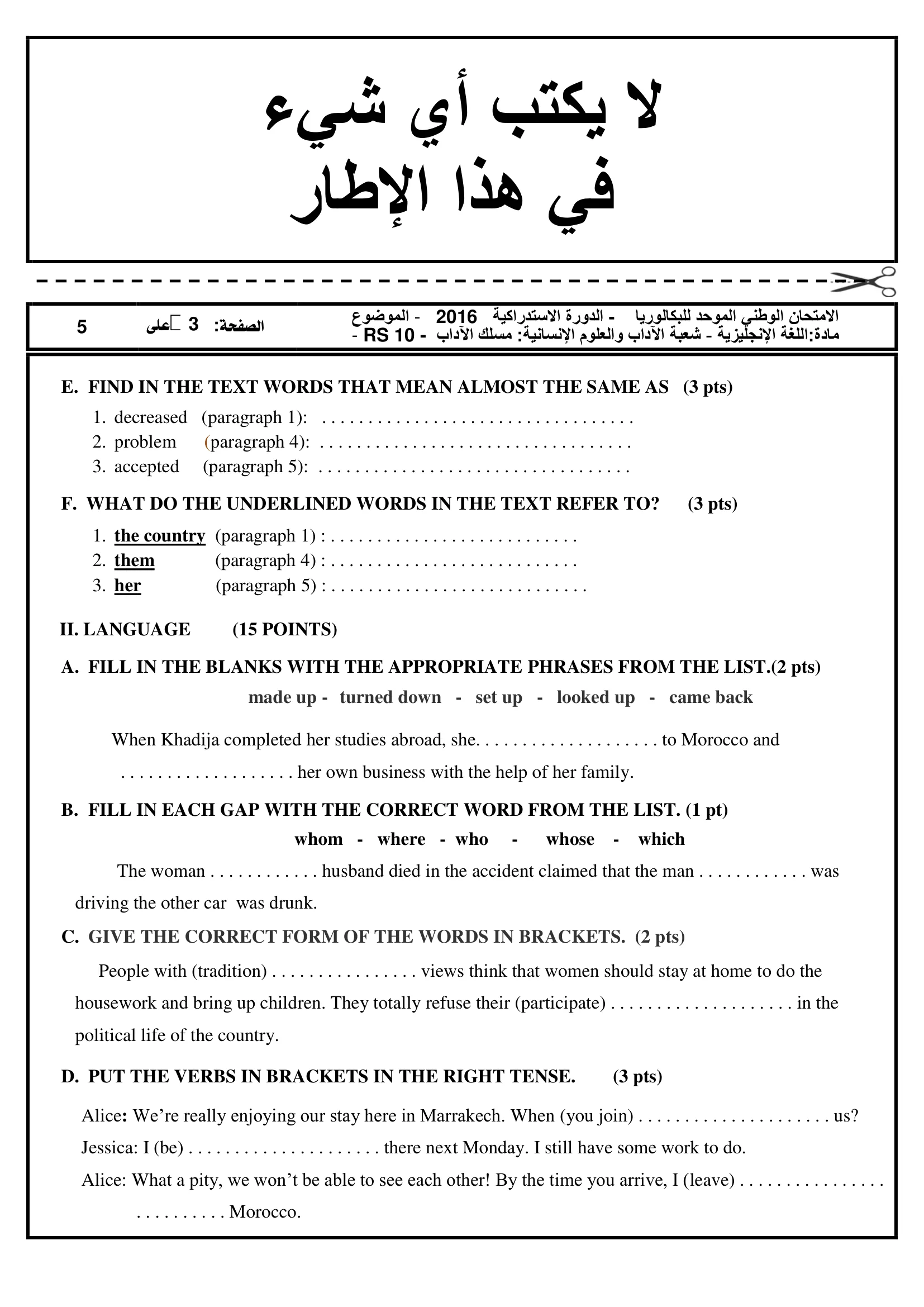
- decreased (paragraph 1): …
- problem (paragraph 4): …
- accepted (paragraph 5): …
F. What do the underlined words in the text refer to? (3 pts)
- the country (paragraph 1) : …
- them (paragraph 4) : …
- her (paragraph 5) : …
II. Language (15 points)
A. Fill in the blanks with the appropriate phrases from the list. (2 pts)
made up – turned down – set up – looked up – came back
- When Khadija completed her studies abroad, she ………… to Morocco …
- … and ………… her own business with the help of her family.
B. Fill in each gap with the correct word from the list. (1 pt)
whom – where – who – whose – which
- The woman ………… husband died in the accident claimed …
- … that the man ………… was driving the other car was drunk.
C. Give the correct form of the words in brackets. (2 pts)
- People with (tradition) ………… views think that women should stay at home …
- They totally refuse their (participate) ………… in the political life of the country.
D. Put the verbs in brackets in the right tense. (3 pts)
- Alice: … When (you join) ………… us?
- Jessica: I (be) ………… there next Monday.
- By the time you arrive, I (leave) ………… Morocco.
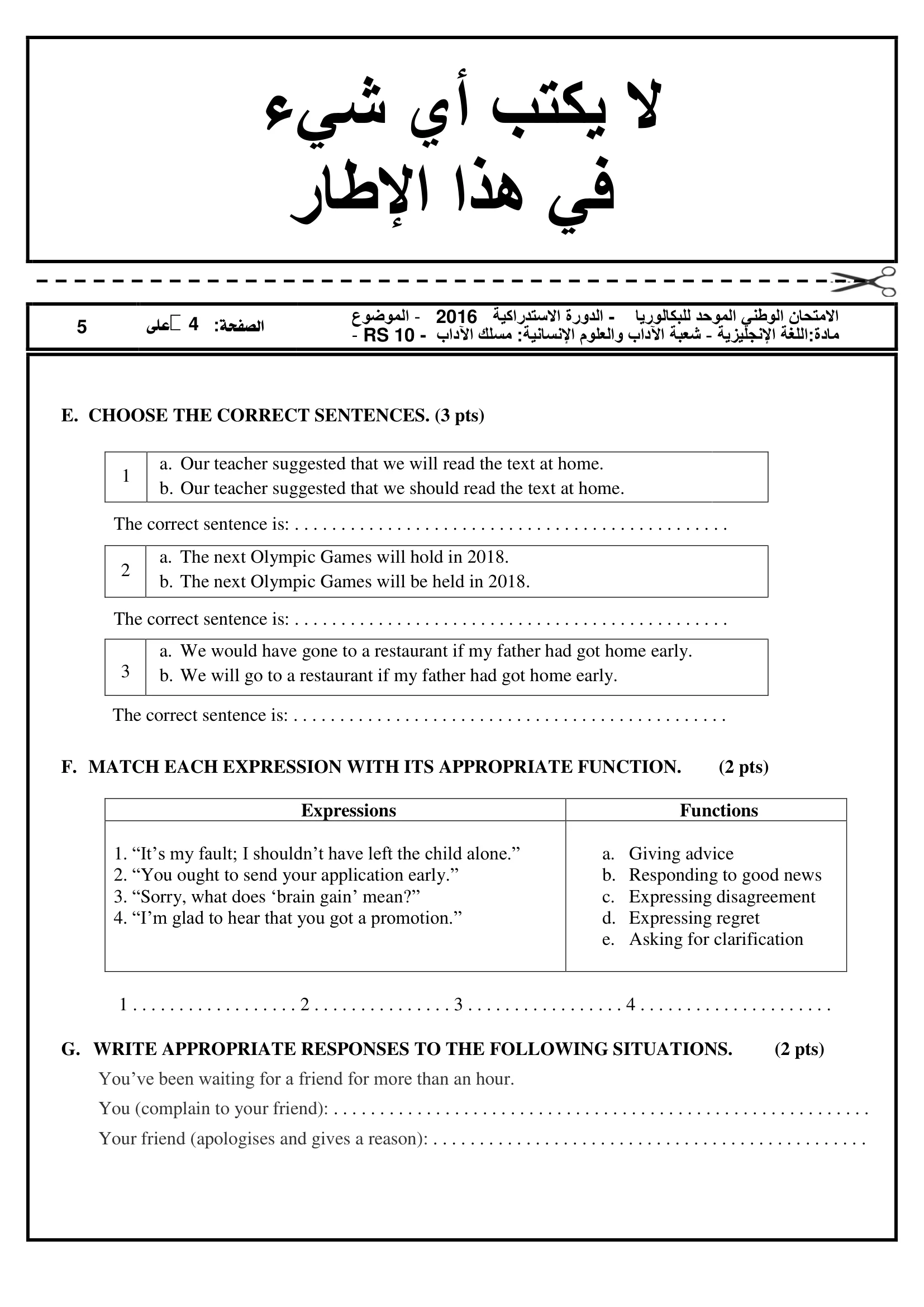
E. Choose the correct sentences. (3 pts)
- Choose the correct sentence (1).
a. Our teacher suggested that we will read the text at home. – b. Our teacher suggested that we should read the text at home. - Choose the correct sentence (2).
a. The next Olympic Games will hold in 2018. – b. The next Olympic Games will be held in 2018. - Choose the correct sentence (3).
a. We would have gone to a restaurant if my father had got home early. – b. We will go to a restaurant if my father had got home early.
F. Match each expression with its appropriate function. (2 pts)
a. Giving advice – b. Responding to good news – c. Expressing disagreement – d. Expressing regret – e. Asking for clarification
- “It’s my fault; I shouldn’t have left the child alone.”
- “You ought to send your application early.”
- “Sorry, what does ‘brain gain’ mean?”
- “I’m glad to hear that you got a promotion.”
G. Write appropriate responses to the following situations. (2 pts)
- You’ve been waiting for a friend for more than an hour. You (complain to your friend): …
- Your friend (apologises and gives a reason): …
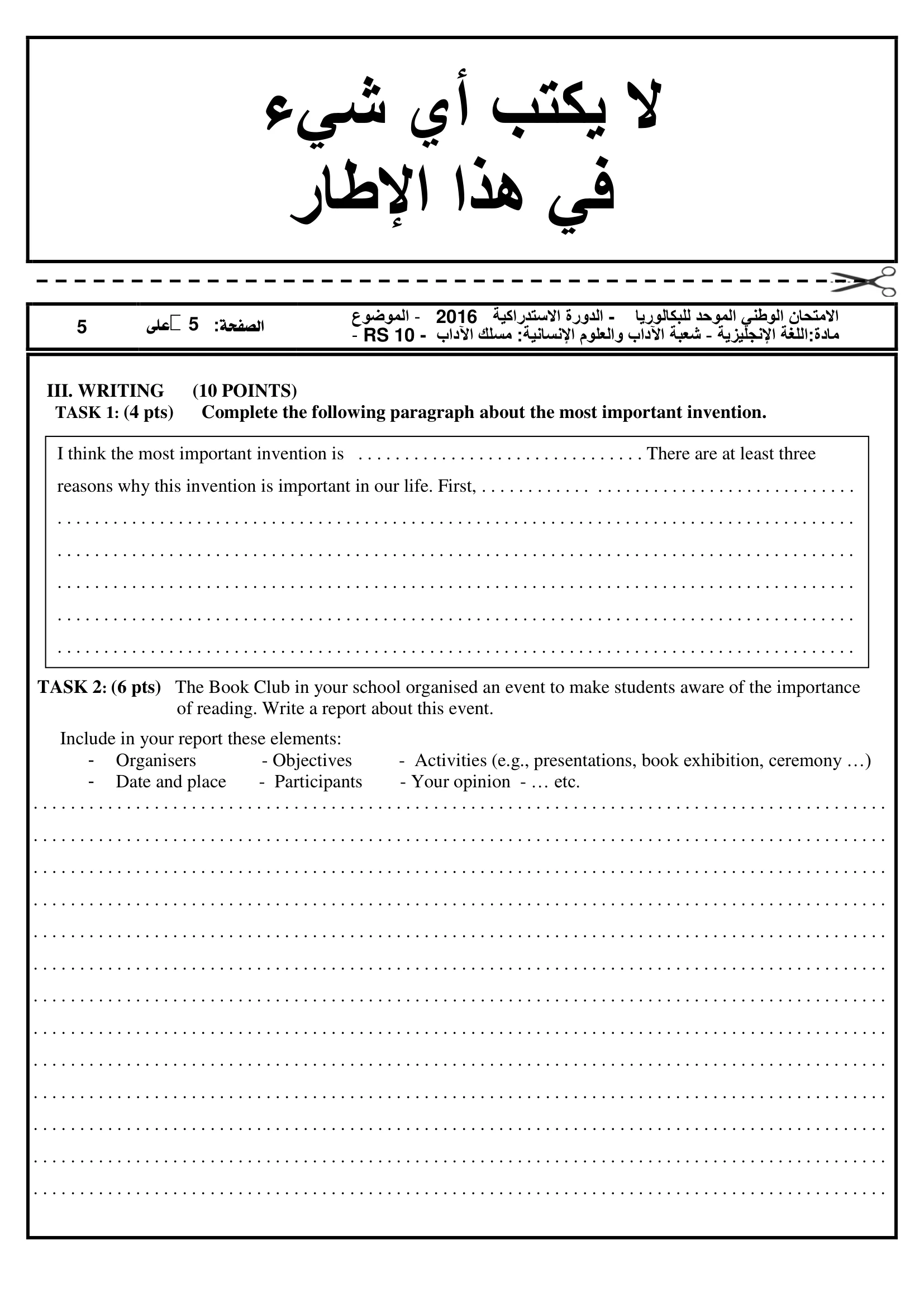
III. Writing (10 points)
Task 1 (4 pts)
Complete the following paragraph about the most important invention: “I think the most important invention is … There are at least three reasons why this invention is important in our life. First, …”
I think the most important invention is …
Task 2 (6 pts)
The Book Club in your school organised an event to make students aware of the importance of reading. Write a report about this event. Include in your report these elements: organisers, objectives, activities (e.g., presentations, book exhibition, ceremony …), date and place, participants, your opinion, etc.
Paper: Baccalaureate national exam, Make-up session 2016, Ministry of National Education (CNEE). Interactive version by ILENG.