
2 Bac English national exam 2024, regular session (Letters): paper and answers
The official paper, as it is. Answer directly on the sheet: tap True or False, write on the dotted lines, choose your answer. The correction and your mark appear at the end.


Enjoy + verb in -ing: Sarah enjoys reading.
The theatre is a place and the clause after it is complete (we perform our plays): where.
After new ways of you need a noun: entertainment.
After are really you need an adjective, and the meaning is negative (they pollute): careless.
Job opportunities = jobs available.
Highly skilled people = very qualified people.
The short action that interrupts (was reading … when): past simple (received).
By next January: an action finished before a moment in the future, future perfect (will have finished).
A real possibility in the future: first conditional, If + present, will + verb.
An order in reported speech: ordered + person + to + verb (to put).
Passive in the future: will be + past participle (built).
Can you help me …, please? is a request (d).
The person complains that the book has not arrived (e).
What can I do …? = asking for advice (a).
I think that … = giving your opinion (b).
Apologising: I’m (really) sorry I couldn’t come … / I apologize for …
Accepting an apology: Don’t worry / That’s all right / Never mind.
In every Moroccan family, we can see big differences between young people and their parents. These differences are normal, because each generation grew up in a different world.
First, their lifestyles are not the same. Our parents went to bed early and spent their free time with family and neighbours, while young people today spend hours on their phones and on social media. Second, they have different interests. Parents like watching the news and visiting relatives, but teenagers prefer video games, online series and music.
Moreover, the two generations often have different opinions. Young people want more freedom to choose their studies, their jobs and even their partners, while many parents prefer traditions. Their appearance is also different: teenagers follow fashion and new hairstyles, but parents wear simpler or traditional clothes.
In my opinion, both generations can learn from each other. Young people should respect their parents’ experience, and parents should try to understand the modern world of their children.
Paper: Baccalaureate national exam, Regular session 2024, Ministry of National Education (CNEE). Interactive version by ILENG.
My mark
Estimated mark: answers corrected with the official answer key, writing corrected automatically with the official grid.
Your mistakes, one by one
Tap a mistake to see the correction.
No mistakes. Excellent work!
The paper as textText, questions and writing tasks of the exam, to read or copy.
Paper of the baccalaureate English national exam (2 Bac), Regular session 2024, Letters stream (NS 10). Topic of the text: Zellij, a traditional Moroccan craft (Zellij, a traditional Moroccan craft). The answers and the mark appear when you finish the exam above.
English national exam 2024, normal session – NS 10
Reading text: Zellij, a traditional Moroccan craft
[1] For centuries, Morocco has been known for the art of making zellij. It is a skill passed on from father to son in Morocco. Making zellij needs a lot of training and hard work. It also requires expertise in math and geometry. Today, more and more young people are interested in learning this craft. They consider it as a significant part of their cultural heritage. However, these young learners do not find it an easy skill to learn. Making zellij requires a lot of patience and precision. It also takes much time and practice to master this art. Still, “learning it allows you to appreciate and contribute to this traditional art form,” said Thaifa, director of Mosaics and Potteries of Fes.
[2] Driss Zourgane, 36, has been making zellij since he was 7. He cuts pieces of colored zellij with his hands into very small shapes and sizes. Another worker takes those shapes and puts them together with cement to create beautiful zellij, or mosaic. Driss spent five years learning the craft. Now, he produces about 400 pieces during a workday of 10 hours. He makes 200 dirhams a day. For Driss, this is a steady income for a family of six that includes his parents and siblings. Zourgane and his friend, Abdelwahd Hafid, said their income is modest, but they are proud to make enough money to support their families.
[3] Almost 3 million people work in Morocco’s artisan industries. A 2016 official report shows a slow decrease in the number of jobs in the artisan sector since 2007 because children now stay longer at school to finish their studies. That is one reason why the number of modern zellij factories has increased. However, though factories can produce thousands of zellij pieces much faster and cheaper, traditional handmade zellij is still popular as it is unique. Tourists love to visit zellij workshops in Fes to buy some pieces. They often buy them as souvenirs for their friends and families.
[4] To advertise the Moroccan culture worldwide, the government encourages the new generations to learn the traditional skills. Across Morocco, there are about 58 artisan schools that teach the art of zellij, woodwork, leather and many other crafts. They teach young people about its history, techniques and cultural importance.
Adapted from: www.deutschland.de
I. Comprehension (15 points)
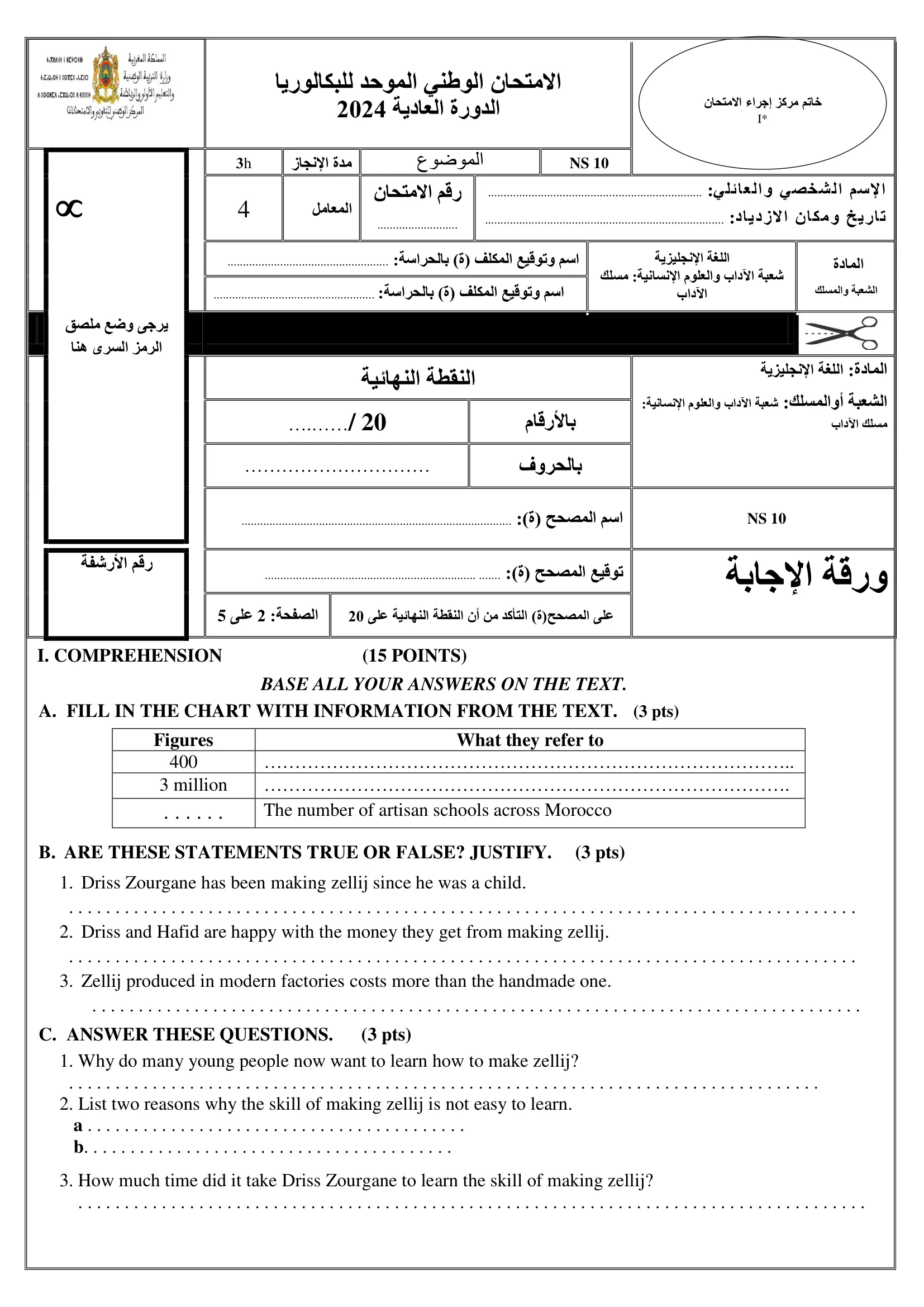
A. Fill in the chart with information from the text. (3 pts)
| Figures | What they refer to |
|---|---|
| 400 | ………… |
| 3 million | ………… |
| The number of artisan schools across Morocco | ………… |
B. Are these statements true or false? Justify. (3 pts)
- Driss Zourgane has been making zellij since he was a child.
- Driss and Hafid are happy with the money they get from making zellij.
- Zellij produced in modern factories costs more than the handmade one.
C. Answer these questions. (3 pts)
- Why do many young people now want to learn how to make zellij?
- List two reasons why the skill of making zellij is not easy to learn.
- How much time did it take Driss Zourgane to learn the skill of making zellij?
D. Complete the following sentences with information from the text. (2 pts)
- According to a 2016 report, the number of people doing artisan jobs is decreasing because …
- The government encourages young people to learn new crafts such as making zellij to. …
E. Find in the text words which mean almost the same as (2 pts)
- admire (paragraph 1)
- special (paragraph 3)
F. What do the underlined words in the text refer to? (2 pts)
- this craft (paragraph 1)
- They (paragraph 3)
II. Language (15 points)
A. Fill in the gaps with the right words from the lists. (2 pts)
- Sarah enjoys ………… books in her free time.
a. to read – b. reading – c. read - The theatre ………… we perform our plays is now closed.
a. who – b. where – c. when
B. Give the correct form of the words in brackets. (2 pts)
- The internet has provided people with new ways of (entertain) ………….
- Millions of tourists visit the pyramids each year. But some of them are really (care) ………… as they pollute the touristic sites.
C. Fill in the gaps with the right words from the list. (2 pts)
opportunities – solidarity – skilled – imagination – natural
- Advances in technology provide many job ………….
- However, most companies prefer highly ………… people.
D. Put the verbs in brackets in the correct tense. (2 pts)
- Last week, Mike was reading a book when he (receive) ………… a phone call from his friend.
- The workers have been building the bridge for months. They (finish) ………… it by next January.
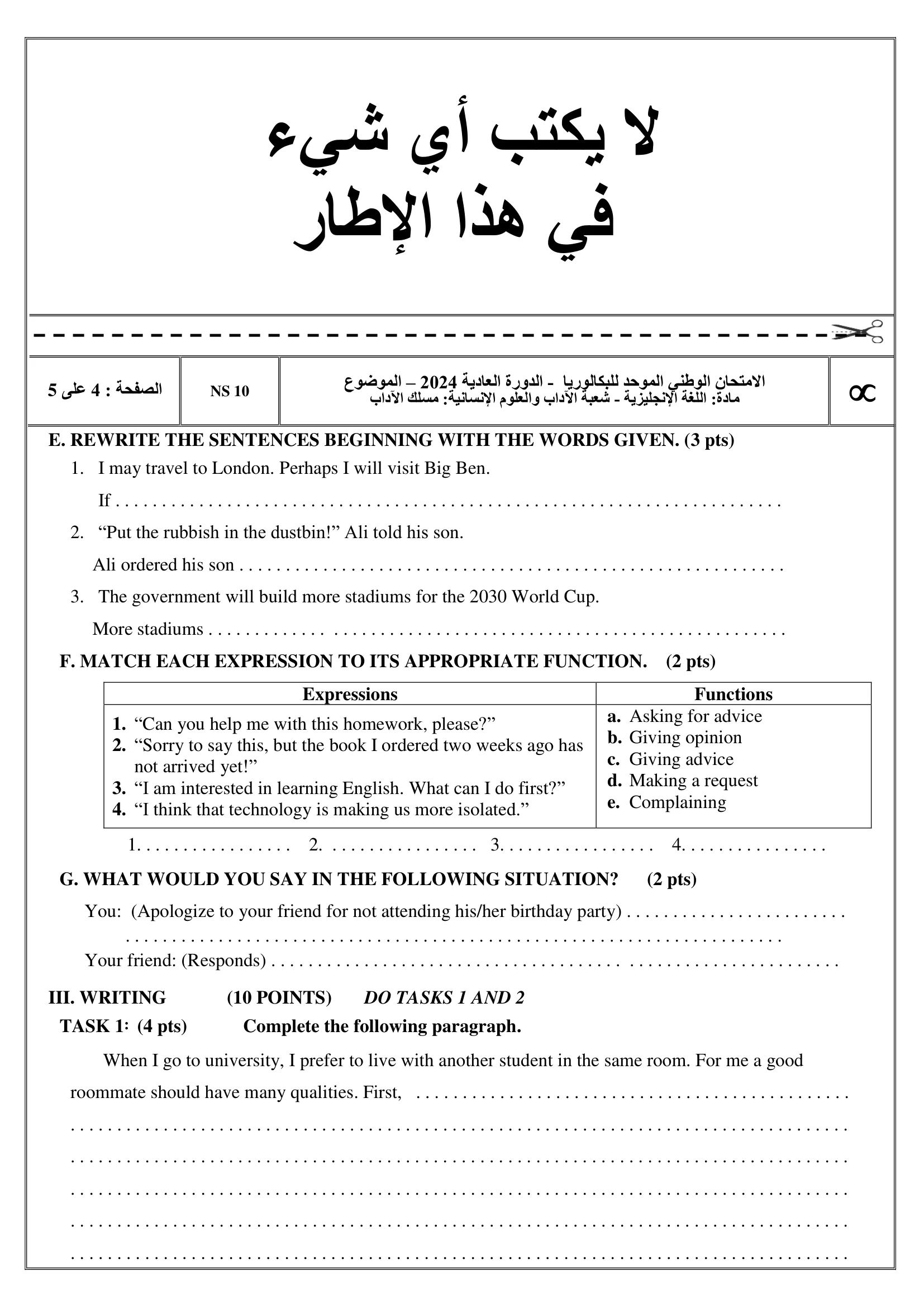
E. Rewrite the sentences beginning with the words given. (3 pts)
- I may travel to London. Perhaps I will visit Big Ben.
If … - “Put the rubbish in the dustbin!” Ali told his son.
Ali ordered his son … - The government will build more stadiums for the 2030 World Cup.
More stadiums …
F. Match each expression to its appropriate function. (2 pts)
a. Asking for advice – b. Giving opinion – c. Giving advice – d. Making a request – e. Complaining
- “Can you help me with this homework, please?”
- “Sorry to say this, but the book I ordered two weeks ago has not arrived yet!”
- “I am interested in learning English. What can I do first?”
- “I think that technology is making us more isolated.”
G. What would you say in the following situation? (2 pts)
- You: (Apologize to your friend for not attending his/her birthday party.)
- Your friend: (Responds.)
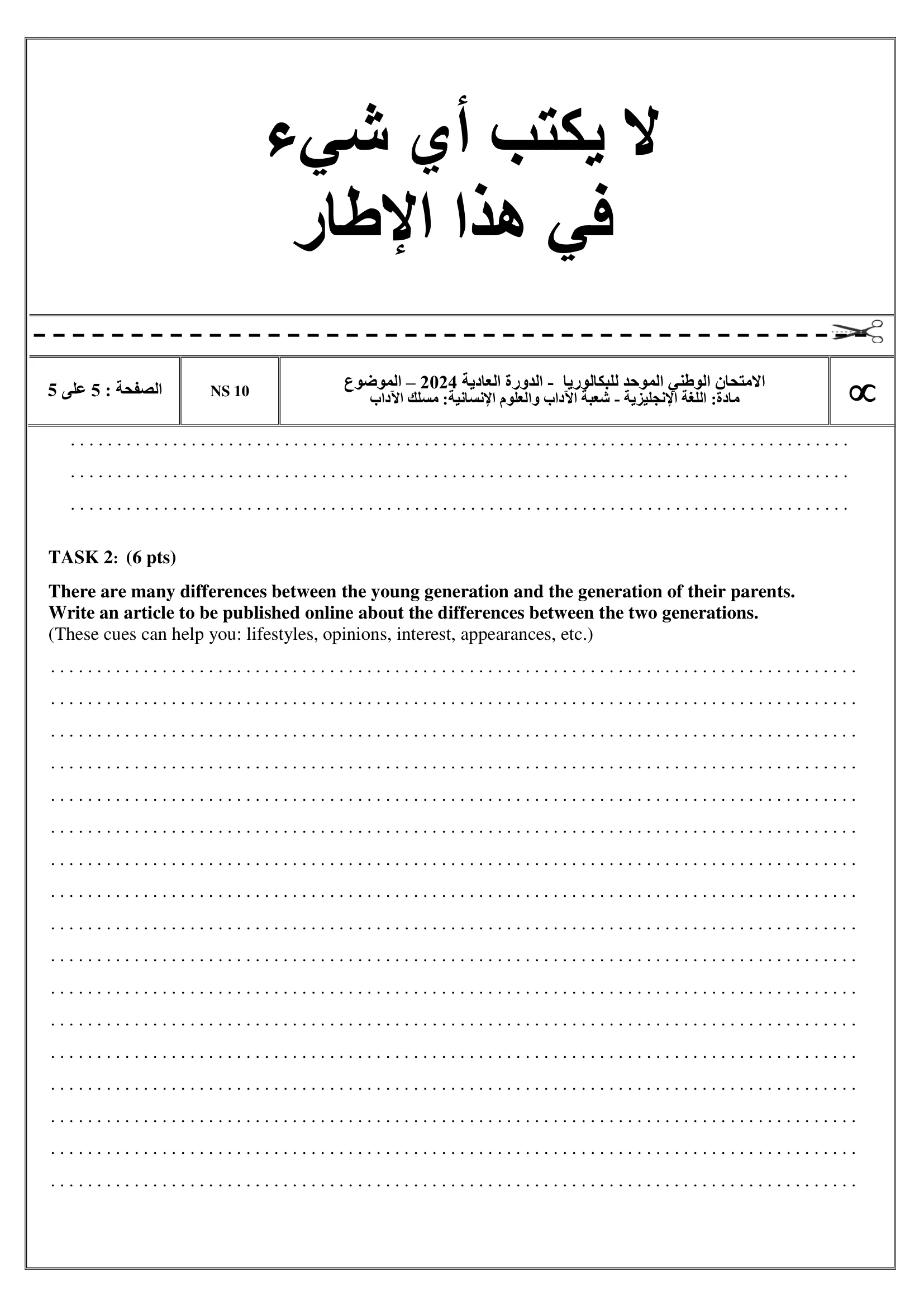
III. Writing (10 points)
Task 1 (4 pts)
Complete the following paragraph: “When I go to university, I prefer to live with another student in the same room. For me a good roommate should have many qualities. First, …”
When I go to university, I prefer to live with another student in the same room. For me a good roommate should have many qualities. First, …
Task 2 (6 pts)
There are many differences between the young generation and the generation of their parents. Write an article to be published online about the differences between the two generations. (These cues can help you: lifestyles, opinions, interests, appearances, etc.)
Paper: Baccalaureate national exam, Regular session 2024, Ministry of National Education (CNEE). Interactive version by ILENG.