2 Bac English national exam 2018, regular session (Letters): paper and answers
The official paper, as it is. Answer directly on the sheet: tap True or False, write on the dotted lines, choose your answer. The correction and your mark appear at the end.

The text answers: they cost less than $15 (paragraph 5).
The text answers: the Moon, Jupiter and Mars (paragraph 3).
The text mentions the TFK survey, but does not say when it took place.
Apply for a job = send an application for a job.
Log on (to) = connect (to an account).
After Morocco’s you need a noun: investment.
Before the noun energies you need an adjective: renewable.
After to be you need an adjective: beneficial.
Before development: an adjective, sustainable.
Impossibility (negative certainty): can’t be.
Advice: ought to (= should) see her doctor.
Yesterday: past simple (read, irregular).
Now: present continuous (am staying).
Yet: present perfect (haven’t got).
By the end of this month: future perfect (will have moved).

Advise someone (not) to + verb: not to sit.
The bags are used: passive (are no longer used).
Third conditional: wouldn’t have been … if + past perfect (had installed).
Why don’t we …? = making a suggestion.
If only I had … = expressing a regret.
For me, … = giving your opinion.
I’m afraid this is not … = complaining.
Apologising: I’m (really) sorry I couldn’t … / I apologize for not …
Saying you don’t understand: I don’t understand what you mean. / I’m not sure I follow you.
Our planet is in danger because of pollution, waste and climate change. However, each one of us can do something to protect the environment.
First, we should reduce the waste we produce. We can stop using plastic bags and bottles and take our own bags when we go shopping. We should also sort our rubbish and recycle paper, glass and plastic.
Second, we need to save energy and water. Switching off lights when we leave a room and taking short showers are simple habits that make a big difference. Using public transport, walking or cycling instead of driving also reduces air pollution.
Third, we can plant trees in our neighbourhood and take part in clean-up campaigns on beaches and in parks. Schools should organise environmental clubs to raise students’ awareness.
In conclusion, protecting the environment is everybody’s responsibility. If we all change our habits today, we will leave a cleaner planet to future generations.
Paper: Baccalaureate national exam, Regular session 2018, Ministry of National Education (CNEE). Interactive version by ILENG.
My mark
Estimated mark: answers corrected with the official answer key, writing corrected automatically with the official grid.
Your mistakes, one by one
Tap a mistake to see the correction.
No mistakes. Excellent work!
The paper as textText, questions and writing tasks of the exam, to read or copy.
Paper of the baccalaureate English national exam (2 Bac), Regular session 2018, Letters stream (NS 10). Topic of the text: Virtual reality in the classroom (Virtual reality in the classroom). The answers and the mark appear when you finish the exam above.
English national exam 2018, normal session – NS 10
Reading text: Virtual reality in the classroom
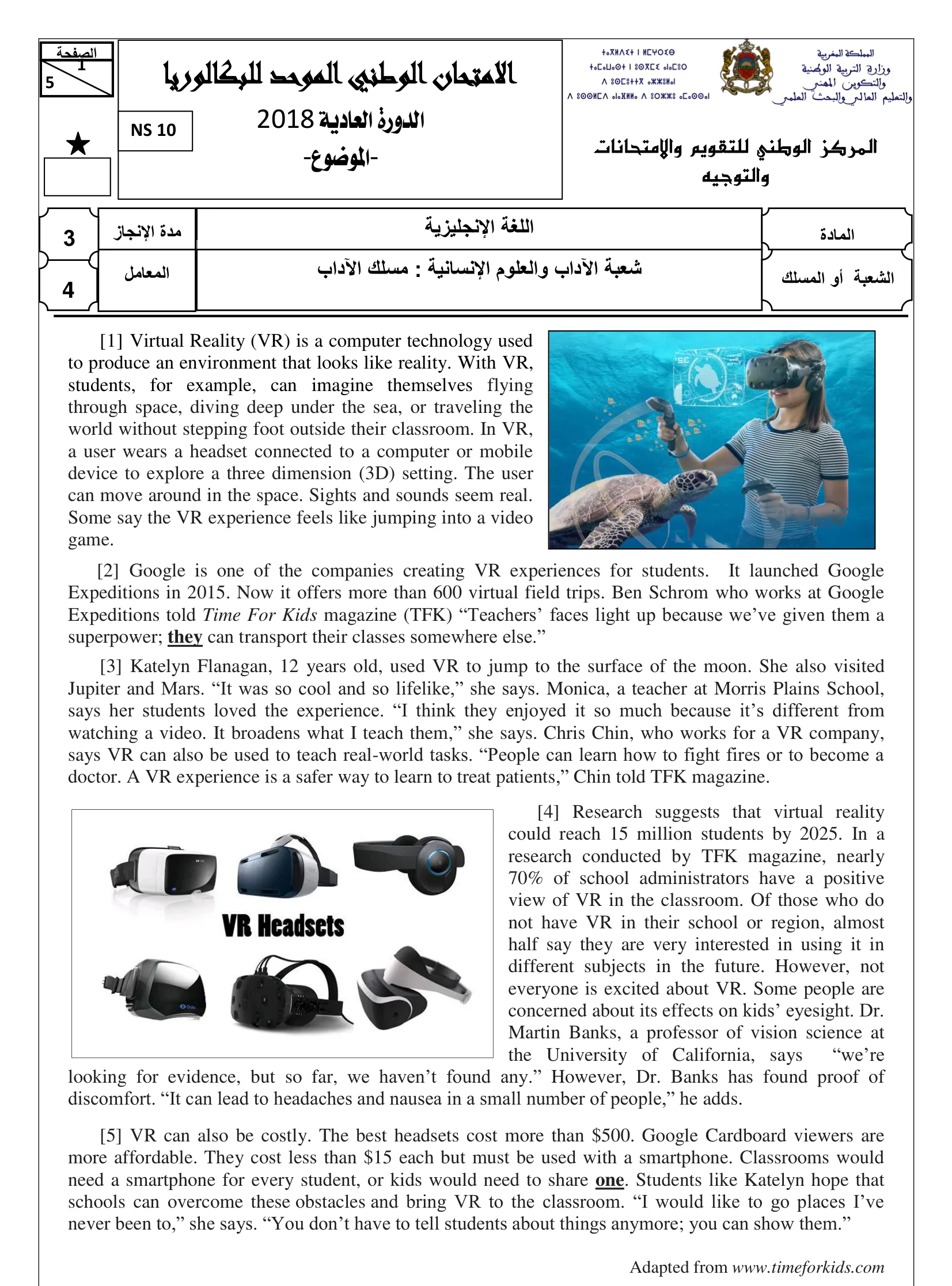
[1] Virtual Reality (VR) is a computer technology used to produce an environment that looks like reality. With VR, students, for example, can imagine themselves flying through space, diving deep under the sea, or traveling the world without stepping foot outside their classroom. In VR, a user wears a headset connected to a computer or mobile device to explore a three dimension (3D) setting. The user can move around in the space. Sights and sounds seem real. Some say the VR experience feels like jumping into a video game.
[2] Google is one of the companies creating VR experiences for students. It launched Google Expeditions in 2015. Now it offers more than 600 virtual field trips. Ben Schrom who works at Google Expeditions told Time For Kids magazine (TFK) “Teachers’ faces light up because we’ve given them a superpower; they can transport their classes somewhere else.”
[3] Katelyn Flanagan, 12 years old, used VR to jump to the surface of the moon. She also visited Jupiter and Mars. “It was so cool and so lifelike,” she says. Monica, a teacher at Morris Plains School, says her students loved the experience. “I think they enjoyed it so much because it’s different from watching a video. It broadens what I teach them,” she says. Chris Chin, who works for a VR company, says VR can also be used to teach real-world tasks. “People can learn how to fight fires or to become a doctor. A VR experience is a safer way to learn to treat patients,” Chin told TFK magazine.
[4] Research suggests that virtual reality could reach 15 million students by 2025. In a research conducted by TFK magazine, nearly 70% of school administrators have a positive view of VR in the classroom. Of those who do not have VR in their school or region, almost half say they are very interested in using it in different subjects in the future. However, not everyone is excited about VR. Some people are concerned about its effects on kids’ eyesight. Dr. Martin Banks, a professor of vision science at the University of California, says “we’re looking for evidence, but so far, we haven’t found any.” However, Dr. Banks has found proof of discomfort. “It can lead to headaches and nausea in a small number of people,” he adds.
[5] VR can also be costly. The best headsets cost more than $500. Google Cardboard viewers are more affordable. They cost less than $15 each but must be used with a smartphone. Classrooms would need a smartphone for every student, or kids would need to share one. Students like Katelyn hope that schools can overcome these obstacles and bring VR to the classroom. “I would like to go places I’ve never been to,” she says. “You don’t have to tell students about things anymore; you can show them.”
Adapted from: www.timeforkids.com
I. Comprehension (15 points)
A. Tick (√) the questions that are answered in the text and put a cross (X) next to the ones that are not answered. (3 pts)
NEXT TO THE ONES THAT ARE NOT ANSWERED. (3 pts) / Example: What is VR? √ / Example: Is Katelyn Flanagan a student in Monica’s class? X
- How much do Google Cardboard viewers cost? …
a. √ – b. X - What places did Katelyn visit in her VR experience? …
a. √ – b. X - When did TFK conduct research about VR? …
a. √ – b. X
B. Are these statements true or false? Justify. (3 pts)
- Google made it possible for students to have access to Virtual Reality.
- Ben Schrom is a teacher.
- School administrators disagree with the use of VR at school.
C. Choose the right answer. (2 pts)
- “without stepping foot outside their classroom” (paragraph 1) means :
a. without leaving their classroom. – b. without getting into the classroom. – c. without making noise in their classroom. - “teachers’ faces light up” (paragraph 2) means:
a. teachers get confused – b. teachers get worried. – c. teachers feel excited.
D. Complete the following sentences. (2 pts)
- Doctors haven’t yet found any evidence of …
- ………… are some of the health problems of using VR.
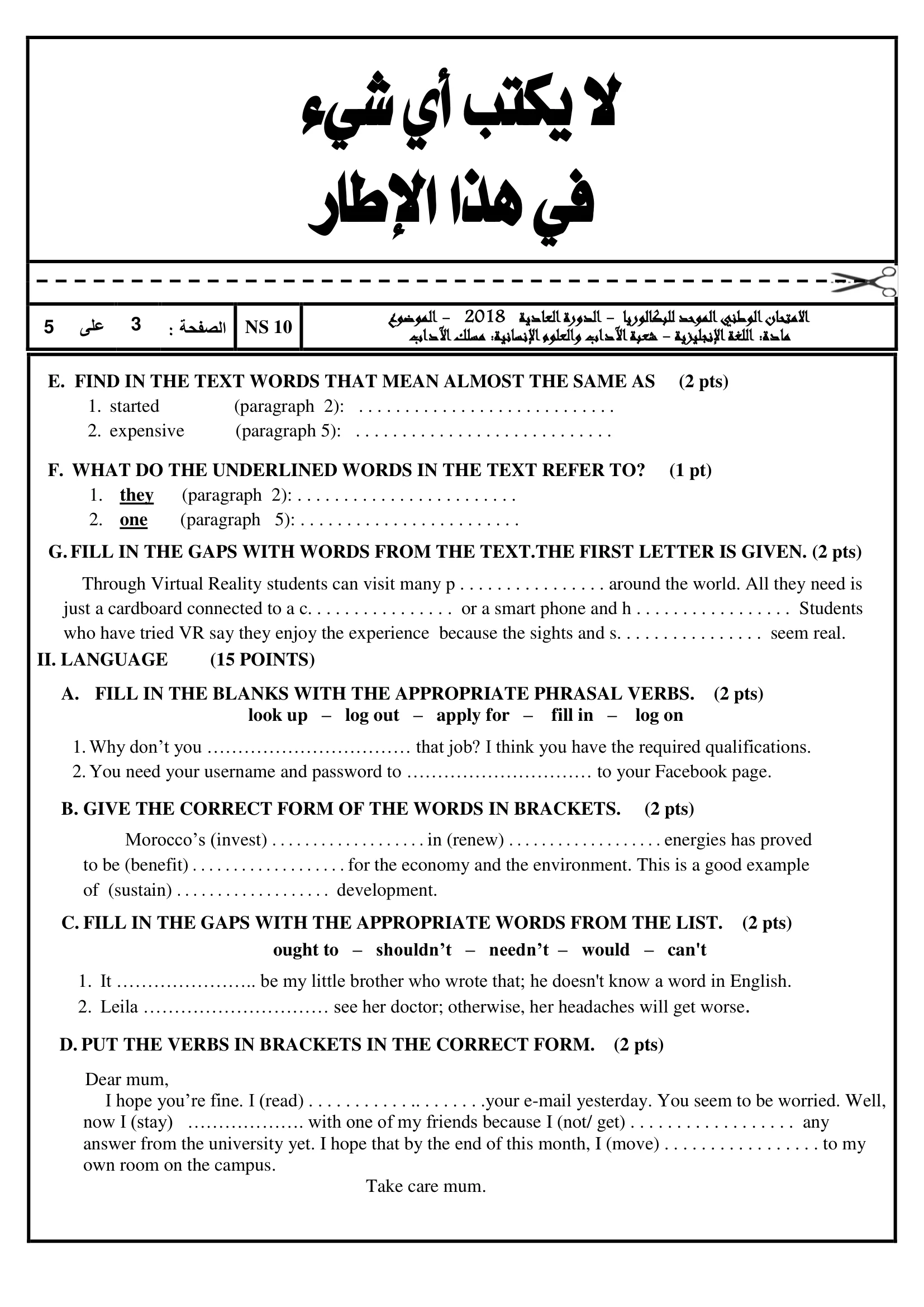
E. Find in the text words that mean almost the same as (2 pts)
- started (paragraph 2): …
- expensive (paragraph 5): …
F. What do the underlined words in the text refer to? (1 pt)
- they (paragraph 2): …
- one (paragraph 5): …
G. Fill in the gaps with words from the text. The first letter is given. (2 pts)
- Through Virtual Reality students can visit many p………… around the world.
- All they need is just a cardboard connected to a c………… …
- … or a smart phone and h………….
- Students who have tried VR say they enjoy the experience because the sights and s………… seem real.
II. Language (15 points)
A. Fill in the blanks with the appropriate phrasal verbs. (2 pts)
look up – log out – apply for – fill in – log on
- Why don’t you ………… that job? I think you have the required qualifications.
- You need your username and password to ………… to your Facebook page.
B. Give the correct form of the words in brackets. (2 pts)
- Morocco’s (invest) ………… in (renew) ………… energies has proved …
- … in (renew) ………… energies …
- … has proved to be (benefit) ………… for the economy and the environment.
- This is a good example of (sustain) ………… development.
C. Fill in the gaps with the appropriate words from the list. (2 pts)
ought to – shouldn’t – needn’t – would – can't
- It ………… be my little brother who wrote that; he doesn't know a word in English.
- Leila ………… see her doctor; otherwise, her headaches will get worse.
D. Put the verbs in brackets in the correct form. (2 pts)
- I hope you’re fine. I (read) ………… your e-mail yesterday.
- Well, now I (stay) ………… with one of my friends …
- … because I (not/ get) ………… any answer from the university yet.
- I hope that by the end of this month, I (move) ………… to my own room on the campus.
E. Correct the underlined mistakes. (3 pts)
- To avoid obesity, doctors advise people not sitting ………… in front of TV for long hours.
- Plastic bags are no longer using ………… for shopping in Morocco.
- Your computer wouldn’t have been infected if you install ………… a powerful antivirus.
F. Match each expression to its appropriate function. (2 pts)
Expressions Functions
- “Why don’t we check this website for more information?” a. expressing opinion
- “If only I had told my teacher about my absence before. ”
- “For me, introducing English in primary school is a good idea. ”
- “I'm afraid this is not the tablet we ordered online. ” e. expressing regret
G. Write an appropriate response to each situation? (2 pts)
- You were invited to a party, but you didn’t attend.
You: (apologize) … - Teacher: Bullying is a serious problem in schools.
You: (express lack of understanding) …
III. Writing (10 points)
Task 1 (4 pts)
Complete the following paragraph: “There are many reasons why people don’t read books these days. First, …”
There are many reasons why people don’t read books these days. First, …
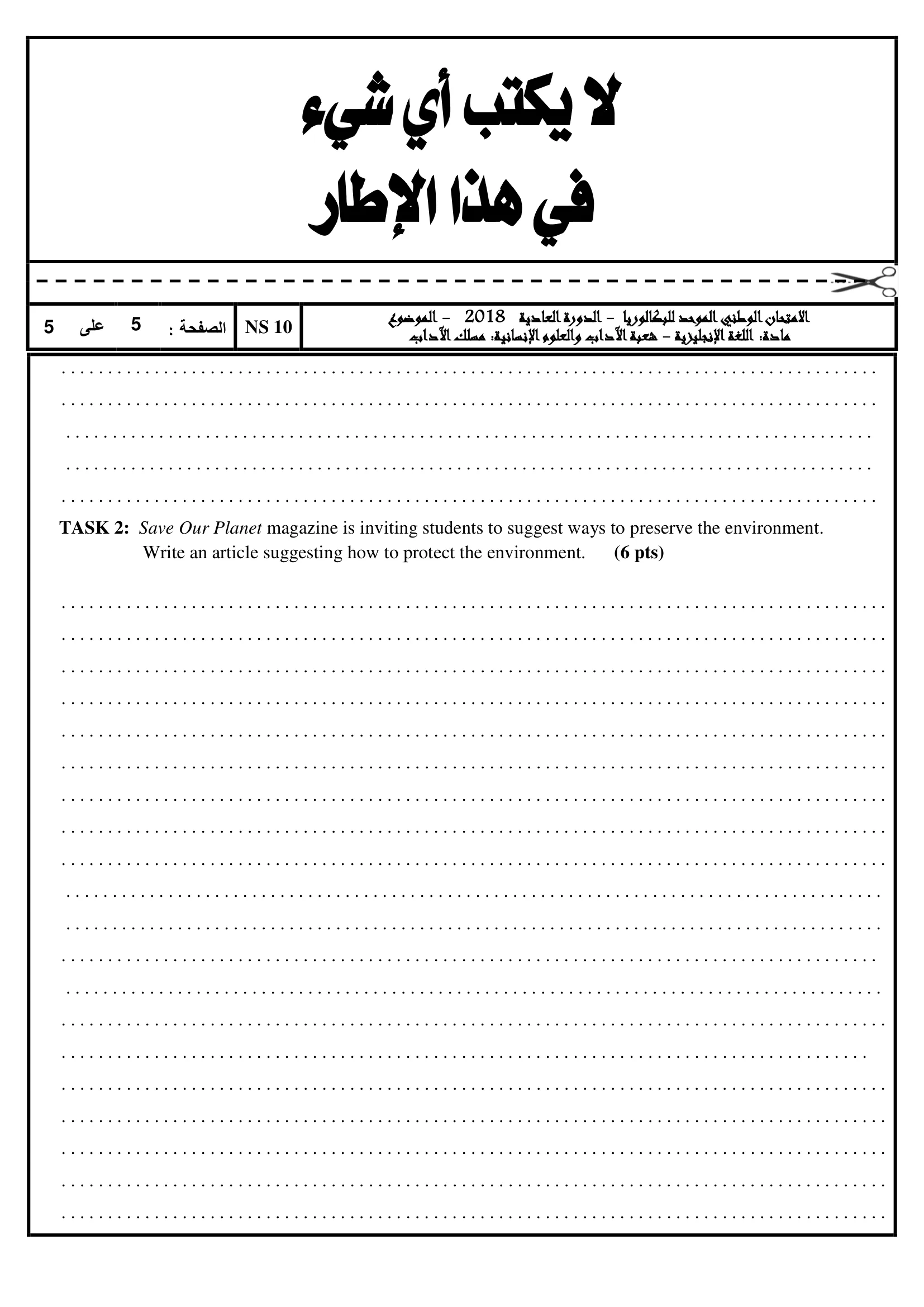
Task 2 (6 pts)
Save Our Planet magazine is inviting students to suggest ways to preserve the environment. Write an article suggesting how to protect the environment.
Paper: Baccalaureate national exam, Regular session 2018, Ministry of National Education (CNEE). Interactive version by ILENG.