2 Bac English national exam 2016, regular session (Humanities): paper and answers
The official paper, as it is. Answer directly on the sheet: tap True or False, write on the dotted lines, choose your answer. The correction and your mark appear at the end.


Children are people and the verb follows (have): who (subject).
Had better (’d better) + base form without “to”: prepare.
Cultural heritage = the culture passed down from the past, which UNESCO protects.
Child mortality = deaths of young children, reduced thanks to vaccines.
An action finished before another past action (I got): past perfect, had already taken off.
Try to + base form = make an effort to do something: try to meet.
Passive with a modal: should be + past participle (given).
Promise + to + base form (promised to help), or promised that he would help.
A past situation that can no longer be changed: third conditional, If + had + past participle, would have + past participle.
After the adjective Moroccan, you need a subject noun: investment.
After the modal must, you need a verb in the base form: cooperate.
Shall we …? = a suggestion.
It’s a pity … = a regret.
Good news: we congratulate (Congratulations! / That’s great news!).
You are asked for your opinion: agree (I agree …) or disagree (I’m afraid I don’t agree …), with a reason.

When I started the year, I was weak in English and I was afraid to speak in class. You were always patient with me. You explained the lessons again when I did not understand, and you gave me extra exercises to practise at home.
You also encouraged me to read short stories and to watch videos in English. Little by little, my vocabulary improved and I became more confident. Now I can take part in class discussions without fear, and my marks have gone up a lot.
Most of all, you believed in me. Your kind words gave me the motivation to work hard, not only in English but in all my subjects. I now dream of studying languages at university.
Thank you again for your help and your kindness. I will never forget you.
Paper: Baccalaureate national exam, Regular session 2016, Ministry of National Education (CNEE). Interactive version by ILENG.
My mark
Estimated mark: answers corrected with the official answer key, writing corrected automatically with the official grid.
Your mistakes, one by one
Tap a mistake to see the correction.
No mistakes. Excellent work!
The paper as textText, questions and writing tasks of the exam, to read or copy.
Paper of the baccalaureate English national exam (2 Bac), Regular session 2016, Humanities stream (NS 11). Topic of the text: Renewable energy in Morocco: the Noor project (Renewable energy in Morocco: the Noor project). The answers and the mark appear when you finish the exam above.
English national exam 2016, normal session – NS 11
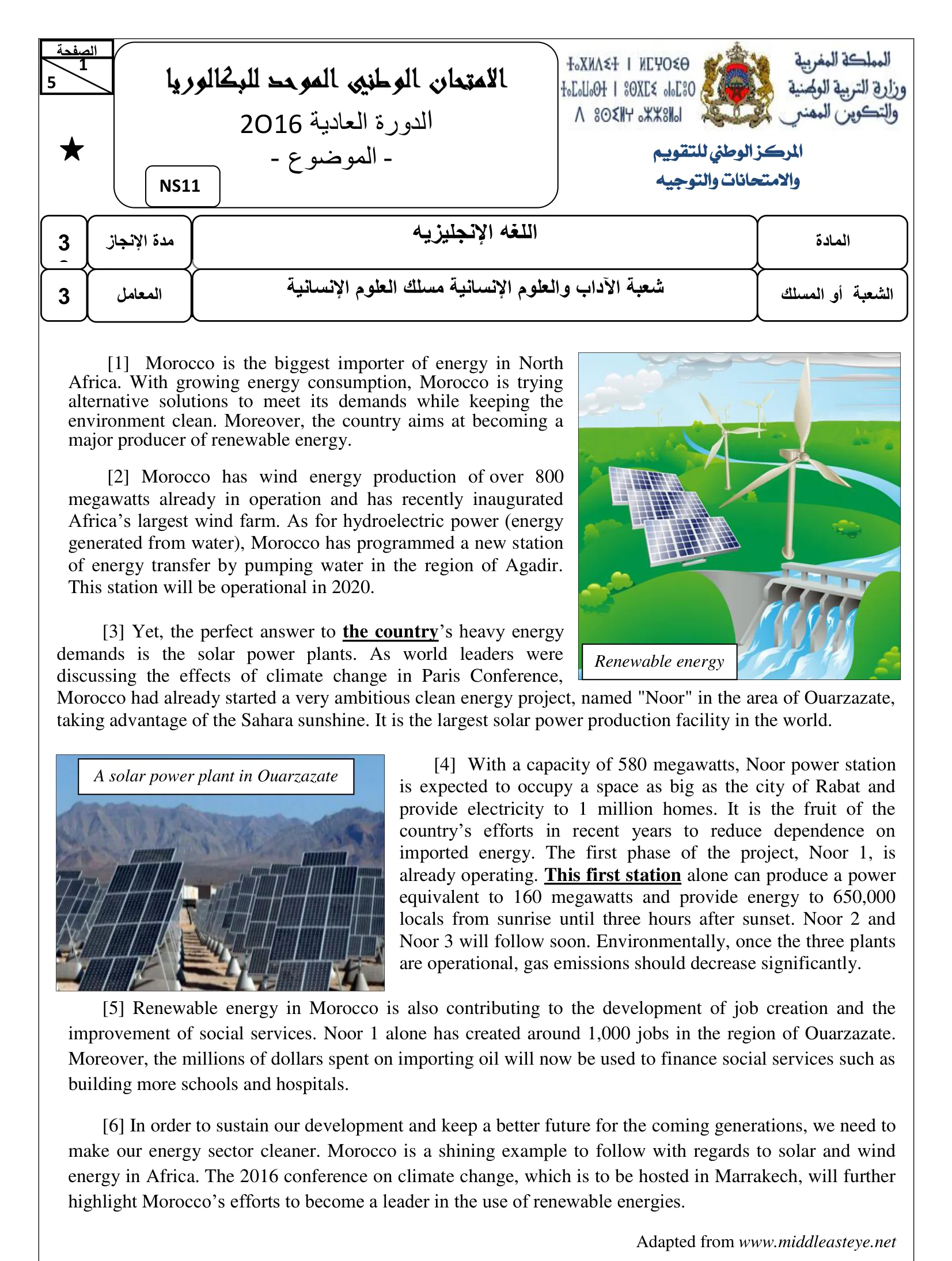
Reading text: Renewable energy in Morocco: the Noor project
[1] Morocco is the biggest importer of energy in North Africa. With growing energy consumption, Morocco is trying alternative solutions to meet its demands while keeping the environment clean. Moreover, the country aims at becoming a major producer of renewable energy.
[2] Morocco has wind energy production of over 800 megawatts already in operation and has recently inaugurated Africa’s largest wind farm. As for hydroelectric power (energy generated from water), Morocco has programmed a new station of energy transfer by pumping water in the region of Agadir. This station will be operational in 2020.
[3] Yet, the perfect answer to the country’s heavy energy demands is the solar power plants. As world leaders were discussing the effects of climate change in Paris Conference, Morocco had already started a very ambitious clean energy project, named "Noor" in the area of Ouarzazate, taking advantage of the Sahara sunshine. It is the largest solar power production facility in the world.
[4] With a capacity of 580 megawatts, Noor power station is expected to occupy a space as big as the city of Rabat and provide electricity to 1 million homes. It is the fruit of the country’s efforts in recent years to reduce dependence on imported energy. The first phase of the project, Noor 1, is already operating. This first station alone can produce a power equivalent to 160 megawatts and provide energy to 650,000 locals from sunrise until three hours after sunset. Noor 2 and Noor 3 will follow soon. Environmentally, once the three plants are operational, gas emissions should decrease significantly.
[5] Renewable energy in Morocco is also contributing to the development of job creation and the improvement of social services. Noor 1 alone has created around 1,000 jobs in the region of Ouarzazate. Moreover, the millions of dollars spent on importing oil will now be used to finance social services such as building more schools and hospitals.
[6] In order to sustain our development and keep a better future for the coming generations, we need to make our energy sector cleaner. Morocco is a shining example to follow with regards to solar and wind energy in Africa. The 2016 conference on climate change, which is to be hosted in Marrakech, will further highlight Morocco’s efforts to become a leader in the use of renewable energies.
Adapted from: www.middleasteye.net
I. Comprehension (15 points)
A. Are these statements true or false? Justify. (2 pts)
- Morocco has a new project to produce energy from water.
- Noor 1 can provide local people with energy all day and night.
B. Match each main idea with its corresponding paragraph. (3 pts)
| Main idea | Paragraph |
|---|---|
| a. Social and economic benefits of renewable energy in Morocco | ………… |
| b. Morocco is a leading example for renewable energy in Africa | ………… |
| c. Description of Noor project | ………… |
C. Answer these questions. (2 pts)
- Name two types of renewable energy mentioned in the text.
- What was the aim of Paris Conference?
D. Complete the following sentences. (2 pts)
- Ouarzazate is an ideal place for Noor project because …
- Morocco will use the money spent on importing oil to …
E. What do the underlined words in the text refer to? (2 pts)
- the country (paragraph 3): …
- This first station (paragraph 4): …
F. Find in the text words or expressions that mean almost the same as (2 pts)
- increasing (paragraph 1): …
- result (paragraph 4): …
G. Choose the best answer. (2 pts)
- The writer is …
a. neutral about Noor project. – b. enthusiastic about Noor project. – c. worried about the future of Noor project.
II. Language (15 points)
A. Fill in the gaps with appropriate words from the list. (2 pts)
- Not all children ………… have family problems drop out of school.
a. whom – b. whose – c. who - You’d better ………… well for the interview if you want to get the job.
a. preparing – b. prepare – c. to prepare
B. Fill in the gaps with appropriate words from the list. (2 pts)
stability - illiteracy - heritage - mortality - education
- One of the goals of UNESCO is to protect the cultural. …
- Thanks to vaccination against malaria, child ………… has been reduced in Africa.
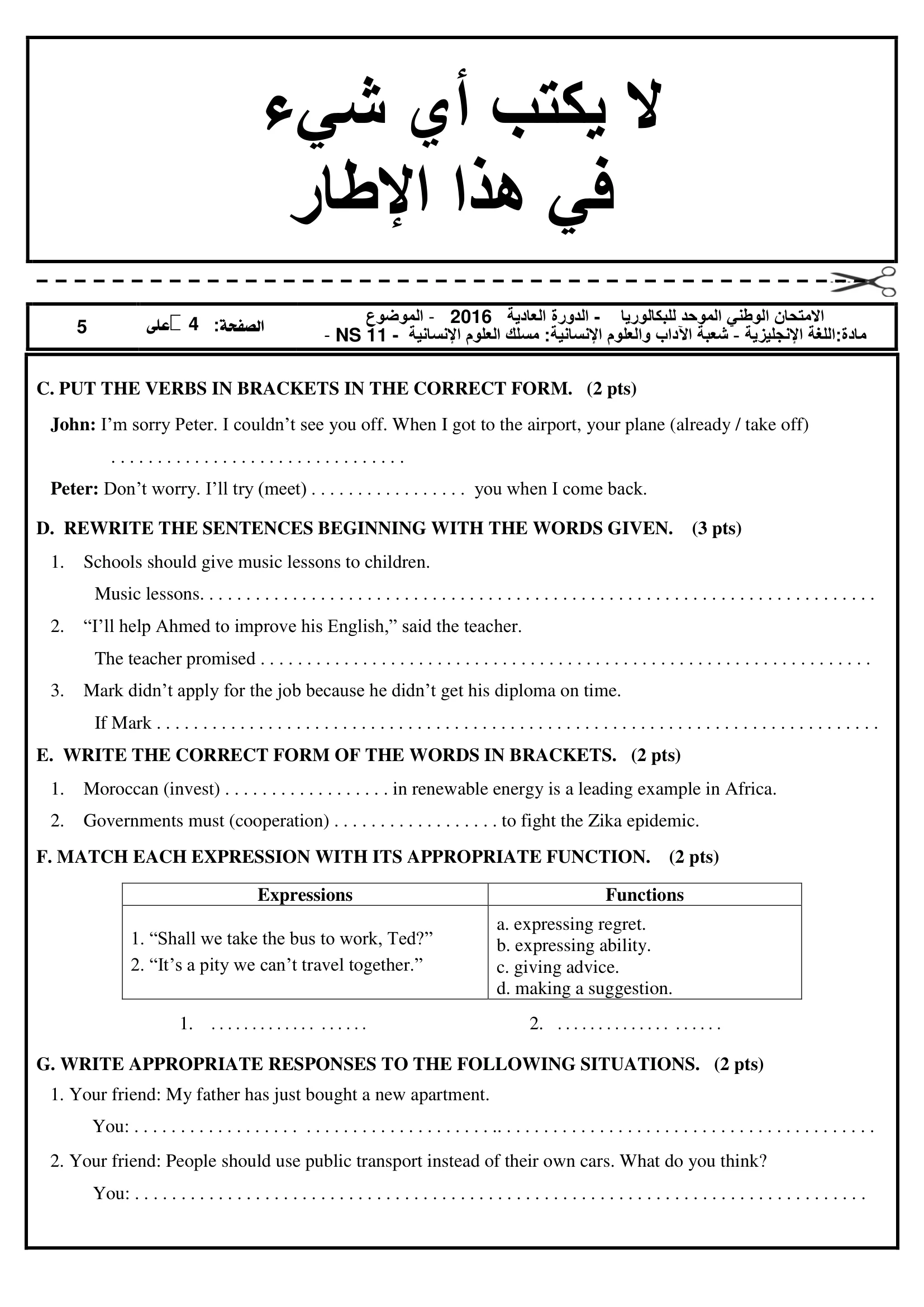
C. Put the verbs in brackets in the correct form. (2 pts)
- John: … When I got to the airport, your plane (already / take off) ………….
- Peter: Don’t worry. I’ll try (meet) ………… you when I come back.
D. Rewrite the sentences beginning with the words given. (3 pts)
- Schools should give music lessons to children.
Music lessons … - “I’ll help Ahmed to improve his English,” said the teacher.
The teacher promised … - Mark didn’t apply for the job because he didn’t get his diploma on time.
If Mark …
E. Write the correct form of the words in brackets. (2 pts)
- Moroccan (invest) ………… in renewable energy is a leading example in Africa.
- Governments must (cooperation) ………… to fight the Zika epidemic.
F. Match each expression with its appropriate function. (2 pts)
a. expressing regret – b. expressing ability – c. giving advice – d. making a suggestion
- “Shall we take the bus to work, Ted?”
- “It’s a pity we can’t travel together.”
G. Write appropriate responses to the following situations. (2 pts)
- Your friend: My father has just bought a new apartment.
You: … - Your friend: People should use public transport instead of their own cars. What do you think?
You: …
III. Writing (10 points)
Task 1 (4 pts)
Complete the following email: “Hi Jane, You said you’re looking for a good place to spend your holiday. Well, I advise you to visit Morocco for the following reasons. First, … I hope you can make it. You’ll certainly enjoy your stay here. Take care.”
following reasons. First, …
Task 2 (6 pts)
One of your teachers has helped you a lot with your studies. Write a thank-you letter to him/her and explain how he/she has helped you. (Start: “Dear teacher,”)
Paper: Baccalaureate national exam, Regular session 2016, Ministry of National Education (CNEE). Interactive version by ILENG.