
2 Bac English national exam 2019, make-up session (Humanities): paper and answers
The official paper, as it is. Answer directly on the sheet: tap True or False, write on the dotted lines, choose your answer. The correction and your mark appear at the end.
Take care of = look after (an elderly person).
Break down (a car) = stop working.
Practise a sport = do a sport; after who you need a verb.
Take special vitamins = take special vitamins (supplements).
Pay attention to = be careful about, notice.
Health problems = problems with your health.
After look for more, you need a noun: autonomy (independence).
After It is, you need an adjective that describes the thing: interesting.
The time = a moment: when.
Decide to + base form: decided to give.
In 2016 = a past date: past simple (married).
An action before another past action (before Albert married): past perfect (had worked / had been working).
By the end of next August: future perfect (will have produced).
Passive in the present simple: are + past participle (offered).
Third conditional: If + past perfect, would/could have + past participle.

I think … = giving your opinion.
You should … = giving advice.
Would you like me to …? = offering help (an offer).
I’m awfully sorry … = apologising.
The answer is “Great idea!”: your friend makes a suggestion (Why don’t we …? / Let’s … / How about …?) about Essaouira.
Your friend gives an opinion: agree (I agree …) or disagree (I don’t agree …) with a reason.
Last summer, I joined a local association in my town as a volunteer, and it was one of the best experiences of my life.
First, I took part in a campaign to clean our neighbourhood. With other young volunteers, we collected rubbish, painted the walls of the primary school and planted trees in the streets. Then, during the school year, I helped children from poor families with their homework twice a week, especially in English and French.
Our work helped the community in many ways. The neighbourhood became cleaner and more beautiful, and the children improved their marks at school. Their parents were very grateful, and other people started to join us.
I also benefited a lot from this experience. I learnt to work in a team, to be patient and to take responsibility. I made new friends and I became more confident. Above all, I understood that we can change things around us if we work together.
I encourage all students to try voluntary work. It is a real act of good citizenship!
Paper: Baccalaureate national exam, Make-up session 2019, Ministry of National Education (CNEE). Interactive version by ILENG.
My mark
Estimated mark: answers corrected with the official answer key, writing corrected automatically with the official grid.
Your mistakes, one by one
Tap a mistake to see the correction.
No mistakes. Excellent work!
The paper as textText, questions and writing tasks of the exam, to read or copy.
Paper of the baccalaureate English national exam (2 Bac), Make-up session 2019, Humanities stream (RS 11). Topic of the text: Culture shock: students abroad tell their stories (Culture shock: students abroad tell their stories). The answers and the mark appear when you finish the exam above.
English national exam 2019, make-up session – RS 11
Reading text: Culture shock: students abroad tell their stories
[1] Leaving home to study or work in another country can be a difficult experience. Such an experience is often referred to as culture shock. This phenomenon describes the impact of moving from a familiar culture to one that is unfamiliar.
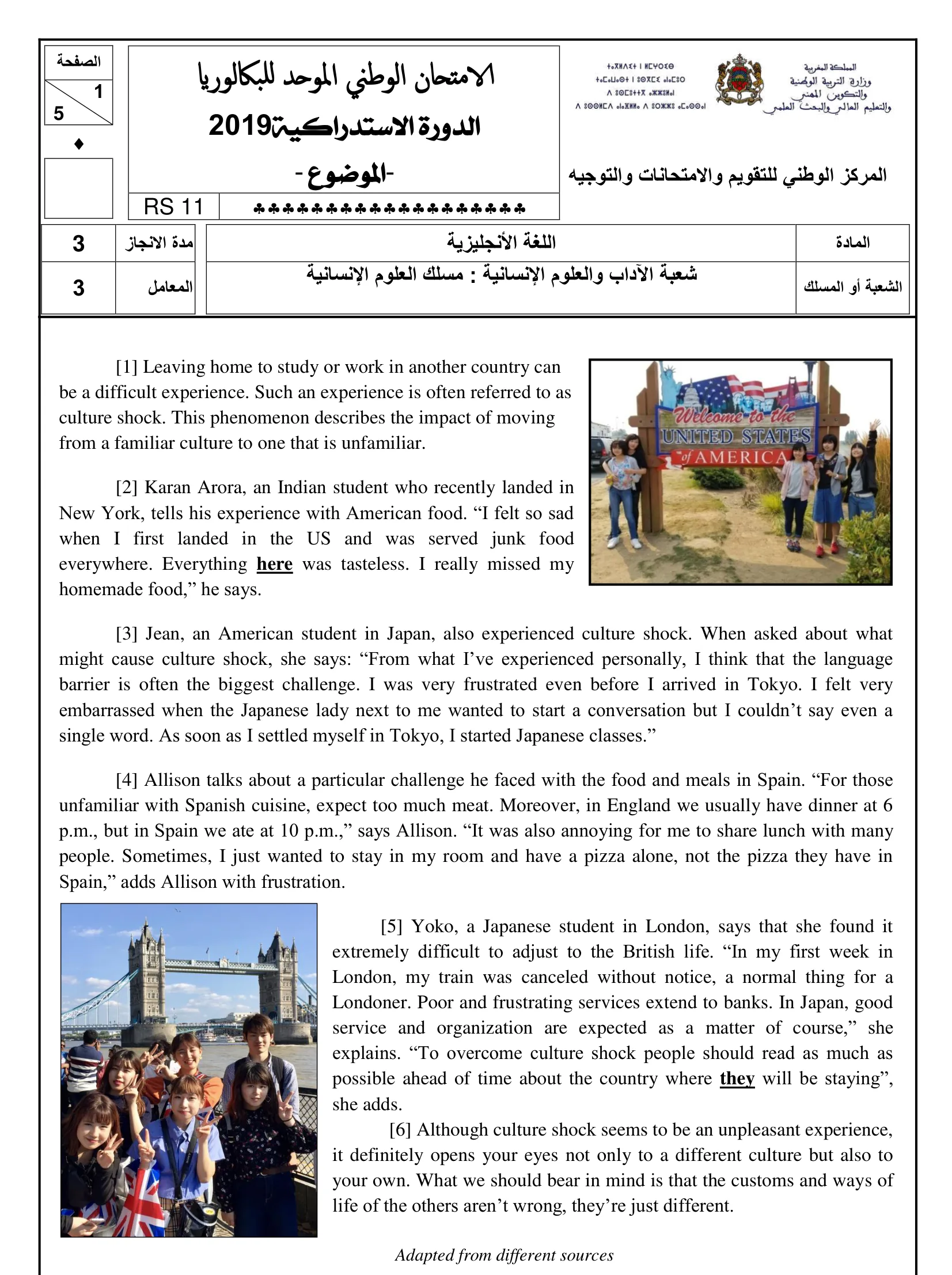
[2] Karan Arora, an Indian student who recently landed in New York, tells his experience with American food. “I felt so sad when I first landed in the US and was served junk food everywhere. Everything here was tasteless. I really missed my homemade food,” he says.
[3] Jean, an American student in Japan, also experienced culture shock. When asked about what might cause culture shock, she says: “From what I’ve experienced personally, I think that the language barrier is often the biggest challenge. I was very frustrated even before I arrived in Tokyo. I felt very embarrassed when the Japanese lady next to me wanted to start a conversation but I couldn’t say even a single word. As soon as I settled myself in Tokyo, I started Japanese classes.”
[4] Allison talks about a particular challenge he faced with the food and meals in Spain. “For those unfamiliar with Spanish cuisine, expect too much meat. Moreover, in England we usually have dinner at 6 p.m., but in Spain we ate at 10 p.m.,” says Allison. “It was also annoying for me to share lunch with many people. Sometimes, I just wanted to stay in my room and have a pizza alone, not the pizza they have in Spain,” adds Allison with frustration.
[5] Yoko, a Japanese student in London, says that she found it extremely difficult to adjust to the British life. “In my first week in London, my train was canceled without notice, a normal thing for a Londoner. Poor and frustrating services extend to banks. In Japan, good service and organization are expected as a matter of course,” she explains. “To overcome culture shock people should read as much as possible ahead of time about the country where they will be staying”, she adds.
[6] Although culture shock seems to be an unpleasant experience, it definitely opens your eyes not only to a different culture but also to your own. What we should bear in mind is that the customs and ways of life of the others aren’t wrong, they’re just different.
Adapted from: different sources
I. Comprehension (15 points)
A. Are these statements true or false? Justify. (3 pts)
- Allison likes the Spanish pizza.
- Yoko is not satisfied with the banking service in London.
- The writer thinks that some cultures are better than others.
B. Answer these questions. (4 pts)
- How does Karan find American food?
- Why couldn’t Jean talk with the lady on the plane?
- What is the difference between English and Spanish dinner time?
- What is Yoko’s advice to people who will move to a different country?
C. Complete these sentences with information from the text. (3 pts)
- To overcome her culture shock, Jean. …
- In London, passengers don’t complain …
- The positive thing about culture shock is …
D. Find in the text words that mean almost the same as (3 pts)
- arrived (paragraph 2) : …
- obstacle (paragraph 3) : …
- adapt (paragraph 5) : …
E. What do the underlined words in the text refer to? (2 pts)
- here (paragraph 2): …
- they (paragraph 5): …
II. Language (15 points)
A. Fill in the gaps with the appropriate phrases from the lists. (1 pt)
- We are looking for an experienced nurse to ………… our grandmother.
a. take care of – b. bring up – c. look for - Jane’s car rarely ………… although it is a very old one.
a. brings about – b. breaks up – c. breaks down
B. Fill in the gaps with the appropriate words from the list. (2 pts)
make – health – vitamins – sick – attention – practise – body
- People who ………… some sports, like body building, …
- … often take special ………… to make their bodies look more attractive.
- Doctors say that sportsmen should pay more ………… to the amount of supplements they use …
- … in order to avoid serious ………… problems.
C. Write the correct form of the words in brackets. (1 pt)
- As children grow up, they look for more (autonomous) ………… ; they want to make their own
- It is (interest) ………… to have friends from different cultures.
D. Fill in each gap with an appropriate word from the lists. (2 pts)
- Summer is the time ………… most people go on vacation.
a. which – b. when – c. where - The national football coach decided ………… a press conference before the match.
a. giving – b. give – c. to give
E. Put the verbs in brackets in the correct tense. (3 pts)
- Before Albert (marry) ………… Karen in 2016, …
- … they (work) ………… together as volunteers in many countries for about 6 years.
- By the end of next August they (produce) ………… a documentary about their experience.
F. Rewrite the sentences beginning with the words given. (2 pts)
- The supermarket offers interesting discounts to new customers.
Interesting discounts … - Anwar could not answer all the questions because he did not manage his time well.
If Anwar had managed his time well, …
G. Match each expression with its appropriate function. (2 pts)
a. asking for opinion – b. making an offer – c. expressing opinion – d. giving advice – e. apologizing
- “I think electric cars will reduce pollution.”
- “You should check the departure time before buying the ticket.”
- “Would you like me to help you with the birthday cake?”
- “I’m awfully sorry, I broke your phone.”
H. Complete the following exchanges appropriately. (2 pts)
- Your friend: … – You: Great idea! I have always wanted to see Essaouira.
- Your friend: I think we should ask our teacher to give us less homework.
You: …
III. Writing (10 points)
Task 1 (4 pts)
Complete the following paragraph about your childhood: “I can remember a lot of good things about my childhood. One of the best stories I can remember is …”
I can remember a lot of good things about my childhood. One of the best stories I can remember is …
Task 2 (6 pts)
Many young people participate in voluntary work as an act of good citizenship. Write an article for your school magazine about your experience in voluntary work. What did you do? How did you help the community? How did you benefit from this experience?
Paper: Baccalaureate national exam, Make-up session 2019, Ministry of National Education (CNEE). Interactive version by ILENG.