
Examen national anglais 2 Bac 2018, session de rattrapage (lettres) : sujet et corrigé
Le sujet officiel, tel quel. Répondez directement sur la copie : touchez True ou False, écrivez sur les pointillés, choisissez votre réponse. La correction et votre note s’affichent à la fin.


Le texte raconte surtout comment Jan et Brian ont créé WhatsApp et réussi.
Coordonné avec le nom unemployment : il faut un nom, illiteracy.
Devant le nom issues : un adjectif, universal.
Devant le nom assistance : un adjectif, financial.
Devant development : un adjectif, sustainable (durable).
How about + verbe en -ing : How about going …?
Collocation : make an effort.
Possession (son père à elle) : whose father.
Fill in a form = remplir un formulaire.
In three months’ time : événement futur prévu (is taking place / will take place).
Today, action en cours : présent continu (is reading).
Last night : prétérit (started).
Action antérieure (after) : plus-que-parfait (had finished).
Regret sur le passé : conditionnel 3, if + had had …, would/could have responded.
Passif au futur : will be + participe passé (will be used).
Discours rapporté : I → she, my → her, left → had left.

I am sorry to say this but … = se plaindre.
Could you explain it, please? = demander une clarification.
I’m glad I passed … = annoncer une bonne nouvelle.
I don’t share the same opinion … = exprimer son désaccord.
Votre ami a un problème : donnez un conseil (You should … / Why don’t you …?).
Une bonne nouvelle : félicitez (Congratulations! / Well done!).
In many societies, more and more teenagers are committing crimes such as theft, violence and drug dealing. This is a worrying problem, and it has several causes.
First, family problems play a big role. When parents divorce, fight all the time or do not pay attention to their children, teenagers feel lonely and look for attention outside the home.
Second, poverty and unemployment push some young people to steal or sell drugs to get money quickly. Many of them also drop out of school, so they have a lot of free time and no hope for the future.
Third, bad friends can have a strong influence. A teenager may start smoking, taking drugs or fighting just to be accepted by a group.
Finally, violent films and video games can make violence look normal and exciting.
To conclude, juvenile crime has many causes, and families, schools and the government must work together to protect young people.

Sujet : Examen national du baccalauréat, Session de rattrapage 2018, Ministère de l’Éducation nationale (CNEE). Version interactive ILENG.
Ma note
Note estimée : réponses corrigées avec le corrigé officiel, writing corrigé automatiquement avec la grille officielle.
Vos erreurs, une par une
Touchez une erreur pour voir la correction.
Aucune erreur. Excellent travail !
Le sujet en version texteTexte, questions et sujets de writing de l’examen, à lire ou à copier.
Sujet de l’examen national d’anglais du baccalauréat (2e année Bac), Session de rattrapage 2018, Filière lettres (RS 10). Thème du texte : WhatsApp : l’histoire de ses fondateurs (WhatsApp: the story of its founders). Les réponses et la note s’affichent quand vous terminez l’examen ci-dessus.
English national exam 2018, make-up session – RS 10
Reading text: WhatsApp: the story of its founders
[1] WhatsApp is now the most used messaging application, especially among teenagers, surpassing Facebook, Skype and others. Nearly one billion people use WhatsApp nowadays.
[2] Teens are flocking to WhatsApp because it gives them the privacy and freedom to exchange any messages they want with whoever they want. “On WhatsApp, I usually feel that I am not being judged, particularly because there isn’t any eye contact or physical contact, only words and signs. So, I feel more intimacy and security. I expose myself more, but it isn’t embarrassing, maybe because I don’t see people’s physical reactions,” says Emily, a teenager from the USA.
[3] Jan Koum and Brian Acton are the founders of WhatsApp. Jan was not from a wealthy family. He stayed with his mother and grandmother in a small apartment. With his hard work, he finally got into San Jose State University where he took training in programming.
[4] Jan met his business partner Brian while he was working at Yahoo as an engineer. They worked together in Yahoo for almost nine years and then left the company together. Then they applied to Facebook, but they were not lucky. They had no plans to become rich until they thought of making an application for iPhone users.
[5] As the initial models failed, Jan was discouraged and was almost about to give up when Brian persuaded him to keep at it. They then created the app which received tremendous success in a very less time. This was because the users found it pretty easy to use and they do not need to register anywhere in order to use the application. After months of beta testing, WhatsApp was, finally, launched in the app store for iPhones in November, 2009. Jan chose the name WhatsApp because it sounded similar to the daily phrase, “What’s up”. This was the dream come true for both partners.
[6] Jan and Brian earned millions of dollars without any advertising on the application. They made money in two ways. They started charging iPhone users on first time installation and the Android users every year. A lot of people used the app and paid both of them. Reports state that around 250 million people use WhatsApp in a month. This is a huge number for any application to reach in the smartphone space.
[7] WhatsApp became popular in just a short amount of time, and this caught Facebook's attention. After several months of venture capital financing, Facebook declared that they were acquiring WhatsApp in February 2014. The deal went down for US $19 Billion. It was Facebook’s largest acquisition till then.
Adapted from: www.successstory.com and www.teensafe.com
I. Comprehension (15 points)
A. Choose the right answer. (1 pt)
The text is about / a. WhatsApp and teenagers. b. WhatsApp success story. c. WhatsApp disadvantages. / The right answer is
- The text is about …
a. WhatsApp and teenagers. – b. WhatsApp success story. – c. WhatsApp disadvantages.
B. Fill in the chart with information from the text. (2 pts)
| Year | Event |
|---|---|
| 2009 | ………… |
| 2014 | ………… |
C. Are these sentences true or false? Justify. (3 pts)
- Emily feels safer when she uses WhatsApp. .
- One of WhatsApp founders studied programming at university.
- Jan and his partner Brian worked for Facebook after leaving Yahoo.
D. Answer the following questions. (3 pts)
- How did Jan and Brian get to know each other?
- How did Jan and Brian make money from WhatsApp?
- Why did WhatsApp attract the attention of Facebook?
E. Complete the following sentences. (2 pts)
- The name of WhatsApp comes from. …
- Facebook paid …
F. Find in the text words that mean almost the same as (2 pts)
- convinced (paragraph 5): …
- large (paragraph 6): …
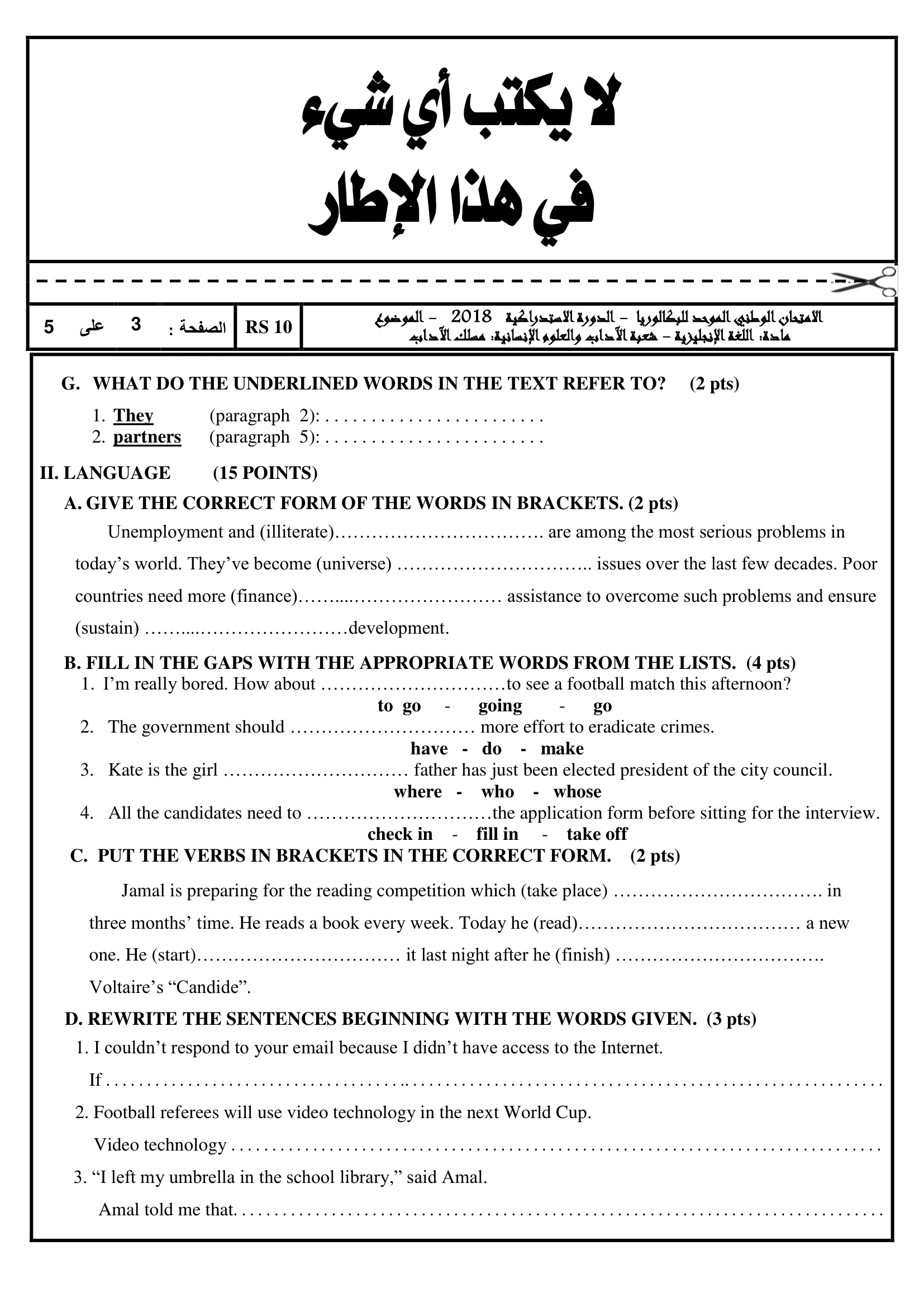
G. What do the underlined words in the text refer to? (2 pts)
- They (paragraph 2): …
- partners (paragraph 5): …
II. Language (15 points)
A. Give the correct form of the words in brackets. (2 pts)
- Unemployment and (illiterate) ………… are among the most serious problems in today’s world.
- They’ve become (universe) ………… issues over the last few decades.
- Poor countries need more (finance) ………… assistance to overcome such problems …
- … and ensure (sustain) ………… development.
B. Fill in the gaps with the appropriate words from the lists. (4 pts)
- I’m really bored. How about ………… to see a football match this afternoon?
a. to go – b. going – c. go - The government should ………… more effort to eradicate crimes.
a. have – b. do – c. make - Kate is the girl ………… father has just been elected president of the city council.
a. where – b. who – c. whose - All the candidates need to ………… the application form before sitting for the interview.
a. check in – b. fill in – c. take off
C. Put the verbs in brackets in the correct form. (2 pts)
- Jamal is preparing for the reading competition which (take place) ………… in three months’ time.
- He reads a book every week. Today he (read) ………… a new one.
- He (start) ………… it last night …
- … after he (finish) ………… Voltaire’s “Candide”.
D. Rewrite the sentences beginning with the words given. (3 pts)
- I couldn’t respond to your email because I didn’t have access to the Internet.
If … - Football referees will use video technology in the next World Cup.
Video technology … - “I left my umbrella in the school library,” said Amal.
Amal told me that. …
E. Match each expression to its appropriate function. (2 pts)
Expressions Functions
- “I am sorry to say this but the music is so loud. ” a. asking for clarification
- “I don’t understand this word. Could you explain it, please?” b. making a complaint
- “I’m glad I passed the exam. ” c. expressing disagreement
- “I don’t share the same opinion about the causes of global warming. ” d. expressing good news
F. Write an appropriate response to each situation? (2 pts)
- Your friend: “I’m really addicted to Facebook. I can’t stop using it. ”
You: … - Your friend: “I got excellent marks in the national Baccalaureate exam. ”
You: …
III. Writing (10 points)
Task 1 (6 pts)
In some societies the number of crimes committed by teenagers is growing. Write an article for your school magazine explaining the causes of this problem.
Task 2 (4 pts)
Respond to your friend’s questions: “What are your plans for the future? What are you going to do after you get your Bac?”
After getting my Bac, I …
Sujet : Examen national du baccalauréat, Session de rattrapage 2018, Ministère de l’Éducation nationale (CNEE). Version interactive ILENG.