
Examen national anglais 2 Bac 2020, session normale (lettres) : sujet et corrigé
Le sujet officiel, tel quel. Répondez directement sur la copie : touchez True ou False, écrivez sur les pointillés, choisissez votre réponse. La correction et votre note s’affichent à la fin.
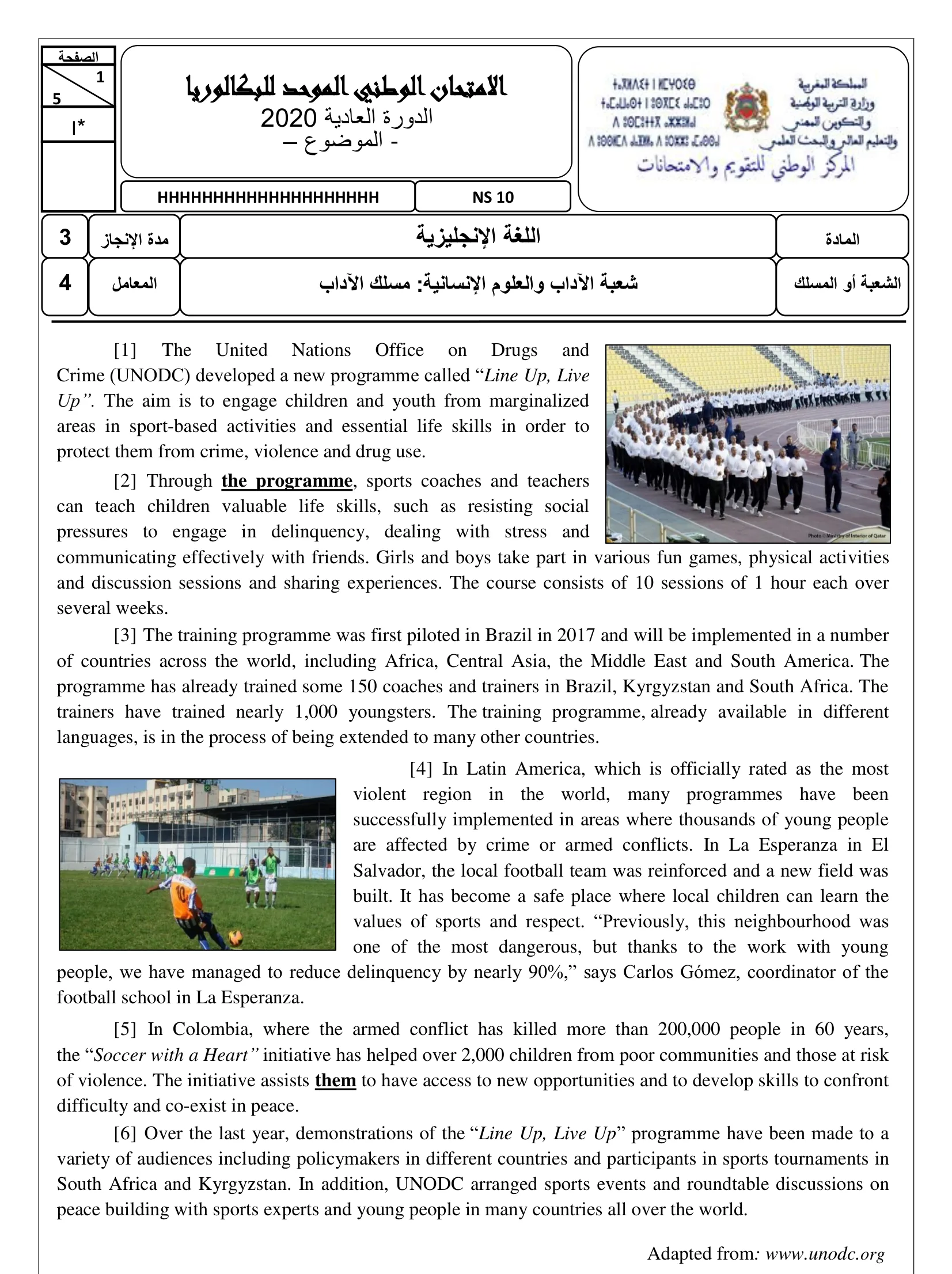
Tout le texte parle de programmes sportifs qui protègent les jeunes de la violence et du crime.

Famous for = célèbre pour.
A garden est un lieu et la phrase après est complète : where.
Turn down the music = baisser le son (c’est trop fort).
Capacité dans le passé : could see.
A real challenge = un vrai défi.
Empower women = donner plus de pouvoir et d’autonomie aux femmes.
Collocation : social media apps.
Public and private businesses = entreprises publiques et privées.
Devant le nom programmes : un adjectif, cultural.
Après the importance of adult il faut un nom : literacy (alphabétisation).
Action en cours interrompue (a power cut) : passé continu (were watching).
Action antérieure à « we got » : plus-que-parfait (had already started).
Last night : prétérit (called).
By the end of 2020 : futur antérieur (will have developed).

Passif au present perfect : have been + participe passé.
Advise someone to + verbe : advised me to go on a diet.
Despite + nom ou verbe en -ing (despite being cheap) ou + the fact that + phrase.
On commence par attirer l’attention du serveur : Excuse me!
Le serveur répond et propose son aide.
Le client se plaint de l’erreur.
Le serveur s’excuse et corrige.
Nancy demande un conseil : You should … / Why don’t you …?
On donne son opinion : In my opinion, … / I think …

I hope you are well. Last weekend, I attended my cousin’s wedding in Fez, and I want to tell you all about it because it was amazing.
The ceremony took place on Saturday evening in a big, beautiful hall. More than two hundred guests came, including family, neighbours and friends. Everybody wore traditional clothes: the women wore colourful caftans and the men wore white djellabas.
The bride changed her dress several times during the night, and each dress represented a different region of Morocco. At one moment, she was carried on a decorated chair called an “amaria” while everyone sang and clapped. A traditional band played chaabi and Andalusian music, and we danced until early morning.
The food was delicious. We had chicken with olives, pastilla, fruit and Moroccan pastries with mint tea. Guests also brought gifts for the couple.
I really wish you had been there. Maybe next summer you can come and see a Moroccan wedding yourself!
Sujet : Examen national du baccalauréat, Session normale 2020, Ministère de l’Éducation nationale (CNEE). Version interactive ILENG.
Ma note
Note estimée : réponses corrigées avec le corrigé officiel, writing corrigé automatiquement avec la grille officielle.
Vos erreurs, une par une
Touchez une erreur pour voir la correction.
Aucune erreur. Excellent travail !
Le sujet en version texteTexte, questions et sujets de writing de l’examen, à lire ou à copier.
Sujet de l’examen national d’anglais du baccalauréat (2e année Bac), Session normale 2020, Filière lettres (NS 10). Thème du texte : Le sport contre la délinquance : « Line Up, Live Up » (Sport against crime: “Line Up, Live Up”). Les réponses et la note s’affichent quand vous terminez l’examen ci-dessus.
English national exam 2020, normal session – NS 10
Reading text: Sport against crime: “Line Up, Live Up”
[1] The United Nations Office on Drugs and Crime (UNODC) developed a new programme called “Line Up, Live Up”. The aim is to engage children and youth from marginalized areas in sport-based activities and essential life skills in order to protect them from crime, violence and drug use.
[2] Through the programme, sports coaches and teachers can teach children valuable life skills, such as resisting social pressures to engage in delinquency, dealing with stress and communicating effectively with friends. Girls and boys take part in various fun games, physical activities and discussion sessions and sharing experiences. The course consists of 10 sessions of 1 hour each over several weeks.
[3] The training programme was first piloted in Brazil in 2017 and will be implemented in a number of countries across the world, including Africa, Central Asia, the Middle East and South America. The programme has already trained some 150 coaches and trainers in Brazil, Kyrgyzstan and South Africa. The trainers have trained nearly 1,000 youngsters. The training programme, already available in different languages, is in the process of being extended to many other countries.
[4] In Latin America, which is officially rated as the most violent region in the world, many programmes have been successfully implemented in areas where thousands of young people are affected by crime or armed conflicts. In La Esperanza in El Salvador, the local football team was reinforced and a new field was built. It has become a safe place where local children can learn the values of sports and respect. “Previously, this neighbourhood was one of the most dangerous, but thanks to the work with young people, we have managed to reduce delinquency by nearly 90%,” says Carlos Gómez, coordinator of the football school in La Esperanza.
[5] In Colombia, where the armed conflict has killed more than 200,000 people in 60 years, the “Soccer with a Heart” initiative has helped over 2,000 children from poor communities and those at risk of violence. The initiative assists them to have access to new opportunities and to develop skills to confront difficulty and co-exist in peace.
[6] Over the last year, demonstrations of the “Line Up, Live Up” programme have been made to a variety of audiences including policymakers in different countries and participants in sports tournaments in South Africa and Kyrgyzstan. In addition, UNODC arranged sports events and roundtable discussions on peace building with sports experts and young people in many countries all over the world.
Adapted from: www.unodc.org
I. Comprehension (15 points)
A. Choose the right answer. (1 pt)
The text is about / a. introducing sport programmes in Latin America. / b. training programmes for football coaches. / c. reducing violence through sport programmes. / The right answer is
- The text is about …
a. introducing sport programmes in Latin America. – b. training programmes for football coaches. – c. reducing violence through sport programmes.
B. Are these sentences true or false? Justify. (3 pts)
- The “Line Up, Live Up” programme was introduced by UNODC.
- The aim of the “Line Up, Live Up” programme is to teach children school subjects.
- The programme was first tested in El Salvador.
C. Answer the following questions. (3 pts)
- Which areas are targeted by the “Line Up, Live Up” programme?
- In addition to sport, what other activities do children do in the “Line Up, Live Up” programme?
- How did the football team in La Esperanza benefit from the programme?
D. Complete the following sentences. (2 pts)
- Many people were killed in Colombia due to. …
- The objective of the “Soccer with a Heart” initiative is to …
E. Pick out from the text phrases or expressions which show that (2 pts)
- Thanks to the programme, La Esperanza has become less dangerous. ( paragraph 4): …
- Politicians and officials in many countries were interested in the “Line Up, Live Up” programme.
F. Find in the text words that mean almost the same as (2 pts)
- participate (paragraph 2): …
- competitions (paragraph 6): …
G. What do the underlined words in the text refer to? (2 pts)
- the programme (paragraph 2): …
- them (paragraph 5): …
II. Language (15 points)
A. Fill in the gaps with the correct words from the lists. (2 pts)
- Venice is an Italian city which is famous ………… its canals.
a. about – b. for – c. with - They have a very large garden ………… kids can play safely.
a. where – b. who – c. which - Could you ………… the music? It’s too loud.
a. turn on – b. turn down – c. turn round - When we arrived at the top of the mountain, we ………… see the whole city.
a. must – b. can – c. could
B. Fill in the gaps with the appropriate words from the list. (2 pts)
empower - private - access - media - justice - challenge - education
- Finding a job is a real ………… for many young people all over the world.
- Many associations are implementing projects to ………… women, especially in rural areas.
- Smart phones have facilitated communication through social ………… apps.
- Nowadays, more and more public and ………… businesses use cameras for safety reasons.
C. Put the words in brackets in the correct form. (2 pts)
- ‘Culture for All’ is an organisation which helps the government to implement (culture) ………… programmes.
- It also sensitizes citizens to the importance of adult (literate) ………….
D. Put the verbs in brackets in the correct tense. (2 pts)
- There was a power cut while we (watch) ………… a film on TV last night.
- When we got to the theatre, the play (already/ start) …
- I (call) ………… Roger at nine last night, but he wasn’t at home.
- I think by the end of 2020, scientists (develop) ………… a vaccine for
E. Rewrite the sentences as indicated. (3 pts)
- They have invited many African ministers to the conference.
Many African ministers … - “If I were you, I’d go on a diet,” Ahmed told me.
Ahmed advised me. … - The hotel was cheap but it was comfortable.
Despite …
F. Put the following exchange in the correct order. (2 pts)
a. Yes sir, how can I help you? – b. I ordered a pizza, not a hamburger. – c. I’m sorry, I’ll change it. – d. Excuse me!
- You: …
- Waiter: …
- You: …
- Waiter: …
G. Complete the following exchanges appropriatly. (2 pts)
- Nancy: I have just lost all my personal documents on the bus. What should I do?
Emma: … - James: Who is the most famous comedian in Morocco, in your opinion?
Jamal: …
III. Writing (10 points)
Task 1 (4 pts)
Complete the following paragraph: “There are many things we can do to be good citizens. For example, we … Besides, … Furthermore, … Finally, …”
There are many things we can do to be good citizens. For example, we …
Task 2 (6 pts)
Write an email to your English friend describing a Moroccan wedding ceremony you have attended recently. These cues may help you: time / place / guests / clothes / activities / habits / traditions / food / gifts / music, etc. (Do not write your name or sign the email.)
Dear …
Sujet : Examen national du baccalauréat, Session normale 2020, Ministère de l’Éducation nationale (CNEE). Version interactive ILENG.