
Examen national anglais 2 Bac 2026, session normale (lettres) : sujet et corrigé
Le sujet officiel, tel quel. Répondez directement sur la copie : touchez True ou False, écrivez sur les pointillés, choisissez votre réponse. La correction et votre note s’affichent à la fin.


Hope + to + verbe (infinitif) : Adam hopes to pursue his education.
Get over = surmonter (get over stress). Carry on = continuer ; get away = s’échapper, partir.
Boost = stimuler, augmenter : le programme veut stimuler la création d’emplois.
Affordable loans = des prêts abordables, pour financer (fund) les projets.
Après l’adjectif economic et avant le verbe has improved, il faut un nom : independence.
Avant le nom societies, il faut un adjectif : prosperous (prospère).
Action antérieure à une autre action passée (started) : plus-que-parfait, had + participe passé → had taken (took est aussi possible avec « before »).
By 2030 : action terminée avant un moment futur → futur antérieur, will have + participe passé.
Passif au present perfect : have/has been + participe passé → have been renovated (monuments = pluriel).
Discours indirect : will → would ; the official promised (that) the government would make …
Conditionnel type 3 (regret sur le passé) : If + plus-que-parfait, would (not) have + participe passé.
Despite + nom ou verbe en -ing (pas de sujet + verbe) : Despite facing … / Despite the challenges … / Despite the fact that + phrase.

C’est une mauvaise nouvelle : on exprime la compassion (I’m sorry to hear that!).
Le client se plaint : l’agent s’excuse (My apologies!).
Pour donner son opinion : In my opinion, … / I think … / As far as I’m concerned, … + une raison.
L’ami réagit : il est d’accord (I agree with you.), pas d’accord (I’m afraid I disagree.) ou en partie (I partly agree, but …).
School should be a safe and happy place, but many students in our school face serious problems every day.
The first problem is stress. Students have long timetables, a lot of homework and many exams, especially in the Baccalaureate year. Many of them sleep badly and feel anxious all the time. The second problem is bullying. Some students laugh at others because of their appearance, their clothes or their marks, and some even bully them online. Finally, there are conflicts between students, and sometimes between students and teachers, because of a lack of communication and respect.
To solve these problems, our school can take some simple steps. First, teachers can organize their tests better and teach us how to plan our revision, so we feel less stressed. Second, the school should have a listening cell with a counsellor where students can talk about their problems in confidence. Third, we can organize awareness campaigns against bullying and clear rules to punish bullies. Finally, clubs, sports and group activities can help students know each other better and solve their conflicts peacefully.
If students, teachers and parents work together, our school can become a place where everyone feels safe, respected and happy to learn.
Sujet : Examen national du baccalauréat, Session normale 2026, Ministère de l’Éducation nationale (CNEE). Version interactive ILENG.
Ma note
Note estimée : réponses corrigées avec le corrigé officiel, writing corrigé automatiquement avec la grille officielle.
Vos erreurs, une par une
Touchez une erreur pour voir la correction.
Aucune erreur. Excellent travail !
Le sujet en version texteTexte, questions et sujets de writing de l’examen, à lire ou à copier.
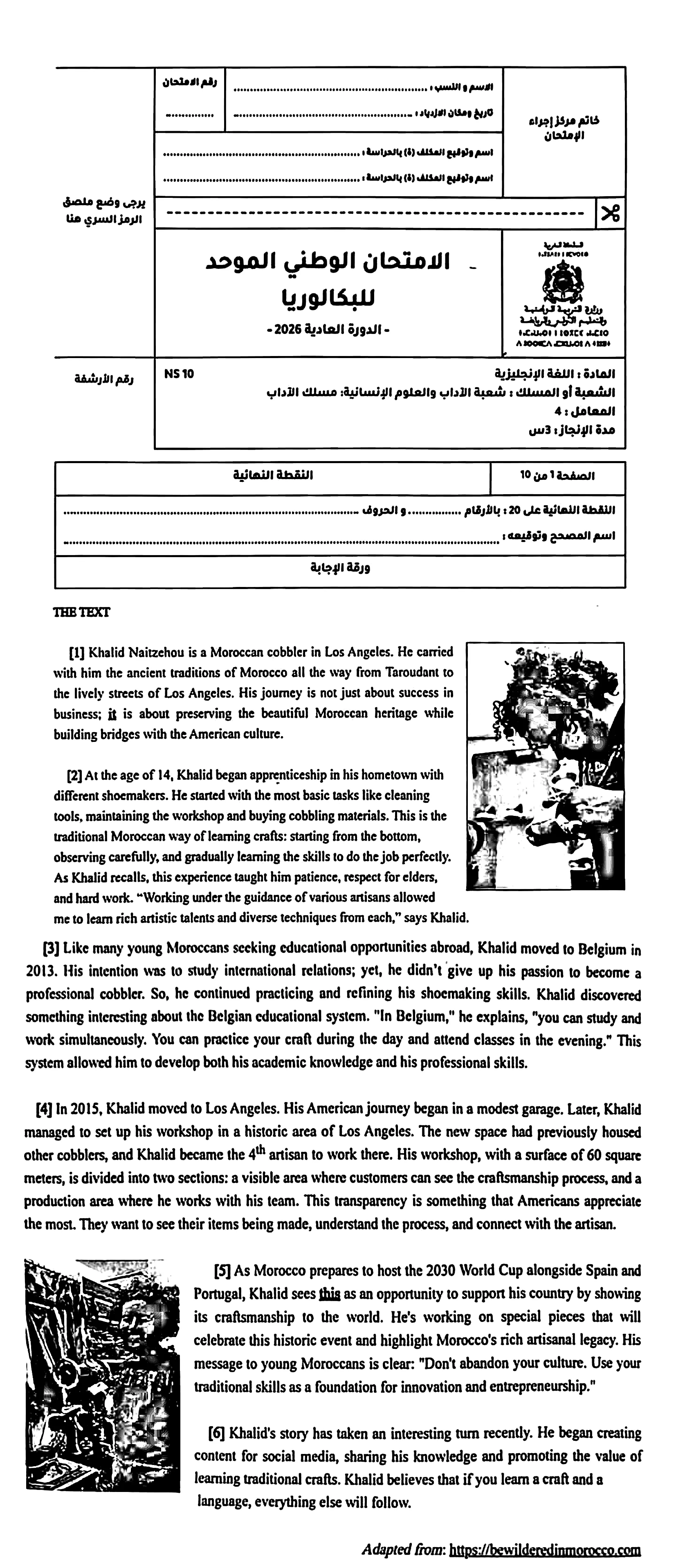
Sujet de l’examen national d’anglais du baccalauréat (2e année Bac), Session normale 2026, Filière lettres (NS 10). Thème du texte : Khalid, un cordonnier marocain à Los Angeles (Khalid, a Moroccan cobbler in Los Angeles). Les réponses et la note s’affichent quand vous terminez l’examen ci-dessus.
English national exam 2026, normal session – NS 10
Reading text: Khalid, a Moroccan cobbler in Los Angeles
[1] Khalid Naitzehou is a Moroccan cobbler in Los Angeles. He carried with him the ancient traditions of Morocco all the way from Taroudant to the lively streets of Los Angeles. His journey is not just about success in business; it is about preserving the beautiful Moroccan heritage while building bridges with the American culture.
[2] At the age of 14, Khalid began apprenticeship in his hometown with different shoemakers. He started with the most basic tasks like cleaning tools, maintaining the workshop and buying cobbling materials. This is the traditional Moroccan way of learning crafts: starting from the bottom, observing carefully, and gradually learning the skills to do the job perfectly. As Khalid recalls, this experience taught him patience, respect for elders, and hard work. "Working under the guidance of various artisans allowed me to learn rich artistic talents and diverse techniques from each," says Khalid.
[3] Like many young Moroccans seeking educational opportunities abroad, Khalid moved to Belgium in 2013. His intention was to study international relations; yet, he didn't give up his passion to become a professional cobbler. So, he continued practicing and refining his shoemaking skills. Khalid discovered something interesting about the Belgian educational system. "In Belgium," he explains, "you can study and work simultaneously. You can practice your craft during the day and attend classes in the evening." This system allowed him to develop both his academic knowledge and his professional skills.
[4] In 2015, Khalid moved to Los Angeles. His American journey began in a modest garage. Later, Khalid managed to set up his workshop in a historic area of Los Angeles. The new space had previously housed other cobblers, and Khalid became the 4th artisan to work there. His workshop, with a surface of 60 square meters, is divided into two sections: a visible area where customers can see the craftsmanship process, and a production area where he works with his team. This transparency is something that Americans appreciate the most. They want to see their items being made, understand the process, and connect with the artisan.
[5] As Morocco prepares to host the 2030 World Cup alongside Spain and Portugal, Khalid sees this as an opportunity to support his country by showing its craftsmanship to the world. He's working on special pieces that will celebrate this historic event and highlight Morocco's rich artisanal legacy. His message to young Moroccans is clear: "Don't abandon your culture. Use your traditional skills as a foundation for innovation and entrepreneurship."
[6] Khalid's story has taken an interesting turn recently. He began creating content for social media, sharing his knowledge and promoting the value of learning traditional crafts. Khalid believes that if you learn a craft and a language, everything else will follow.
Adapted from: https://bewilderedinmorocco.com
I. Comprehension (15 points)
A. Choose the right answer. (1 pt)
- The main purpose of the writer is to:
a. show how Moroccan artisans make traditional shoes. – b. explain how Khalid emigrated to Belgium and then to America. – c. tell the story of an ambitious young Moroccan artisan.
B. Complete the chart with the right information from the text. (2 pts)
| Figures/Dates | What they refer to |
|---|---|
| The year Khalid moved to Los Angeles | ………… |
| 60 | ………… |
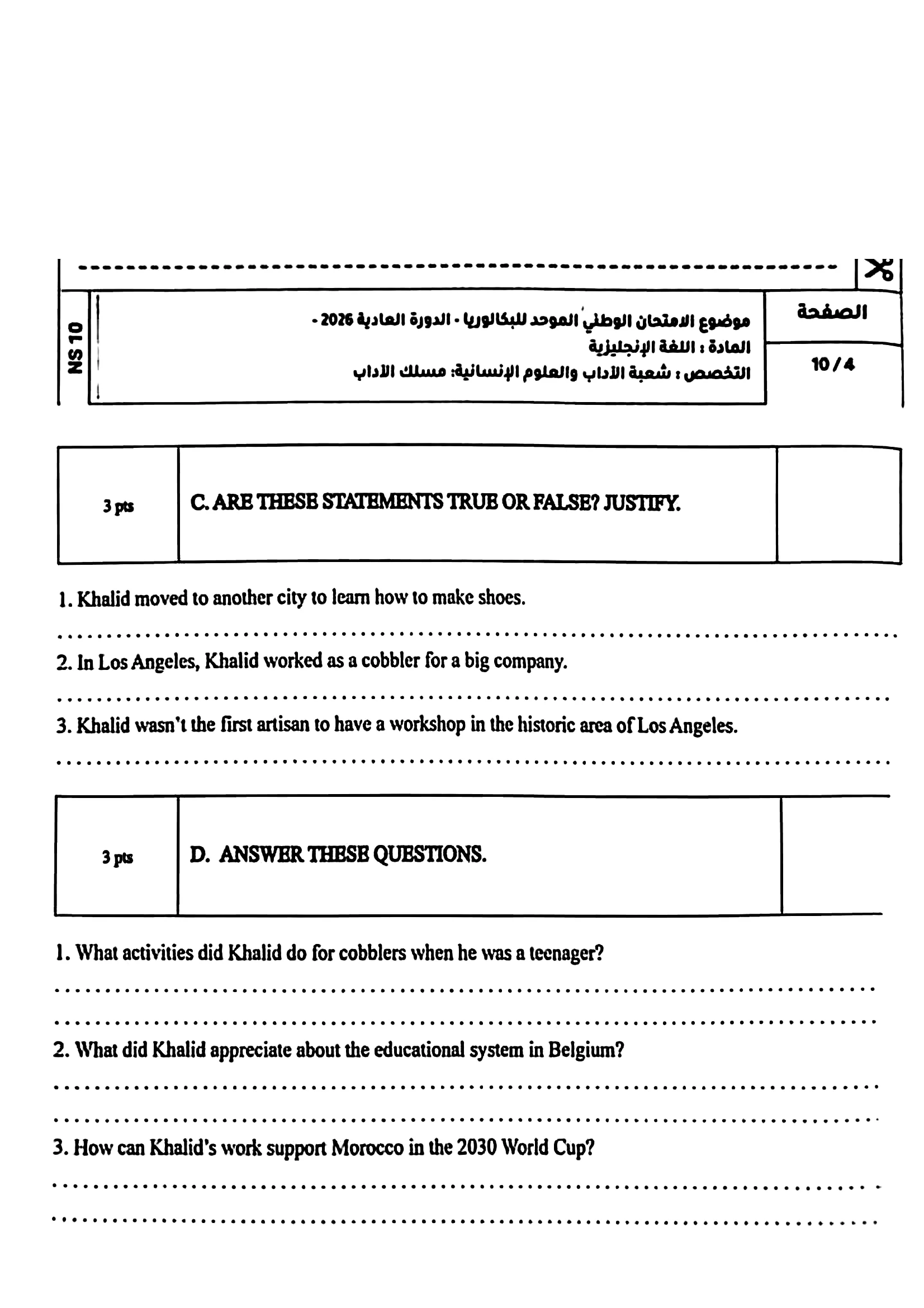
C. Are these statements true or false? Justify. (3 pts)
- Khalid moved to another city to learn how to make shoes.
- In Los Angeles, Khalid worked as a cobbler for a big company.
- Khalid wasn't the first artisan to have a workshop in the historic area of Los Angeles.
D. Answer these questions. (3 pts)
- What activities did Khalid do for cobblers when he was a teenager?
- What did Khalid appreciate about the educational system in Belgium?
- How can Khalid's work support Morocco in the 2030 World Cup?
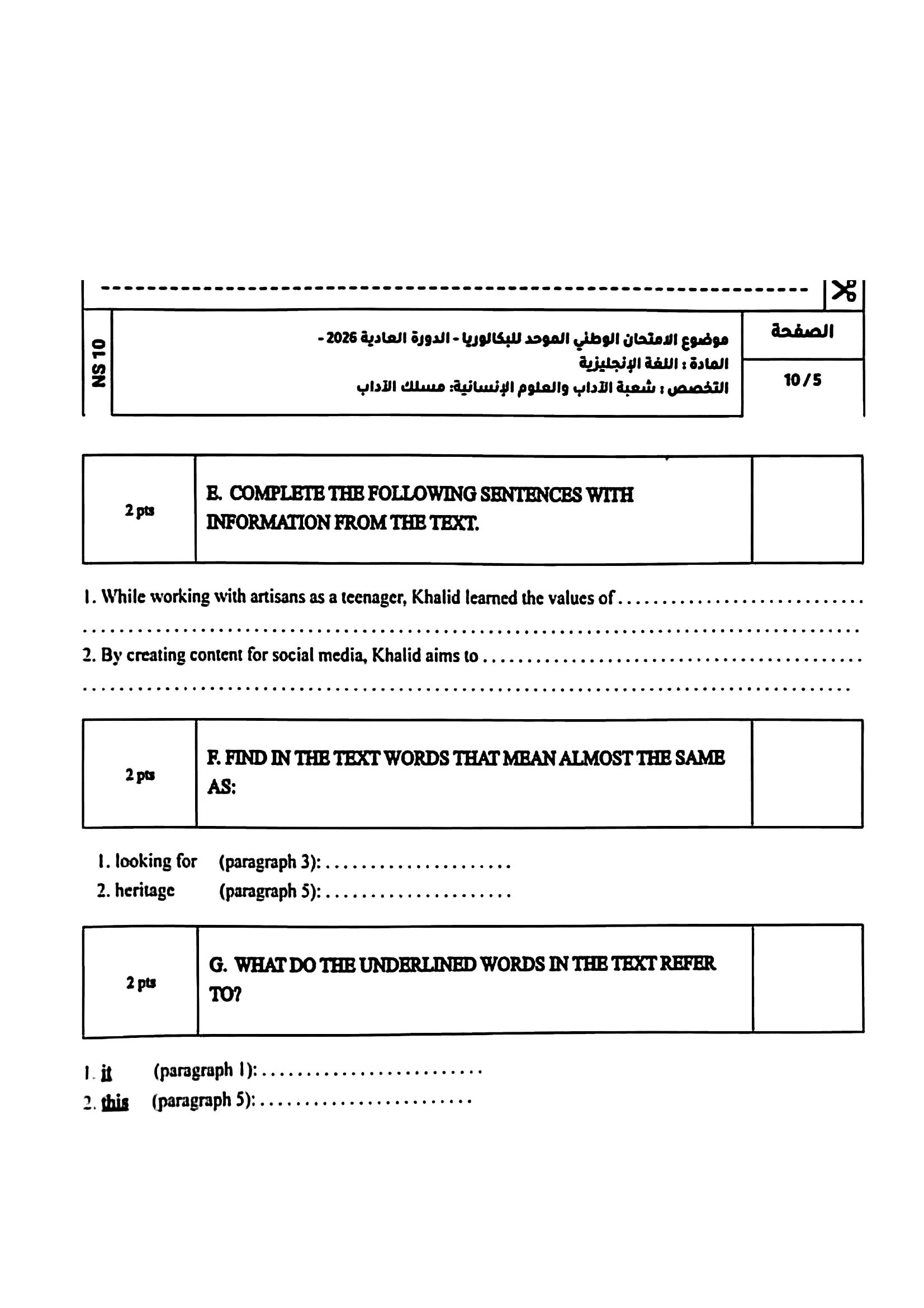
E. Complete the following sentences with (2 pts)
INFORMATION FROM THE TEXT.
- While working with artisans as a teenager, Khalid learned the values of …
- By creating content for social media, Khalid aims to …
F. Find in the text words that mean almost the same (2 pts)
- looking for (paragraph 3): …
- heritage (paragraph 5): …
G. What do the underlined words in the text refer to? (2 pts)
- it (paragraph 1)
- this (paragraph 5)
II. Language (15 points)
A. Fill in the gaps with the correct words from the lists. (2 pts)
- Adam hopes ………… his education in a university that values innovation and research.
a. pursuing – b. pursue – c. to pursue - Humor can help people ………… stress in their daily life.
a. get over – b. carry on – c. get away
B. Fill in the gaps with the correct words from the list. (1 pt)
regulation – reduce – loans – housing – boost
- The new government program seeks to ………… job creation through offering affordable … to small businesses to fund their projects.
- The new government program seeks to … job creation through offering affordable ………… to small businesses to fund their projects.
C. Put the words in brackets in the correct form. (2 pts)
- Women’s economic (independent) ………… has improved their social status, allowing them to help build … societies.
- Women’s economic … has improved their social status, allowing them to help build (prosper) ………… societies.
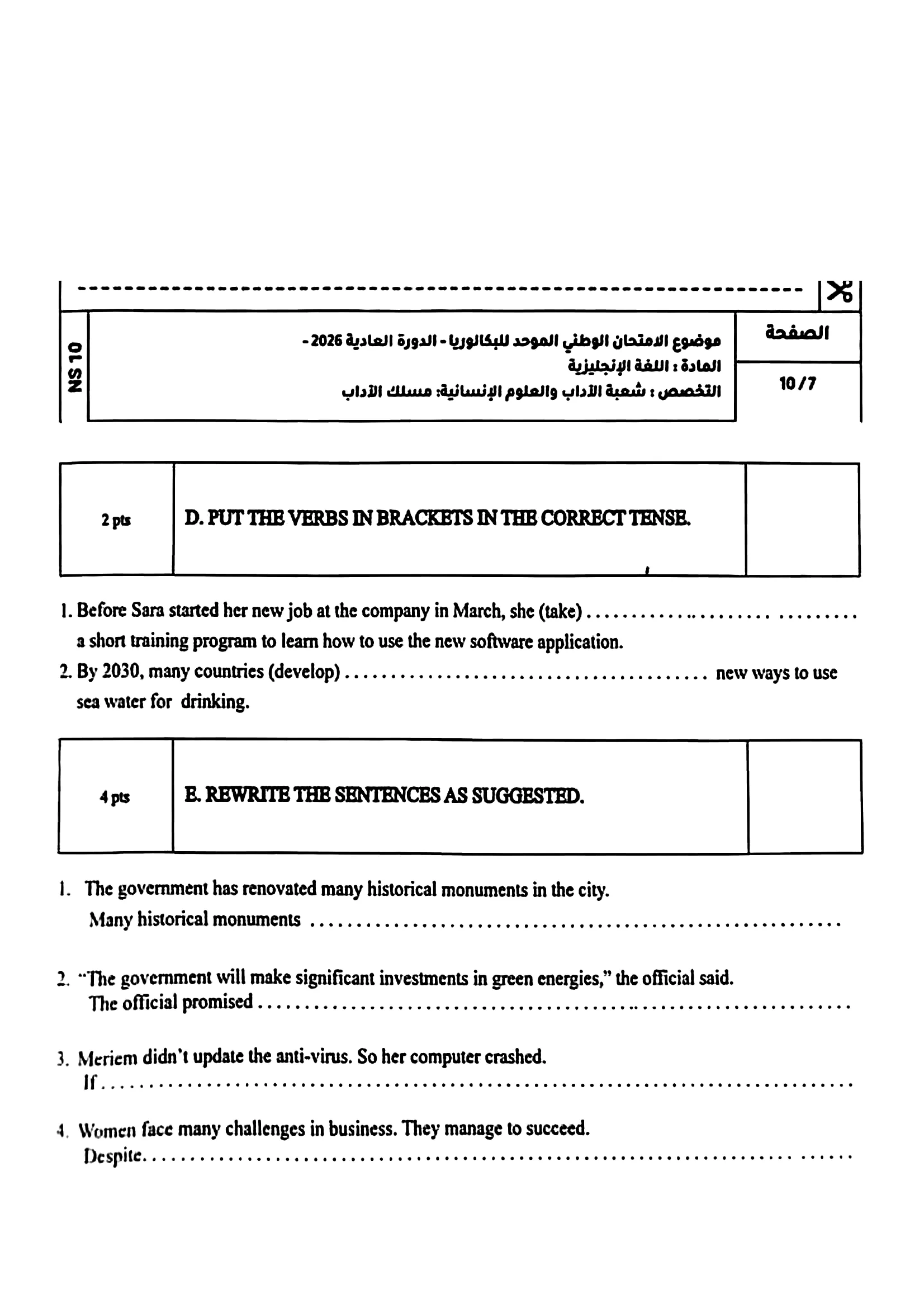
D. Put the verbs in brackets in the correct tense. (2 pts)
- Before Sara started her new job at the company in March, she (take) …
- By 2030, many countries (develop) ………… new ways to use
E. Rewrite the sentences as suggested. (4 pts)
- The government has renovated many historical monuments in the city.
Many historical monuments … - "The government will make significant investments in green energies," the official said.
The official promised … - Meriem didn't update the anti-virus. So her computer crashed.
If … - Women face many challenges in business. They manage to succeed.
Despite …
F. Choose the appropriate responses. (2 pts)
- Joe: Our project plan failed due to lack of funding. — Alex: …
a. Congratulations! – b. I’m sorry to hear that! – c. I like it! - Customer: I’m afraid, but this is the third time I report the same problem. — Agent: …
a. Please do. – b. Never mind. – c. My apologies!
G. Complete the following exchange. (2 pts)
- You: (Express your opinion about the use of AI in doing class assignments.)
You: … - Your friend: (Responds.)
Your friend: …
III. Writing (10 points)
Task 1 (4 pts)
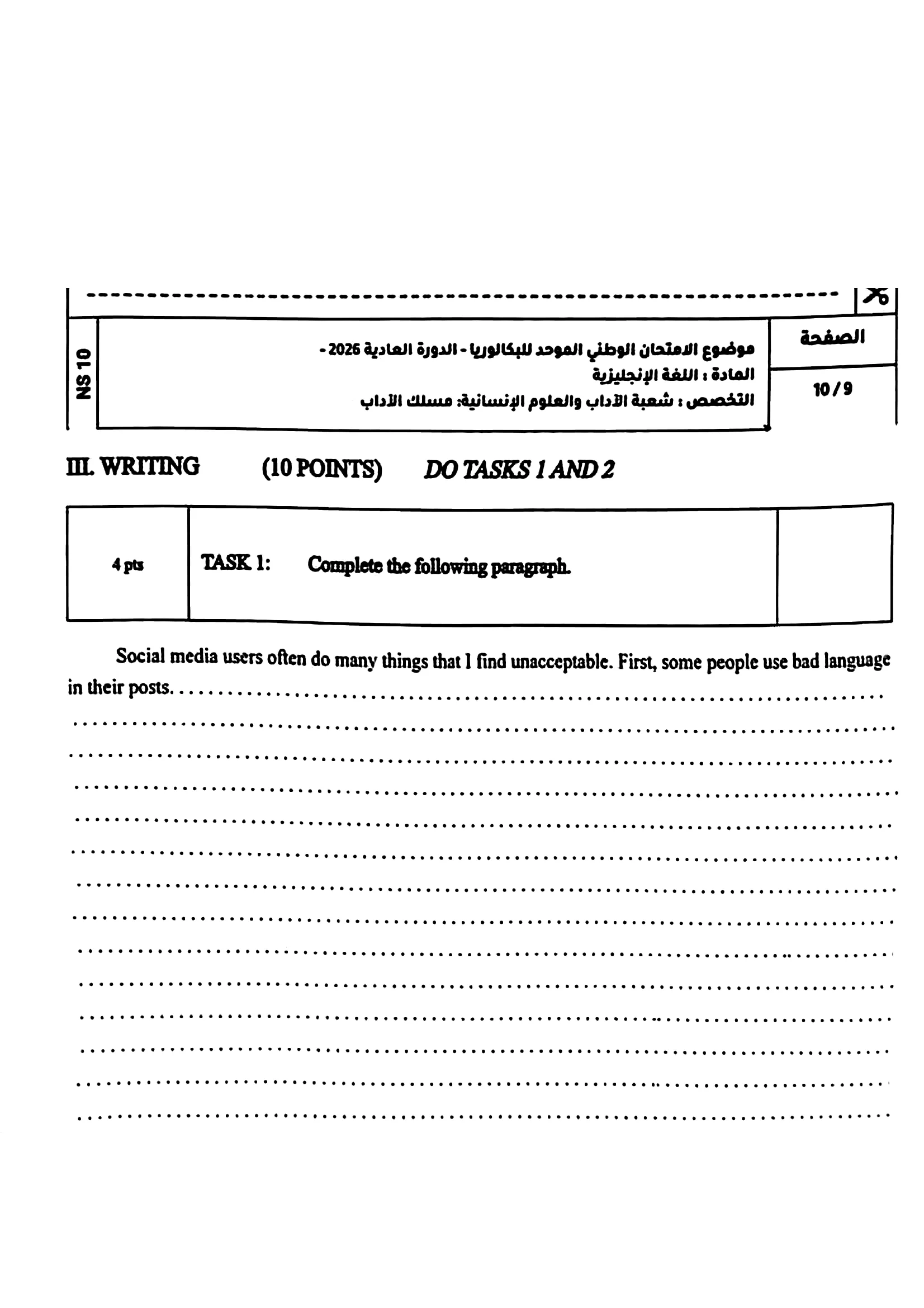
Complete the following paragraph: “Social media users often do many things that I find unacceptable. First, some people use bad language in their posts …”
Social media users often do many things that I find unacceptable. First, some people use bad language in their posts …
Task 2 (6 pts)
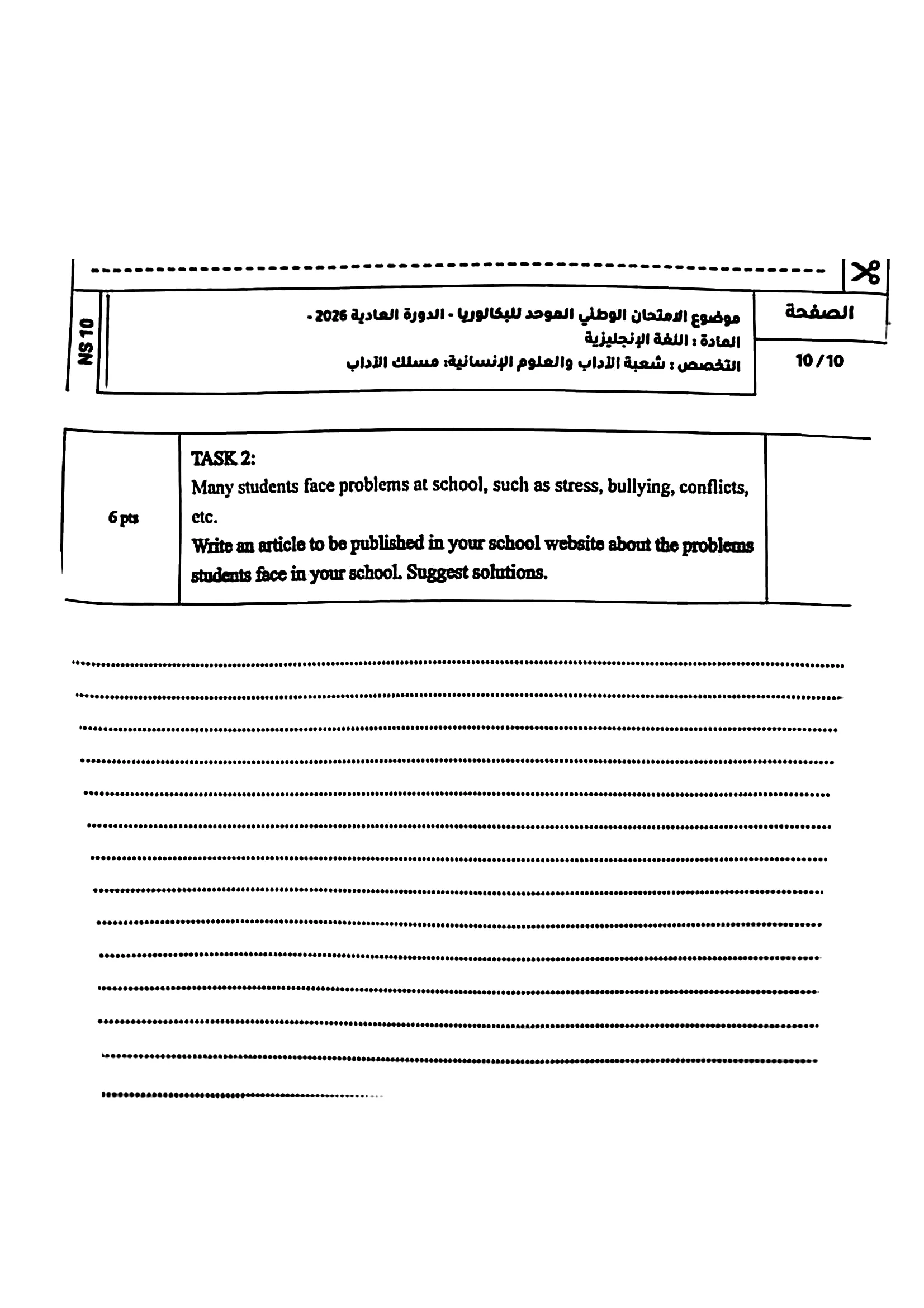
Many students face problems at school, such as stress, bullying, conflicts, etc. Write an article to be published in your school website about the problems students face in your school. Suggest solutions.
Sujet : Examen national du baccalauréat, Session normale 2026, Ministère de l’Éducation nationale (CNEE). Version interactive ILENG.