
Examen national anglais 2 Bac 2016, session de rattrapage (sciences humaines) : sujet et corrigé
Le sujet officiel, tel quel. Répondez directement sur la copie : touchez True ou False, écrivez sur les pointillés, choisissez votre réponse. La correction et votre note s’affichent à la fin.


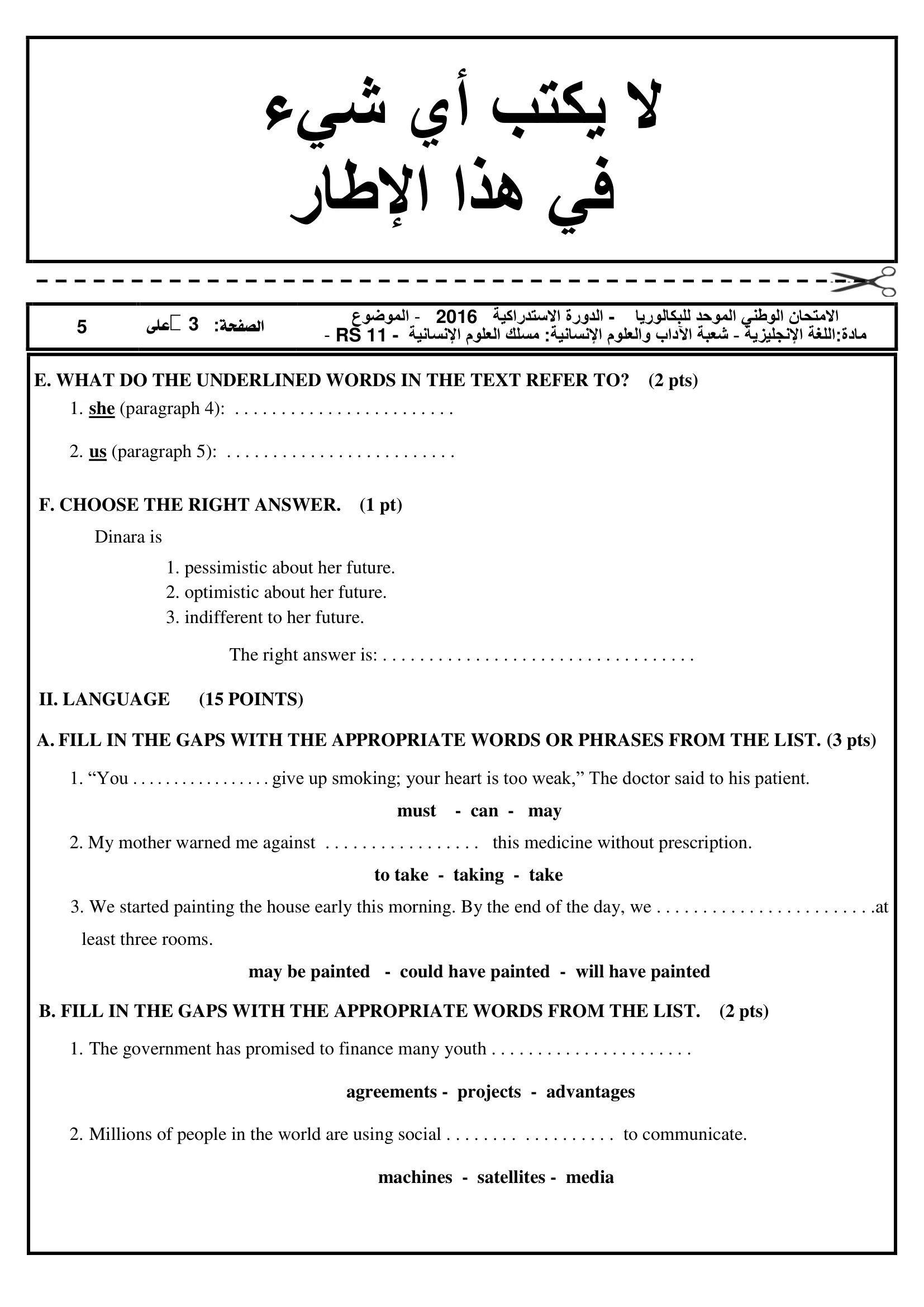
Le cœur est trop faible : une obligation forte, must.
Après une préposition (warn against), le verbe prend -ing : taking.
By the end of the day : action terminée avant un moment du futur, futur antérieur (will have painted).
Finance youth projects = financer des projets pour les jeunes.
Social media = les réseaux sociaux.
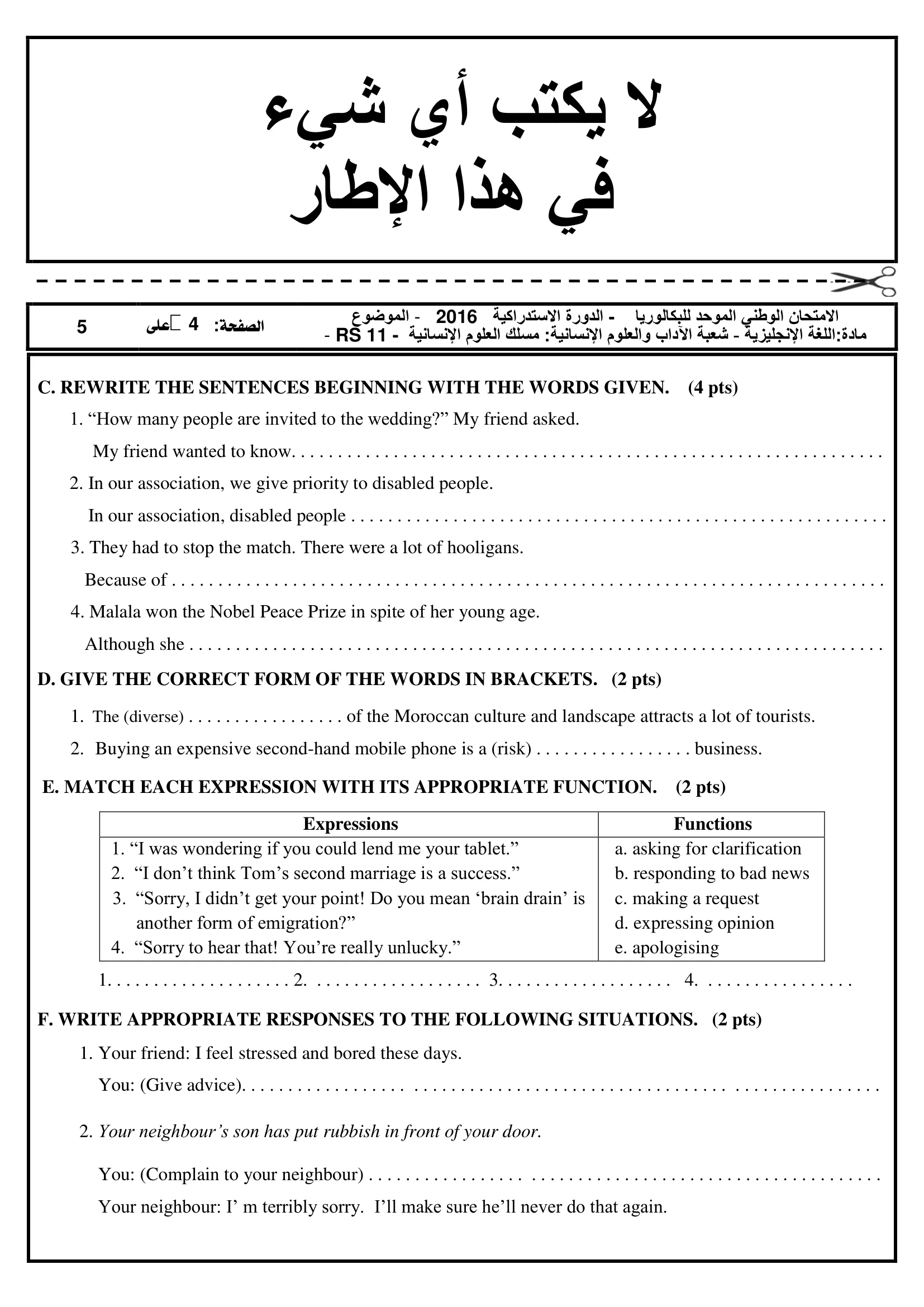
Question indirecte : ordre sujet + verbe (people were invited), et le présent recule au prétérit (are → were).
Passif au présent simple : are + participe passé (given).
Because of + nom (pas de verbe) : because of the hooligans.
Although + sujet + verbe (she was young) ; in spite of + nom.
Après The et avant of, il faut un nom : diversity.
Avant le nom business, il faut un adjectif : risky.
I was wondering if you could … = une demande polie.
I don’t think … = donner son opinion.
I didn’t get your point. Do you mean …? = demander une clarification.
Sorry to hear that! = réagir à une mauvaise nouvelle.
Pour conseiller : You should … / Why don’t you …? / If I were you, I would …
Pour se plaindre poliment : Excuse me, I’m afraid … / Could you please …? Le voisin répond en s’excusant.
If you are looking for the most beautiful city of the year, I strongly recommend Chefchaouen, a small town in the Rif Mountains in the north of Morocco.
First of all, Chefchaouen is famous for its blue streets and houses. Walking in its old medina feels like walking in a painting, and every corner is perfect for photos. The town is also surrounded by green mountains, forests and waterfalls such as Akchour, where visitors can go hiking and swim in fresh water.
Moreover, the people of Chefchaouen are friendly and welcoming. Tourists can taste delicious local food, like goat cheese and tajine, and buy traditional handmade products, such as carpets and woollen clothes. In addition, the city is calm and clean, far from the noise and pollution of big cities.
In conclusion, Chefchaouen combines natural beauty, rich culture and peace. That is why I think it deserves to be the best city of the year.
Sujet : Examen national du baccalauréat, Session de rattrapage 2016, Ministère de l’Éducation nationale (CNEE). Version interactive ILENG.
Ma note
Note estimée : réponses corrigées avec le corrigé officiel, writing corrigé automatiquement avec la grille officielle.
Vos erreurs, une par une
Touchez une erreur pour voir la correction.
Aucune erreur. Excellent travail !
Le sujet en version texteTexte, questions et sujets de writing de l’examen, à lire ou à copier.
Sujet de l’examen national d’anglais du baccalauréat (2e année Bac), Session de rattrapage 2016, Filière sciences humaines (RS 11). Thème du texte : Dinara, une enfant des rues à Rio de Janeiro (Dinara, a street child in Rio de Janeiro). Les réponses et la note s’affichent quand vous terminez l’examen ci-dessus.
English national exam 2016, make-up session – RS 11
Reading text: Dinara, a street child in Rio de Janeiro
[1] Dinara is 14 years old and lives in a park in Rio de Janeiro, Brazil. For the last two decades, there has been a huge reduction in the number of street children in Rio. But Dinara is part of a group of about 60 children who still survive on the streets.
[2] “We sleep in a park. In the evening, we go inside the park before it closes. We feel safe there. Sometimes, we fight because we don’t have enough blankets or food, but the group is a family and if an outsider attacks us, we are united and we will protect each other,” she said.
[3] During the day, these street children are helped by a drop-in centre run by a foundation in Rio called AMAR. The foundation has volunteers who cater for the needs of street children. “At AMAR, I can eat, wash my clothes, play football and basketball with the other kids, and I use the computer for facebook,” Dinara said.
[4] Her mother, Gabriela, lived on the streets as a child too. After giving birth to Dinara, she was able to buy a house, but the building collapsed when Dinara was nine. This incident left Dinara and her brothers without a mother to take care of them. They had no other option but to seek food and shelter on the streets.
[5] On the streets of Rio de Janeiro, the children face great dangers and get little sympathy from society. “Society does not look well on us. We are discriminated against and people are scared of us. If only they would help us as there are children with stories much worse than mine,” said Dinara.
[6] Though she lives on the street, Dinara manages to go to school thanks to her elder brother. He ensures that she attends classes regularly. However, she will never forget the sad story of her younger brother Dennis, who was murdered in front of her in a drug affair.
[7] There is no doubt that Dinara has experienced hardships in her childhood, yet she retains a smile and an extraordinary energy in pursuing her dreams. “I’m receiving social support, and AMAR foundation is helping me to join a basketball team. I believe that one day I will have a job, a family and a house,” she said.
Adapted from: www.streetchildunited.org
I. Comprehension (15 points)
A. Are these statements true or false? Justify. (3 pts)
- The number of street children in Rio is increasing.
- Gabriella never lived on the street.
- Dinara saw her younger brother die.
B. Answer these questions. (3 pts)
- Why do street children prefer to sleep in the park?
- How does AMAR foundation help street children?
- How did Dinara’s mother die?
C. Complete the sentences with information from the text. (3 pts)
- Street children live like a family although …
- After the death of their mother, Dinara and her brothers …
- Dinara is unhappy with society because …
D. Find in the text words which mean almost the same as (3 pts)
- choice (paragraph 4): …
- afraid (paragraph 5): …
- difficulties (paragraph 7): …
E. What do the underlined words in the text refer to? (2 pts)
- she (paragraph 4): …
- us (paragraph 5): …
F. Choose the right answer. (1 pt)
- Dinara is …
a. pessimistic about her future. – b. optimistic about her future. – c. indifferent to her future.
II. Language (15 points)
A. Fill in the gaps with the appropriate words or phrases from the list. (3 pts)
- “You ………… give up smoking; your heart is too weak,” The doctor said to his patient.
a. must – b. can – c. may - My mother warned me against ………… this medicine without prescription.
a. to take – b. taking – c. take - We started painting the house early this morning. By the end of the day, we ………… at
a. may be painted – b. could have painted – c. will have painted
B. Fill in the gaps with the appropriate words from the list. (2 pts)
- The government has promised to finance many youth …
a. agreements – b. projects – c. advantages - Millions of people in the world are using social ………… to communicate.
a. machines – b. satellites – c. media
C. Rewrite the sentences beginning with the words given. (4 pts)
- “How many people are invited to the wedding?” My friend asked.
My friend wanted to know … - In our association, we give priority to disabled people.
In our association, disabled people … - They had to stop the match. There were a lot of hooligans.
Because of … - Malala won the Nobel Peace Prize in spite of her young age.
Although she …
D. Give the correct form of the words in brackets. (2 pts)
- The (diverse) ………… of the Moroccan culture and landscape attracts a lot of tourists.
- Buying an expensive second-hand mobile phone is a (risk) ………… business.
E. Match each expression with its appropriate function. (2 pts)
a. asking for clarification – b. responding to bad news – c. making a request – d. expressing opinion – e. apologising
- “I was wondering if you could lend me your tablet.”
- “I don’t think Tom’s second marriage is a success.”
- “Sorry, I didn’t get your point! Do you mean ‘brain drain’ is another form of emigration?”
- “Sorry to hear that! You’re really unlucky.”
F. Write appropriate responses to the following situations. (2 pts)
- Your friend: I feel stressed and bored these days.
You: (Give advice) … - Your neighbour’s son has put rubbish in front of your door.
You: (Complain to your neighbour) …
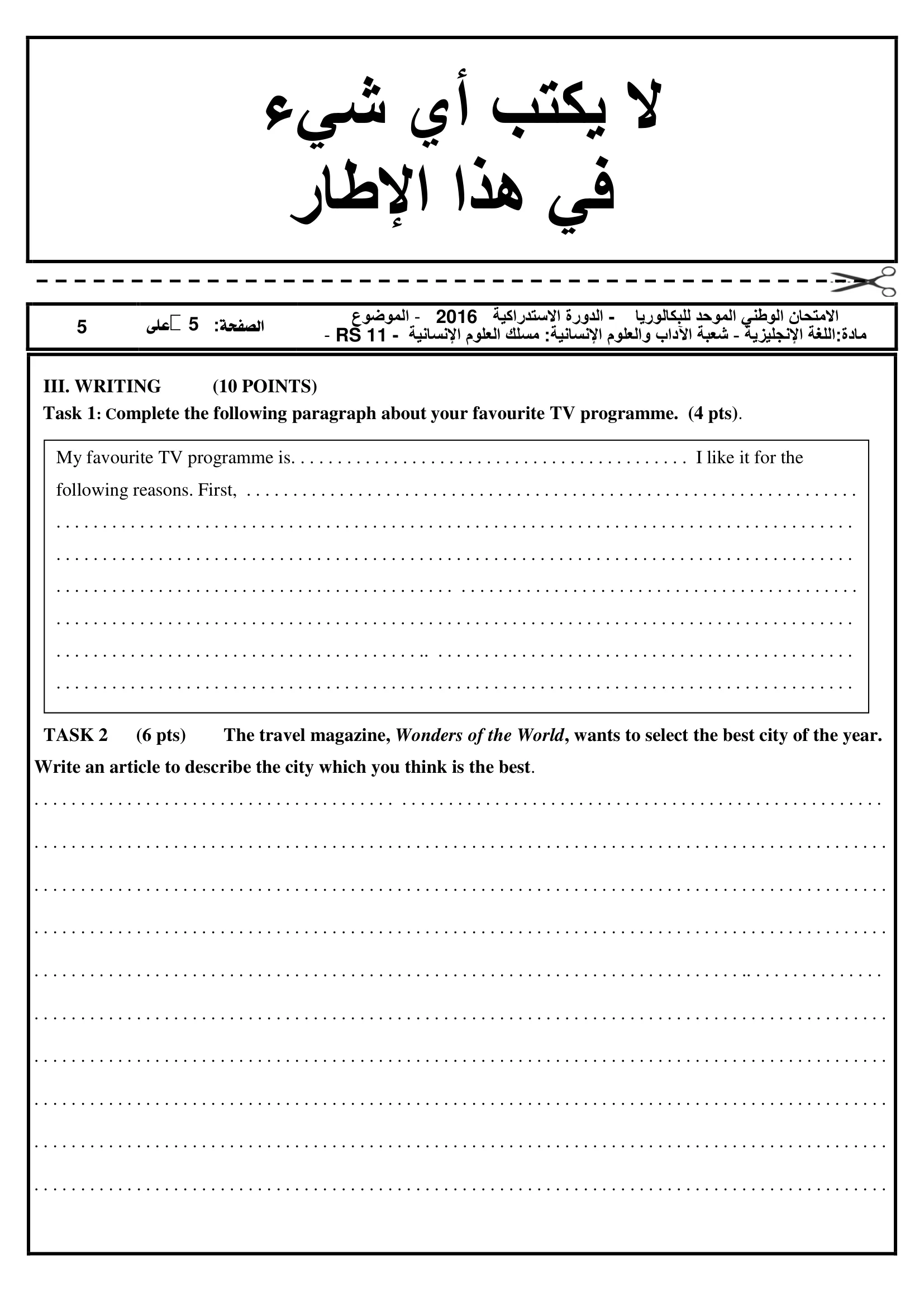
III. Writing (10 points)
Task 1 (4 pts)
Complete the following paragraph about your favourite TV programme: “My favourite TV programme is … I like it for the following reasons. First, …”
My favourite TV programme is …
Task 2 (6 pts)
The travel magazine Wonders of the World wants to select the best city of the year. Write an article to describe the city which you think is the best.
Sujet : Examen national du baccalauréat, Session de rattrapage 2016, Ministère de l’Éducation nationale (CNEE). Version interactive ILENG.