
Examen national anglais 2 Bac 2022, session normale (sciences humaines) : sujet et corrigé
Le sujet officiel, tel quel. Répondez directement sur la copie : touchez True ou False, écrivez sur les pointillés, choisissez votre réponse. La correction et votre note s’affichent à la fin.


Natural resources = les ressources naturelles.
Cyber security = la cybersécurité.
Avant le nom people, il faut un adjectif, et le sens (à cause de la pandémie) demande le contraire : unemployed (au chômage).
Après to, il faut un verbe : to promote (promouvoir).
Don’t forget + to + verbe : ne pas oublier de faire quelque chose (to send).
Action antérieure à « we went » : plus-que-parfait (had spent) ; le prétérit (spent) est aussi accepté avec « after ».
By 2050 : action terminée avant un moment du futur, futur antérieur (will have developed).
Look forward to + verbe en -ing : having.
I wish pour un souhait au présent : I wish + prétérit (had).
Après une préposition (with), on utilise whom pour une personne.
Passif au futur : will be + participe passé (taken).
Ordre au discours indirect : asked + personne + to + verbe ; me → him/her.
Regret sur le passé : 3e conditionnel, If + had (not) + participe passé, would have + participe passé (would have gone).
« Do you mind if I … ? » : pour accepter, on répond non (No, not at all = ça ne me dérange pas).
Une mauvaise nouvelle : on montre de la sympathie (Sorry to hear that).
Faire une suggestion : Why don’t you …? / How about …? / You could …
Répondre à une plainte : s’excuser et proposer une solution (I’m sorry … Let me …).
How are you? I hope you and your family are fine. I’m really sorry I haven’t written to you for such a long time. This year was very busy for me because I was preparing for the Baccalaureate exam. I studied every day, even at weekends, and I had no time for anything else.
Now the exams are over, and I have great plans for the summer holiday. First, I will spend two weeks with my family in Agadir, where we will swim and relax on the beach. After that, I am going to take an English course to improve my speaking before university. I also want to help my uncle in his shop to earn some money.
What about you? What are your plans for the summer? It would be great if you could visit us in August, so we can spend some time together like the old days.
Write back soon!
Sujet : Examen national du baccalauréat, Session normale 2022, Ministère de l’Éducation nationale (CNEE). Version interactive ILENG.
Ma note
Note estimée : réponses corrigées avec le corrigé officiel, writing corrigé automatiquement avec la grille officielle.
Vos erreurs, une par une
Touchez une erreur pour voir la correction.
Aucune erreur. Excellent travail !
Le sujet en version texteTexte, questions et sujets de writing de l’examen, à lire ou à copier.
Sujet de l’examen national d’anglais du baccalauréat (2e année Bac), Session normale 2022, Filière sciences humaines (NS 11). Thème du texte : La déforestation et la protection des forêts (Deforestation and how to protect forests). Les réponses et la note s’affichent quand vous terminez l’examen ci-dessus.
English national exam 2022, normal session – NS 11
Reading text: Deforestation and how to protect forests
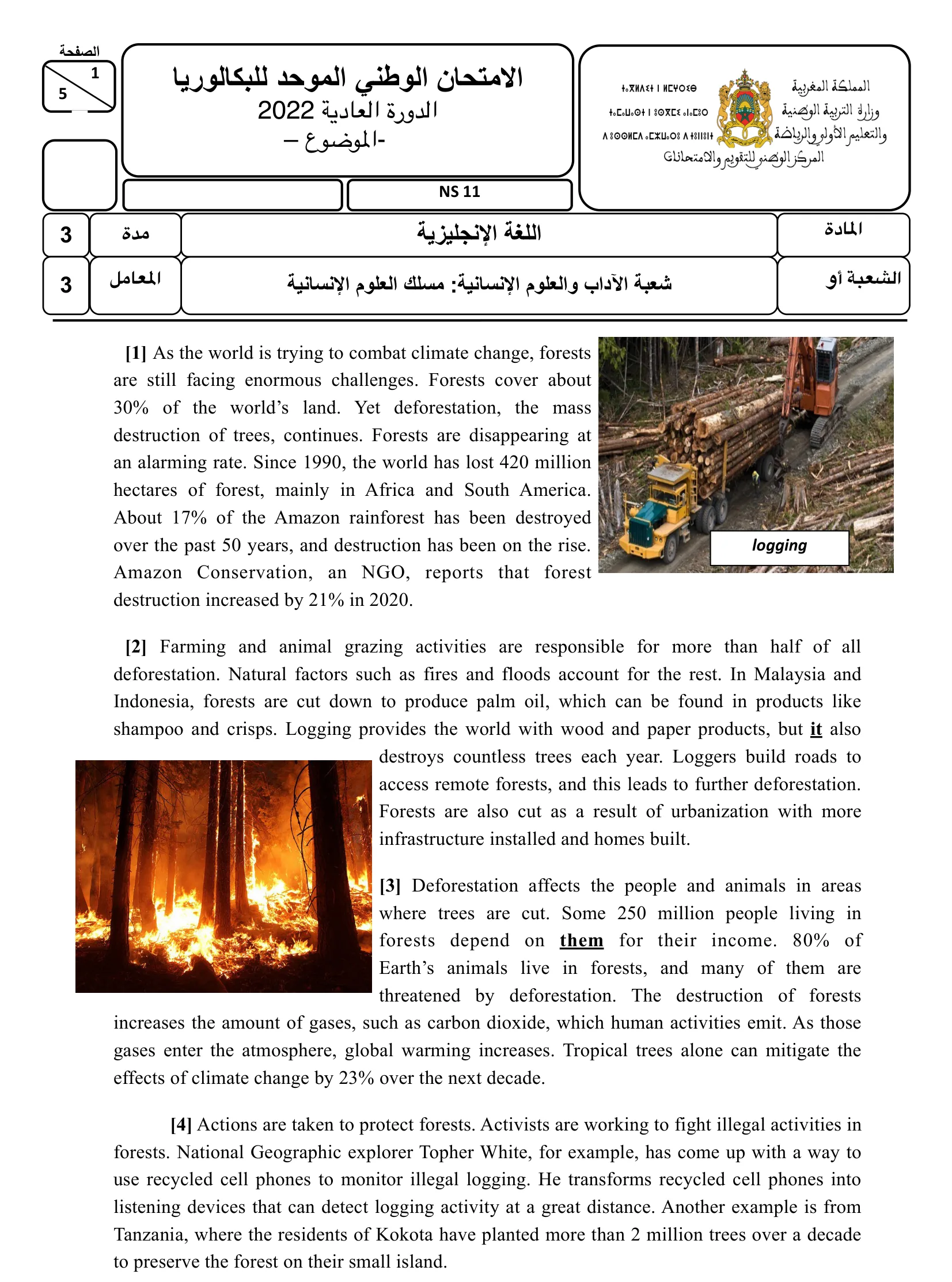
[1] As the world is trying to combat climate change, forests are still facing enormous challenges. Forests cover about 30% of the world’s land. Yet deforestation, the mass destruction of trees, continues. Forests are disappearing at an alarming rate. Since 1990, the world has lost 420 million hectares of forest, mainly in Africa and South America. About 17% of the Amazon rainforest has been destroyed over the past 50 years, and destruction has been on the rise. Amazon Conservation, an NGO, reports that forest destruction increased by 21% in 2020.
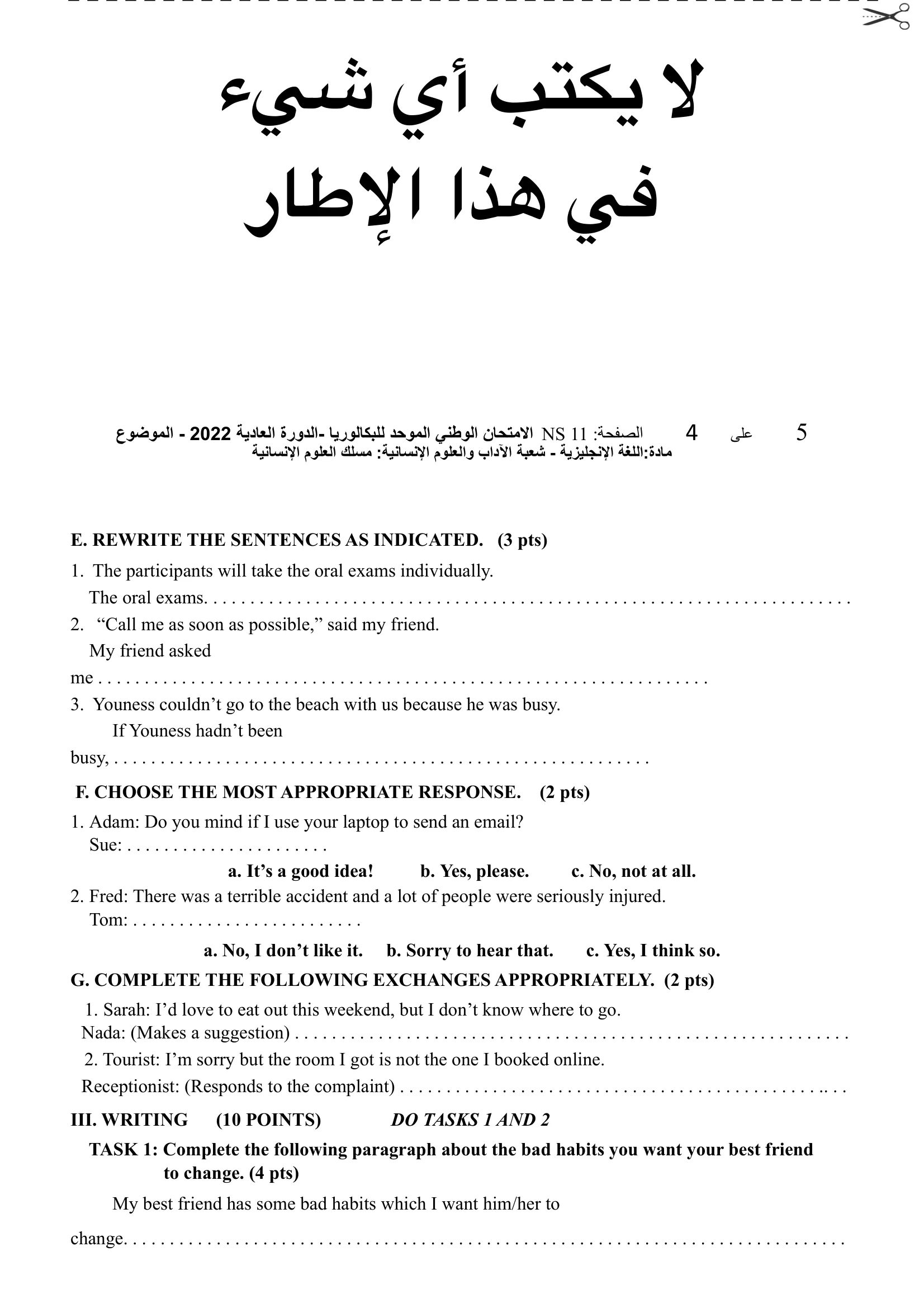
[2] Farming and animal grazing activities are responsible for more than half of all deforestation. Natural factors such as fires and floods account for the rest. In Malaysia and Indonesia, forests are cut down to produce palm oil, which can be found in products like shampoo and crisps. Logging provides the world with wood and paper products, but it also destroys countless trees each year. Loggers build roads to access remote forests, and this leads to further deforestation. Forests are also cut as a result of urbanization with more infrastructure installed and homes built.
[3] Deforestation affects the people and animals in areas where trees are cut. Some 250 million people living in forests depend on them for their income. 80% of Earth’s animals live in forests, and many of them are threatened by deforestation. The destruction of forests increases the amount of gases, such as carbon dioxide, which human activities emit. As those gases enter the atmosphere, global warming increases. Tropical trees alone can mitigate the effects of climate change by 23% over the next decade.
[4] Actions are taken to protect forests. Activists are working to fight illegal activities in forests. National Geographic explorer Topher White, for example, has come up with a way to use recycled cell phones to monitor illegal logging. He transforms recycled cell phones into listening devices that can detect logging activity at a great distance. Another example is from Tanzania, where the residents of Kokota have planted more than 2 million trees over a decade to preserve the forest on their small island.
I. Comprehension (15 points)
A. Are these statements true or false? Justify. (3 pts)
- The destruction of the Amazon forest has decreased recently.
- 80% of Earth’s animals are affected by deforestation.
- People in Tanzania are fighting deforestation.
B. Answer the following questions. (4 pts)
- Which parts of the world suffer most from deforestation?
- Why do people in Indonesia cut down trees?
- Give two environmental benefits of the forests mentioned in the text.
a). … - Why does Topher White use recycled mobile phones?
C. Fill in the chart with information from the text. (2 pts)
| Figures | What they refer to |
|---|---|
| 17% | ………… |
| 250 million | ………… |
D. Complete the following sentences with ideas from the text. (2 pts)
- Farming and animal grazing are two. …
- Gases such as carbon
dioxide …
E. Find in the text words that mean almost the same as (2 pts)
- reach (paragraph 2): …
- reduce (paragraph 3): …
F. What do the underlined words in the text refer to? (2 pts)
- it (paragraph 2): …
- them (paragraph 3): …
II. Language (15 points)
A. Fill in the gaps with the right words from the list. (2 pts)
marginalization - resources - stereotypes - security - youth
- Preserving natural ………… will help future generations.
- Cyber ………… is a real challenge facing countries all over the world.
B. Put the words in brackets in the right form. (2 pts)
- The number of (employed) ………… people has increased as a result of the pandemic.
- The government has launched a new program to (promotion) ………… human rights.
C. Put the verbs in brackets in the correct form. (2 pts)
- Don’t forget (send) ………… me the photos of today’s trip.
- During our visit to Marrakesh, we went to Ourika after we (spend) ………… one
- By 2050, most world countries (develop) ………… clean energy facilities.
- Third world countries are looking forward to (have) ………… all their populations
D. Correct the underlined mistakes in the following sentences. (2 pts)
- I am busy these days. I wish I have more time for the gym.
- The person with who I am working on the project is very serious.
E. Rewrite the sentences as indicated. (3 pts)
- The participants will take the oral exams individually.
The oral exams … - “Call me as soon as possible,” said my friend.
My friend asked me … - Youness couldn’t go to the beach with us because he was busy.
If Youness hadn’t been busy, …
F. Choose the most appropriate response. (2 pts)
- Adam: Do you mind if I use your laptop to send an email?
Sue: …
a. It’s a good idea! – b. Yes, please. – c. No, not at all. - Fred: There was a terrible accident and a lot of people were seriously injured.
Tom: …
a. No, I don’t like it. – b. Sorry to hear that. – c. Yes, I think so.
G. Complete the following exchanges appropriately. (2 pts)
- Sarah: I’d love to eat out this weekend, but I don’t know where to go.
Nada: (Makes a suggestion) … - Tourist: I’m sorry but the room I got is not the one I booked online.
Receptionist: (Responds to the complaint) …
III. Writing (10 points)
Task 1 (4 pts)
Complete the following paragraph about the bad habits you want your best friend to change: “My best friend has some bad habits which I want him/her to change. …”
My best friend has some bad habits which I want him/her to change. …
Task 2 (6 pts)
Write an email to a friend you haven’t seen or contacted for a long time. In your email, include the following: apologize for not writing before and say why; tell her/him about your plans for the summer holiday. (Do not write your name or sign the email.)
Hello …
Sujet : Examen national du baccalauréat, Session normale 2022, Ministère de l’Éducation nationale (CNEE). Version interactive ILENG.