
Examen national anglais 2 Bac 2018, session de rattrapage (sciences humaines) : sujet et corrigé
Le sujet officiel, tel quel. Répondez directement sur la copie : touchez True ou False, écrivez sur les pointillés, choisissez votre réponse. La correction et votre note s’affichent à la fin.

Après la préposition in (interested in), le verbe prend -ing : starting.
Déduction (presque certain) sur le passé : must have met.
In order to + base verbale exprime le but : in order to set up.
Because of + nom : because of (their) poverty (pas « because of they are poor »).
Turn down an application = refuser une candidature.
Take up (a sport, lessons) = commencer une activité.
3e conditionnel : If + had + participe passé (had performed), would have qualified.
Passif : are + participe passé (forced).
Advise someone to + base verbale : advised the tourists to follow.
The scientific community = la communauté scientifique.
The tourist industry = le secteur du tourisme.
Can you …, please? = une demande.
I’m really sorry for … = s’excuser.
Are you saying that …? = demander une clarification.
Un problème avec un achat = se plaindre.
Pour suggérer : Why don’t we …? / Let’s … / How about going …?
Répondre à une suggestion : accepter (That’s a great idea! / Good idea!) ou refuser poliment (I’d rather …).

Thanks for your email. It was nice to read about you and your friends. I also have a small group of close friends, and we do many things together.
At the weekend, we usually go to the beach or play basketball in our neighbourhood. Sometimes we go to the cinema or just sit in a café and chat for hours. In the summer, we go camping in the mountains, which is always great fun.
We also help each other a lot. Before exams, we meet at the library and revise together. Each of us explains the subject he is good at: I help my friends in English, and they help me in maths and philosophy. When one of us has a problem, the others listen and give him advice.
For me, friends are like a second family. What about your friends? Do you also revise with them before the Bac? Write back soon.
Sujet : Examen national du baccalauréat, Session de rattrapage 2018, Ministère de l’Éducation nationale (CNEE). Version interactive ILENG.
Ma note
Note estimée : réponses corrigées avec le corrigé officiel, writing corrigé automatiquement avec la grille officielle.
Vos erreurs, une par une
Touchez une erreur pour voir la correction.
Aucune erreur. Excellent travail !
Le sujet en version texteTexte, questions et sujets de writing de l’examen, à lire ou à copier.
Sujet de l’examen national d’anglais du baccalauréat (2e année Bac), Session de rattrapage 2018, Filière sciences humaines (RS 11). Thème du texte : Des couveuses gratuites pour les prématurés en Indonésie (Free incubators for premature babies in Indonesia). Les réponses et la note s’affichent quand vous terminez l’examen ci-dessus.
English national exam 2018, make-up session – RS 11
Reading text: Free incubators for premature babies in Indonesia
[1] When she was born prematurely, Maryamah was just 1.2 kilograms. Now, she is still underweight. She’s one of hundreds of premature babies born in Indonesia benefiting from the work of professor Koestor who is building incubators and lending them for free to low-income families.
[2] The World Health Organization (WHO) says that premature birth complications are the main cause of death among children under five. Babies who are born early need incubators to keep them warm and protect them from infections. But getting access to these life-saving devices is a huge challenge for millions of people living in poverty in Indonesia.
[3] Koestor, who works at the University of Indonesia, started his lending scheme in 2012 using his technical expertise to build ultra-light, portable incubators. His interest in incubators began when he fixed one of the devices for a pediatrician, and then learnt how to construct them himself. To fund his scheme, he looked for individuals willing to donate about $260 each, the cost of making one incubator.
[4] People requiring an incubator send a text message to a special number and a volunteer brings one for them. The service began in the capital Jakarta, and has now expanded to an additional 48 cities and will be extended to 300 cities. Koestor has so far built 180 incubators that have helped about 1500 babies. “Our success ratio is 100 percent; the 1500 babies are all alive and healthy,” he said.
[5] The scheme has proved invaluable for Maryamah and her parents. Maryamah’s mother underwent a caesarean section in February when she was almost eight months pregnant due to high blood pressure. After seven weeks, when the baby was still 1.5 kilos, doctors said Maryamah could no longer stay in the hospital as her condition had stabilized. “We were slowly recovering from the shock of having a premature baby, but then we had another problem: how to take care of her at home,” the father said.
[6] After asking around, the father found about the incubator lending service from a friend. “I sent a text message and the response was very fast. After a few minutes the operator got in touch with me and said that the incubator can be picked up as soon as the baby is at home,” he said. Maryamah now weighs 2.4 kilograms and although she still spends a lot of time in the incubator, her parents now feel safe taking her out and playing with her.
Adapted from: www.deccanchronicle.com
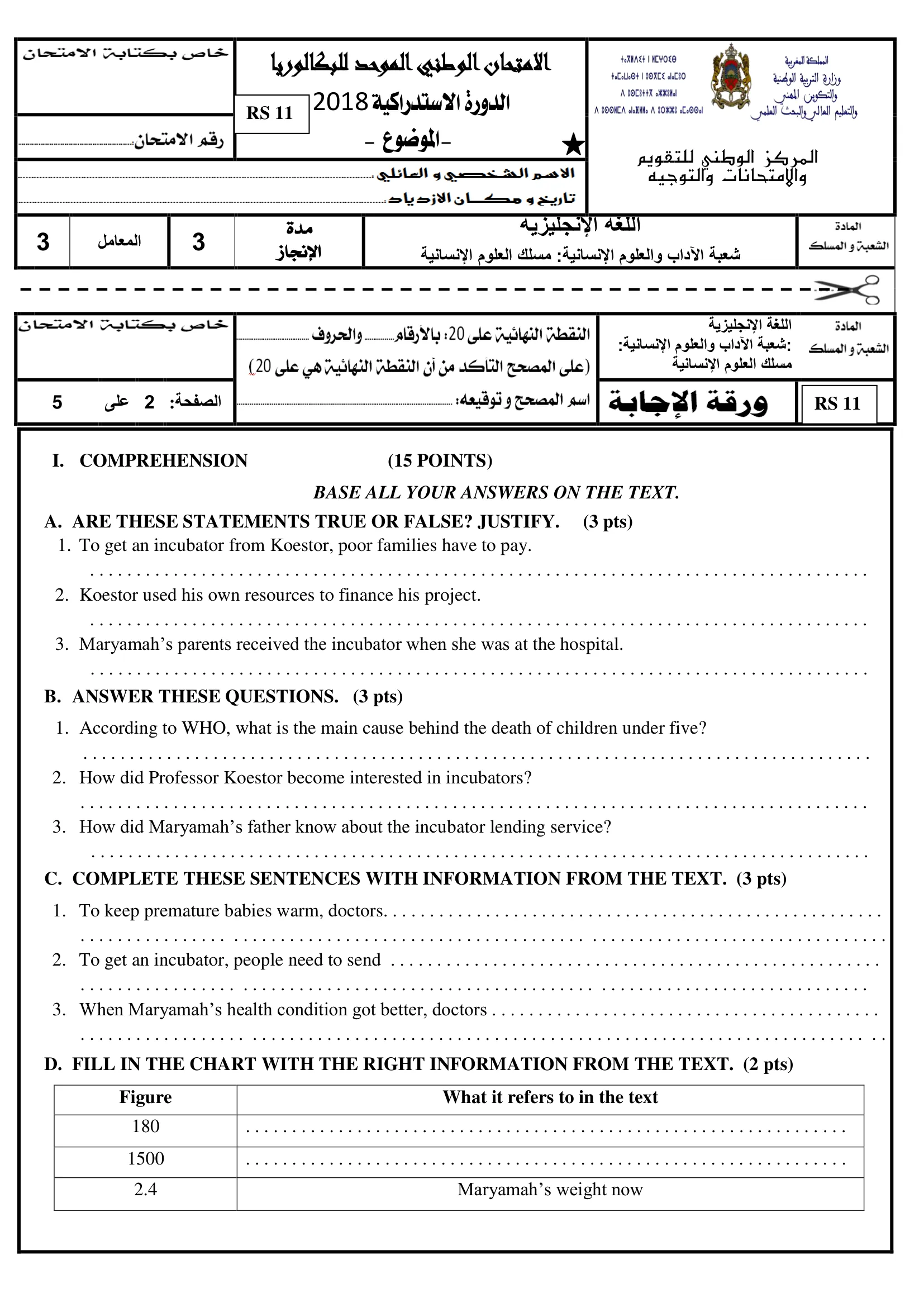
I. Comprehension (15 points)
A. Are these statements true or false? Justify. (3 pts)
- To get an incubator from Koestor, poor families have to pay.
- Koestor used his own resources to finance his project.
- Maryamah’s parents received the incubator when she was at the hospital.
B. Answer these questions. (3 pts)
- According to WHO, what is the main cause behind the death of children under five?
- How did Professor Koestor become interested in incubators?
- How did Maryamah’s father know about the incubator lending service?
C. Complete these sentences with information from the text. (3 pts)
- To keep premature babies warm, doctors. …
- To get an incubator, people need to send …
- When Maryamah’s health condition got better, doctors …
D. Fill in the chart with the right information from the text. (2 pts)
| Figure | What it refers to in the text |
|---|---|
| 180 | ………… |
| 1500 | ………… |
| 2.4 | Maryamah’s weight now |
E. What do the underlined words in the text refer to? (2 pts)
- he (paragraph 3): …
- the baby (paragraph 5): …
F. Find in the text words or phrases which mean almost the same as (2 pts)
- find money for (paragraph 3): …
- answer (paragraph 6): …
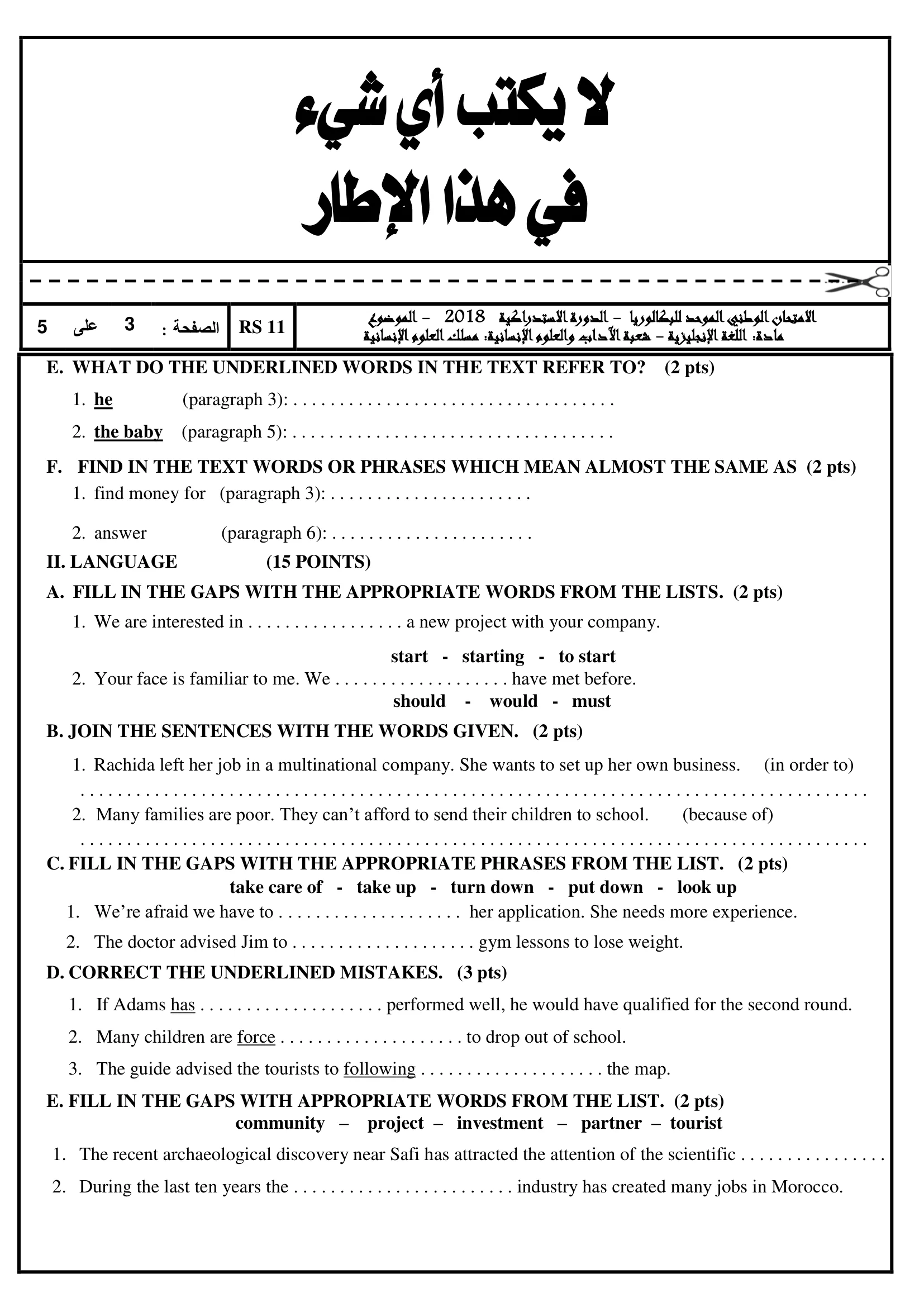
II. Language (15 points)
A. Fill in the gaps with the appropriate words from the lists. (2 pts)
- We are interested in ………… a new project with your company.
a. start – b. starting – c. to start - Your face is familiar to me. We ………… have met before.
a. should – b. would – c. must
B. Join the sentences with the words given. (2 pts)
- Rachida left her job in a multinational company. She wants to set up her own business. (in order to)
- Many families are poor. They can’t afford to send their children to school. (because of)
C. Fill in the gaps with the appropriate phrases from the list. (2 pts)
take care of – take up – turn down – put down – look up
- We’re afraid we have to ………… her application. She needs more experience.
- The doctor advised Jim to ………… gym lessons to lose weight.
D. Correct the underlined mistakes. (3 pts)
- If Adams has ………… performed well, he would have qualified for the second round.
- Many children are force ………… to drop out of school.
- The guide advised the tourists to following ………… the map.
E. Fill in the gaps with appropriate words from the list. (2 pts)
community – project – investment – partner – tourist
- The recent archaeological discovery near Safi has attracted the attention of the scientific …
- During the last ten years the ………… industry has created many jobs in Morocco.
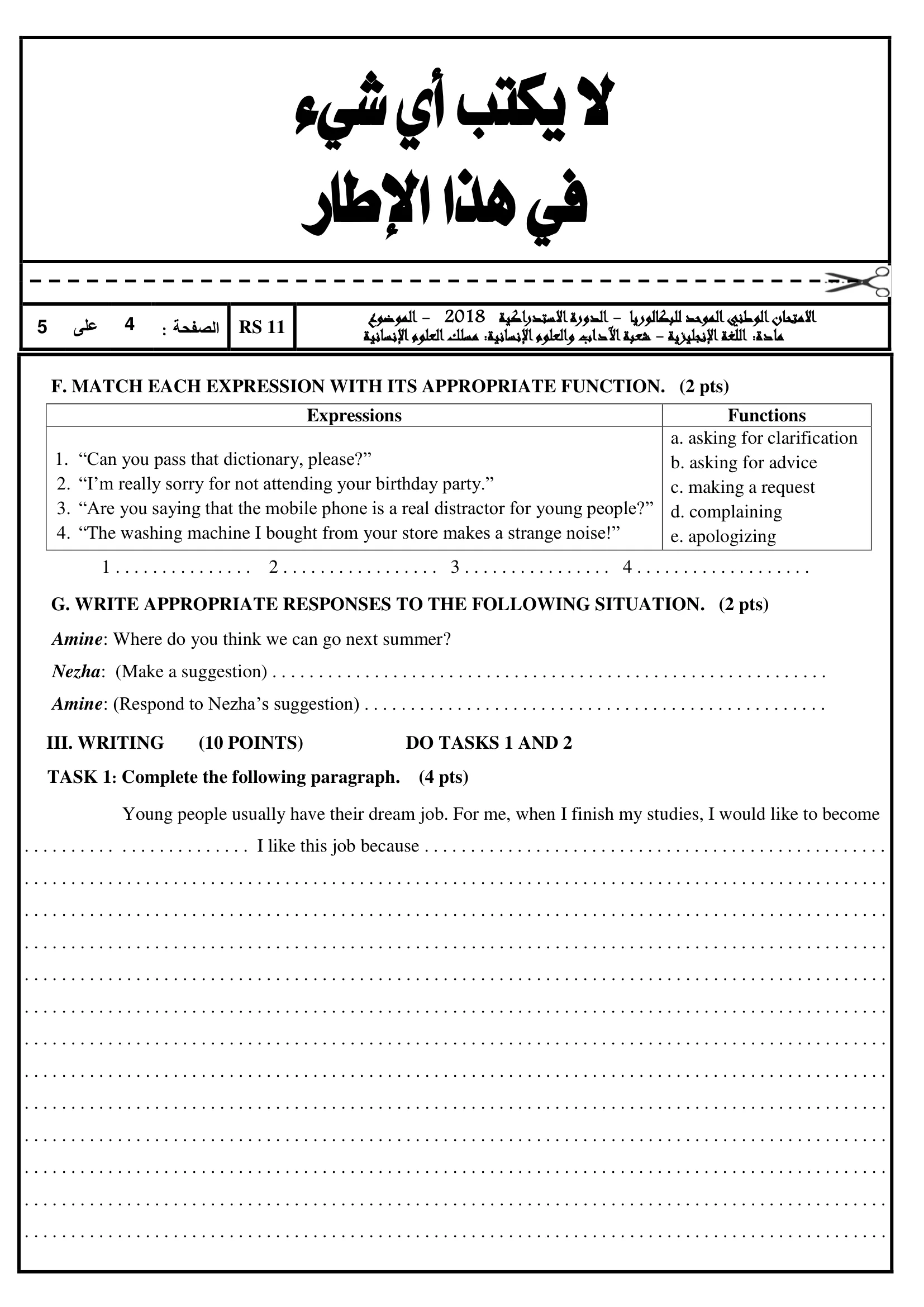
F. Match each expression with its appropriate function. (2 pts)
a. asking for clarification – b. asking for advice – c. making a request – d. complaining – e. apologizing
- “Can you pass that dictionary, please?”
- “I’m really sorry for not attending your birthday party.”
- “Are you saying that the mobile phone is a real distractor for young people?”
- “The washing machine I bought from your store makes a strange noise!”
G. Write appropriate responses to the following situation. (2 pts)
- Amine: Where do you think we can go next summer? – Nezha: (Make a suggestion) …
- Amine: (Respond to Nezha’s suggestion) …
III. Writing (10 points)
Task 1 (4 pts)
Complete the following paragraph: “Young people usually have their dream job. For me, when I finish my studies, I would like to become … I like this job because …”
Young people usually have their dream job. For me, when I finish my studies, I would like to become …
Task 2 (6 pts)
Respond to the following email: “… I have many friends. Sometimes, we revise our lessons together. In other times we just play football. What about you? What activities do you do with your friends? And how do you help each other?” (Do not write your name or sign the email.)
Sujet : Examen national du baccalauréat, Session de rattrapage 2018, Ministère de l’Éducation nationale (CNEE). Version interactive ILENG.