
Examen national anglais 2 Bac 2020, session normale (sciences humaines) : sujet et corrigé
Le sujet officiel, tel quel. Répondez directement sur la copie : touchez True ou False, écrivez sur les pointillés, choisissez votre réponse. La correction et votre note s’affichent à la fin.

Take the initiative = prendre l’initiative.
Environmental issues = les problèmes environnementaux.
The most popular = le plus populaire, le plus aimé.
Living conditions = les conditions de vie.
Après the et avant of, il faut un nom : empowerment (l’autonomisation).
Avant le nom effect, il faut un adjectif : harmful (nocif).
Demande polie au discours indirect : asked + personne + to + base verbale (to give), ou if he could give.
Passif avec la personne comme sujet : are + participe passé (offered).
In spite of + nom ou verbe en -ing : in spite of receiving the invitation.
Récit au passé (I was too late) : prétérit négatif (didn’t take).
Action antérieure à « joined » : plus-que-parfait (had graduated) ; le prétérit est aussi accepté avec « in 1983 ».

The student est une personne sujet de « wins » : who.
« I’m not really sure » = une possibilité : might be.
Refuser une demande poliment : I’m sorry, I can’t … / I’m afraid I can’t …, avec une raison.
S’excuser et donner une raison : I’m (really) sorry, I … because …
Rick se plaint : le vendeur s’excuse (Sorry for that).
Fred demande un conseil ; la seule réponse logique est « Sorry, I have no idea » (je n’en ai aucune idée).
Every school has its stars, and in our school, one of them is Yasmine, a second-year Baccalaureate student. Yasmine is a talented painter, and many students and teachers admire her work.
Yasmine started drawing when she was only five years old. Today, she paints beautiful pictures of Moroccan landscapes, old medinas and people's faces. She uses watercolours and oil paints, and she can draw a portrait in less than an hour. Last year, she won the first prize in a regional painting competition, and some of her paintings were shown in an exhibition at the cultural centre of our town.
What makes Yasmine special is not only her talent but also her personality. She is modest, kind and hard-working. She also helps younger students in the school art club and teaches them how to mix colours and draw.
Yasmine dreams of studying fine arts and becoming a famous artist. We are proud of her, and we are sure she will succeed!
Sujet : Examen national du baccalauréat, Session normale 2020, Ministère de l’Éducation nationale (CNEE). Version interactive ILENG.
Ma note
Note estimée : réponses corrigées avec le corrigé officiel, writing corrigé automatiquement avec la grille officielle.
Vos erreurs, une par une
Touchez une erreur pour voir la correction.
Aucune erreur. Excellent travail !
Le sujet en version texteTexte, questions et sujets de writing de l’examen, à lire ou à copier.
Sujet de l’examen national d’anglais du baccalauréat (2e année Bac), Session normale 2020, Filière sciences humaines (NS 11). Thème du texte : Le voyage de Peter au Maroc et l’hospitalité marocaine (Peter’s trip to Morocco and Moroccan hospitality). Les réponses et la note s’affichent quand vous terminez l’examen ci-dessus.
English national exam 2020, normal session – NS 11
Reading text: Peter’s trip to Morocco and Moroccan hospitality
Peter is an American tourist who visited Morocco with four of his friends. This is the story of their trip:
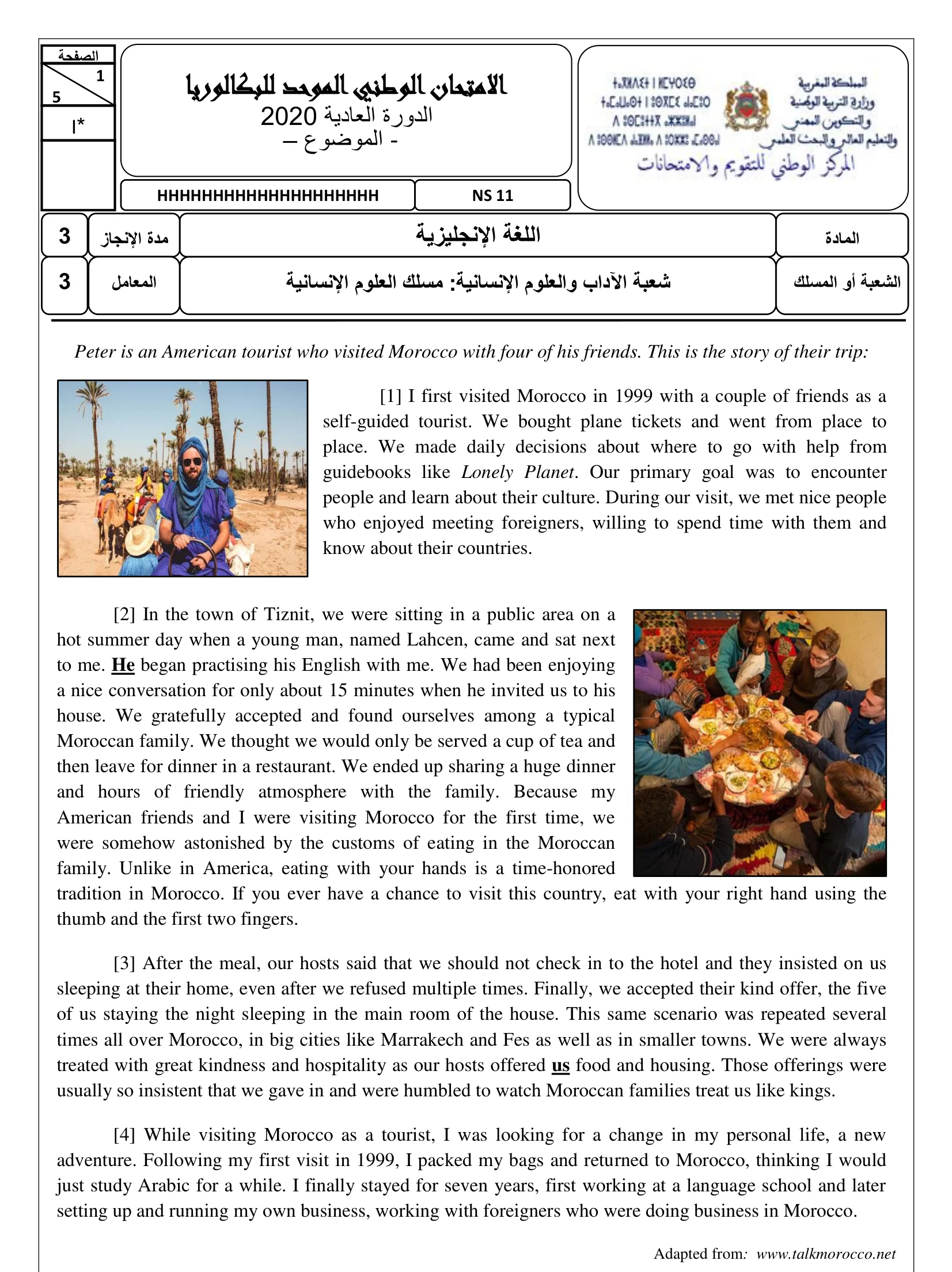
[1] I first visited Morocco in 1999 with a couple of friends as a self-guided tourist. We bought plane tickets and went from place to place. We made daily decisions about where to go with help from guidebooks like Lonely Planet. Our primary goal was to encounter people and learn about their culture. During our visit, we met nice people who enjoyed meeting foreigners, willing to spend time with them and know about their countries.
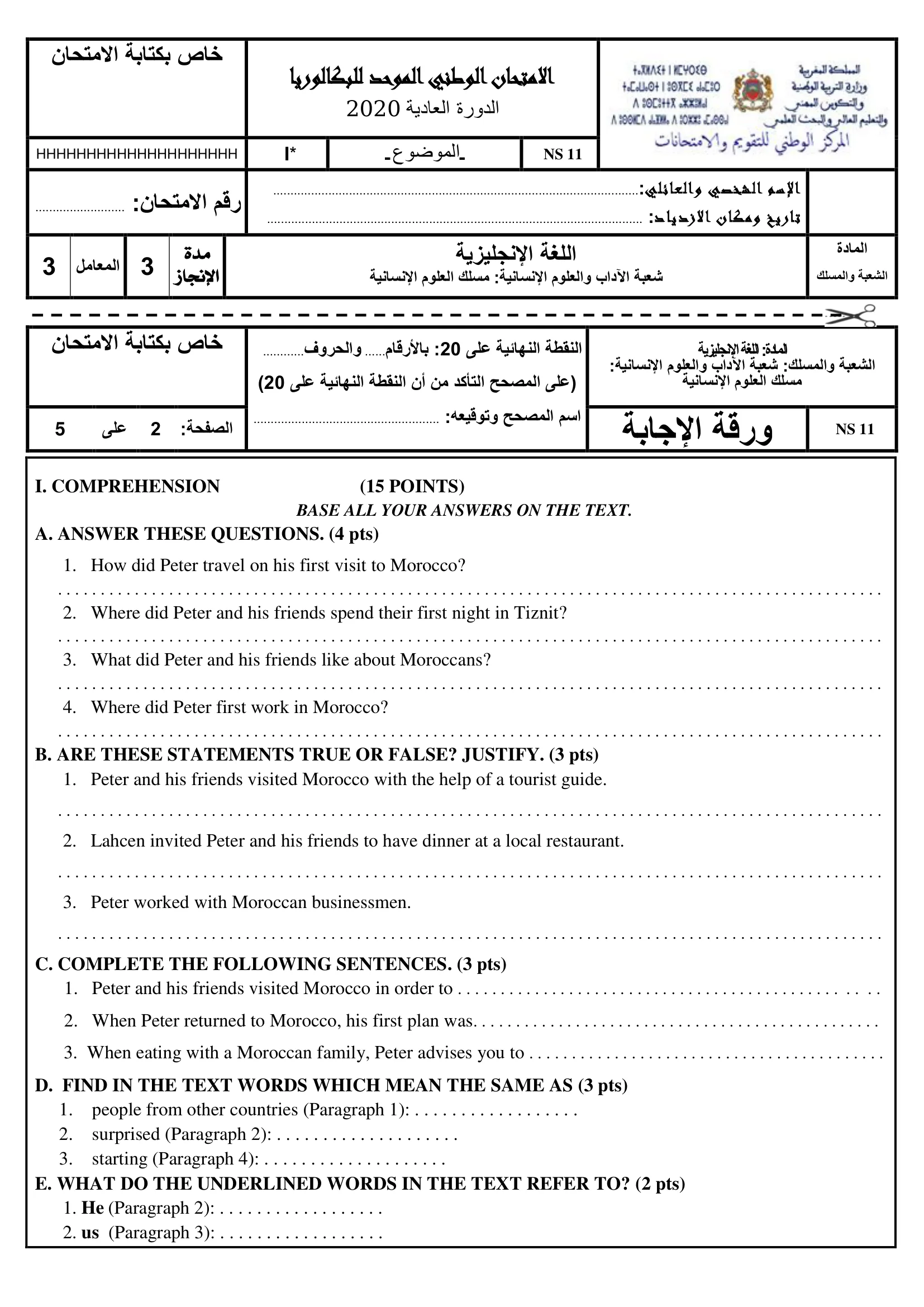
[2] In the town of Tiznit, we were sitting in a public area on a hot summer day when a young man, named Lahcen, came and sat next to me. He began practising his English with me. We had been enjoying a nice conversation for only about 15 minutes when he invited us to his house. We gratefully accepted and found ourselves among a typical Moroccan family. We thought we would only be served a cup of tea and then leave for dinner in a restaurant. We ended up sharing a huge dinner and hours of friendly atmosphere with the family. Because my American friends and I were visiting Morocco for the first time, we were somehow astonished by the customs of eating in the Moroccan family. Unlike in America, eating with your hands is a time-honored tradition in Morocco. If you ever have a chance to visit this country, eat with your right hand using the thumb and the first two fingers.
[3] After the meal, our hosts said that we should not check in to the hotel and they insisted on us sleeping at their home, even after we refused multiple times. Finally, we accepted their kind offer, the five of us staying the night sleeping in the main room of the house. This same scenario was repeated several times all over Morocco, in big cities like Marrakech and Fes as well as in smaller towns. We were always treated with great kindness and hospitality as our hosts offered us food and housing. Those offerings were usually so insistent that we gave in and were humbled to watch Moroccan families treat us like kings.
[4] While visiting Morocco as a tourist, I was looking for a change in my personal life, a new adventure. Following my first visit in 1999, I packed my bags and returned to Morocco, thinking I would just study Arabic for a while. I finally stayed for seven years, first working at a language school and later setting up and running my own business, working with foreigners who were doing business in Morocco.
Adapted from: www.talkmorocco.net
I. Comprehension (15 points)
A. Answer these questions. (4 pts)
- How did Peter travel on his first visit to Morocco?
- Where did Peter and his friends spend their first night in Tiznit?
- What did Peter and his friends like about Moroccans?
- Where did Peter first work in Morocco?
B. Are these statements true or false? Justify. (3 pts)
- Peter and his friends visited Morocco with the help of a tourist guide.
- Lahcen invited Peter and his friends to have dinner at a local restaurant.
- Peter worked with Moroccan businessmen.
C. Complete the following sentences. (3 pts)
- Peter and his friends visited Morocco in order to …
- When Peter returned to Morocco, his first plan was. …
- When eating with a Moroccan family, Peter advises you to …
D. Find in the text words which mean the same as (3 pts)
- people from other countries (Paragraph 1): …
- surprised (Paragraph 2): …
- starting (Paragraph 4): …
E. What do the underlined words in the text refer to? (2 pts)
- He (Paragraph 2): …
- us (Paragraph 3): …
II. Language (15 points)
A. Fill in the blanks with the correct words from the list. (2 pts)
solar – political – issues – initiative – popular – sharing – living – technology
- Young people should take the ………… for a better future.
- We are all concerned about environmental ………… We should take pollution and global
- Gaming has become the most ………… pastime activity for young people nowadays.
- Local associations are doing a lot of work to improve the ………… conditions of their
B. Put the words in brackets in the correct form. (2 pts)
- Building more schools in rural areas will contribute to the (empower) ………… of women.
- Social media may have a (harm) ………… effect on kids.
C. Rewrite the following sentences as indicated. (3 pts)
- “Could you please give more information about the project?” asked the journalist.
The journalist asked the minister … - This school offers students interesting activities.
Students … - Fred received the invitation. Yet, he didn’t attend the party.
In spite of …
D. Put the verbs in brackets in the correct tense. (2 pts)
- I was too late for the music concert because I (not/take) ………… the first bus.
- Moncef Slaoui (graduate) ………… from the Free University of Brussels in 1983 before he
E. Choose the correct anwser. (2 pts)
- A tablet will be given to the student ………… wins the competition.
a. whom – b. who – c. which - I’m not really sure about the place of our meeting tomorrow. It ………… in the same
a. might be – b. had been – c. must be
F. Complete the following exchanges appropriately. (2 pts)
- Tony: Can you please drive me to the airport?
Jane: (Decline Tony’s request) … - Sue: Why didn’t you come to my birthday party last weekend?
Nancy: (Apologise and give a reason) …
G. Choose the most appropriate response to each statement. (2 pts)
- Rick: I’m sorry to say this, but the mobile phone I bought here yesterday has poor sound quality.
Shop assistant: …
a. Ok, that’s good. – b. I’d love to. – c. No, thanks. – d. Sorry for that. - Fred: What do you think I should study when I go to university next year?
Sam: …
a. That’s a good idea. – b. Sorry, I have no idea. – c. Congratulations! – d. Sorry to hear that.
III. Writing (10 points)
Task 1 (4 pts)
Complete the following paragraph about where you would like to go on a school excursion: “On a school excursion, I would like to go to … This place is worth visiting for the following reasons. …”
On a school excursion, I would like to go to …
Task 2 (6 pts)
Write an article to be published in your school magazine about a talented or gifted person. (Who is this person? What does he/she do? What are his/her talents? etc.)
Sujet : Examen national du baccalauréat, Session normale 2020, Ministère de l’Éducation nationale (CNEE). Version interactive ILENG.